CBL0137 Hydrochloride (CBL0137) Targets Chromatin Architecture via FACT Trapping
Copy code to add this image to your page
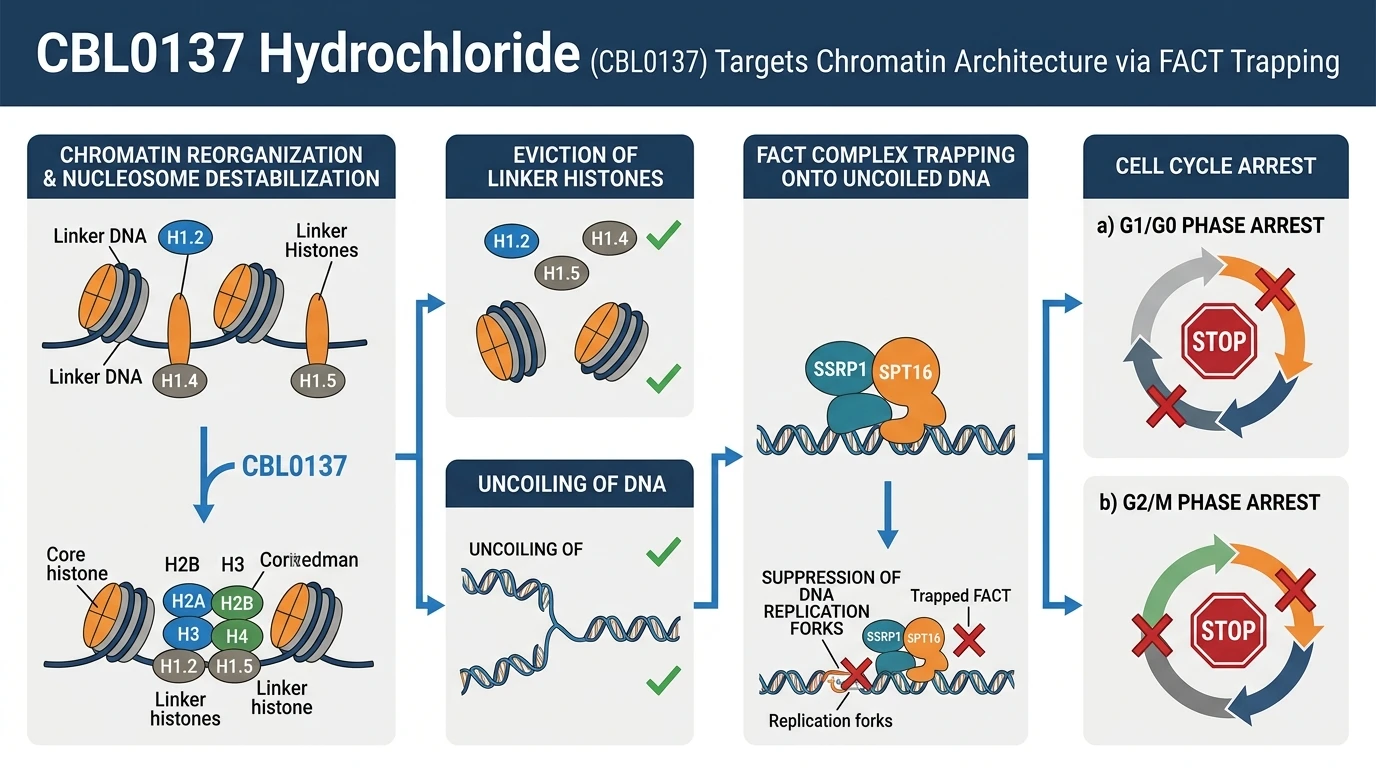
Small molecules modulating chromatin architecture represent a distinct therapeutic strategy in oncology, diverging from conventional DNA alkylating agents or catalytic topoisomerase inhibitors. CBL0137 Hydrochloride, a small-molecule carbazole derivative known as a curaxin, engages genomic DNA to induce structural destabilization of nucleosomal architecture without causing direct enzymatic DNA strand breaks. The primary biochemical consequence of this engagement is the alterations induced in nucleosome stability and the physical sequestration of the Facilitates Chromatin Transcription (FACT) complex. FACT operates as a heterodimeric histone chaperone composed of SUPT16H and SSRP1 subunits. Under normal physiological conditions, FACT transiently destabilizes core nucleosomes during transcription and DNA replication, allowing RNA Polymerase II or replication machinery to progress while maintaining nucleosomal integrity. Upon exposure to CBL0137, intercalation into DNA induces local altered DNA torsion and unwinding. This conformational disruption converts core nucleosomes into altered, uncoiled DNA-histone structures. The destabilized nucleosomes present high-affinity binding surfaces that trap the FACT chaperone complex onto chromatin. The resulting chromatin-trapping event depletes the soluble intracellular pool of functional FACT, rendering cells unable to transcribe essential genes or complete DNA replication. Unlike plant secondary metabolites that alter linker histone localization without destabilizing core nucleosomal architecture, CBL0137 induces profound and rapid biochemical alterations across the chromatin template. A critical hallmark of this action is the marked depletion of specific linker histone isoforms from chromatin, including H1.2, H1.4, and H1.5. These linker histones normally bind to the entry/exit sites of DNA wrapping around nucleosomal cores to stabilize higher-order 30-nm chromatin fibers. Empirical analyses reveal that exposure to CBL0137 Hydrochloride results in loss of these linker histones from the chromatin fraction within hours, destabilizing higher-order chromatin structure. Detailed structural evaluations, alongside comparative sequence mapping of human linker histone H1.4 isoforms, indicate that linker histone eviction operates synergistically with core nucleosome disassembly. At the cellular level, the loss of nucleosome integrity and persistent trapping of the FACT complex lead to immediate arrest of DNA synthesis. High-throughput nucleotide incorporation assays confirm that DNA replication halts rapidly following compound exposure. This cessation of replication forks activates DNA damage signaling cascades, specifically ATR and ATM kinase pathways, leading to cell cycle checkpoint activation. Under tested in vitro conditions, treated cancer cell lines display pronounced cell cycle arrest at both G1/G0 and G2/M phases. The dual-phase cell cycle block reflects both the inability to re-enter synthesis from G1 and the stalling of mitotic entry due to damaged or improperly condensed chromatin structures. In contrast to traditional cytotoxic agents, the destabilization of chromatin by curaxins does not rely on target gene mutations or specific cell lineage drivers. The uncoiling of nucleosomal DNA induced by small-molecule intercalation alters the physical mechanical properties of the chromatin fiber. When the FACT heterodimer binds to these unwound nucleosomes, its interaction changes from a transient, functional chaperoning event into a high-affinity, non-exchangeable complex. The trapping of FACT on chromatin depletes available chaperone pools required for active RNA polymerase II elongation throughout the genome. Consequently, transcription of short-half-life anti-apoptotic proteins and major transcription factors declines rapidly. In parallel, the loss of linker histones H1.2, H1.4, and H1.5 leaves linker DNA exposed, accelerating structural loosening and exposing additional high-affinity binding sites for FACT. This self-reinforcing feed-forward cascade ensures sustained depletion of soluble chaperone complexes and persistent suppression of DNA synthesis across rapidly dividing cells.
Chromatin Restructuring and Depletion of Linker Histones
Copy code to add this image to your page
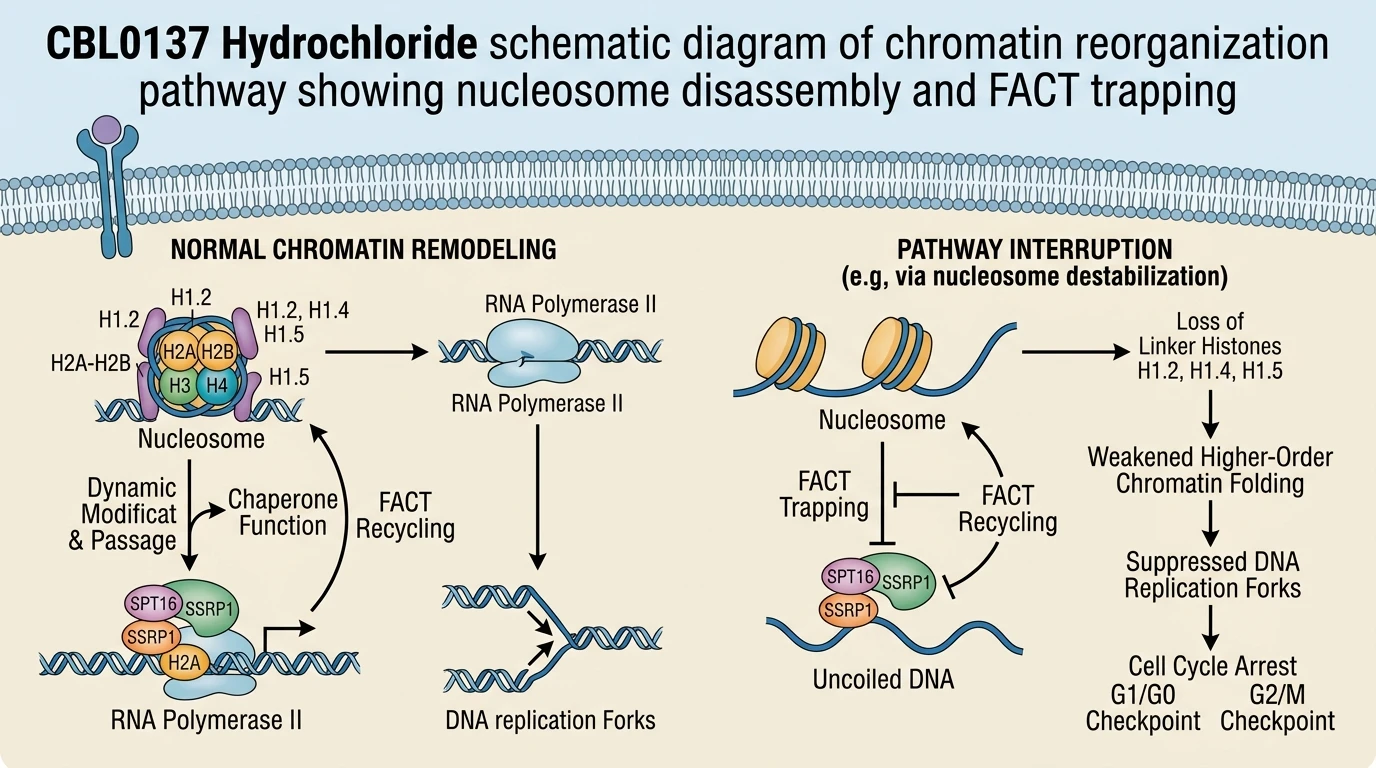
CBL0137 Hydrochloride destabilizes nucleosome core particles and alters DNA Torsion, leading to nucleosome disassembly and chromatin trapping of the FACT chaperone complex. Unlike plant secondary metabolites that alter linker histone localization without disturbing core nucleosomes, this agent induces rapid depletion of linker histones H1.2, H1.4, and H1.5 from chromatin templates. The resulting physical sequestration of FACT suppresses global transcription elongation, inhibits DNA synthesis, and enforces cell cycle arrest at G1/G0 and G2/M checkpoints.
Depletion of Linker Histones H1.2 H1.4 and H1.5
Linker histones act as fundamental stabilizers of higher-order chromatin structure. Under tested in vitro assay conditions, exposure to CBL0137 induces selective depletion of linker histones H1.2, H1.4, and H1.5 from chromatin fractions. Downstream nucleosome disassembly occurred rapidly following compound administration. Unlike plant secondary metabolites, which alter linker histone localization without compromising core nucleosomes, this agent disrupts core and linker histones simultaneously. The immediate loss of linker histone binding destabilizes higher-order genomic architecture—a phenomenon observed consistently across treated tumor cell lineages.
Chromatin Trapping of FACT Halts DNA Replication
The Facilitates Chromatin Transcription complex requires dynamic association with nucleosomes to facilitate elongation. Treatment with CBL0137 traps the FACT complex onto destabilized nucleosomal DNA. Soluble FACT levels dropped below detectable thresholds within hours. This persistent physical trapping prevents chaperone recycling to active transcription sites. DNA synthesis ceased concurrently in patient-derived cellular models. Consequently, cells experience marked cell cycle arrest at both G1/G0 and G2/M boundaries, preventing further mitotic progression.