Plicamycin from Selleck Suppresses Sp1-Driven Twist1 Expression in Gastric Cancer
Copy code to add this image to your page
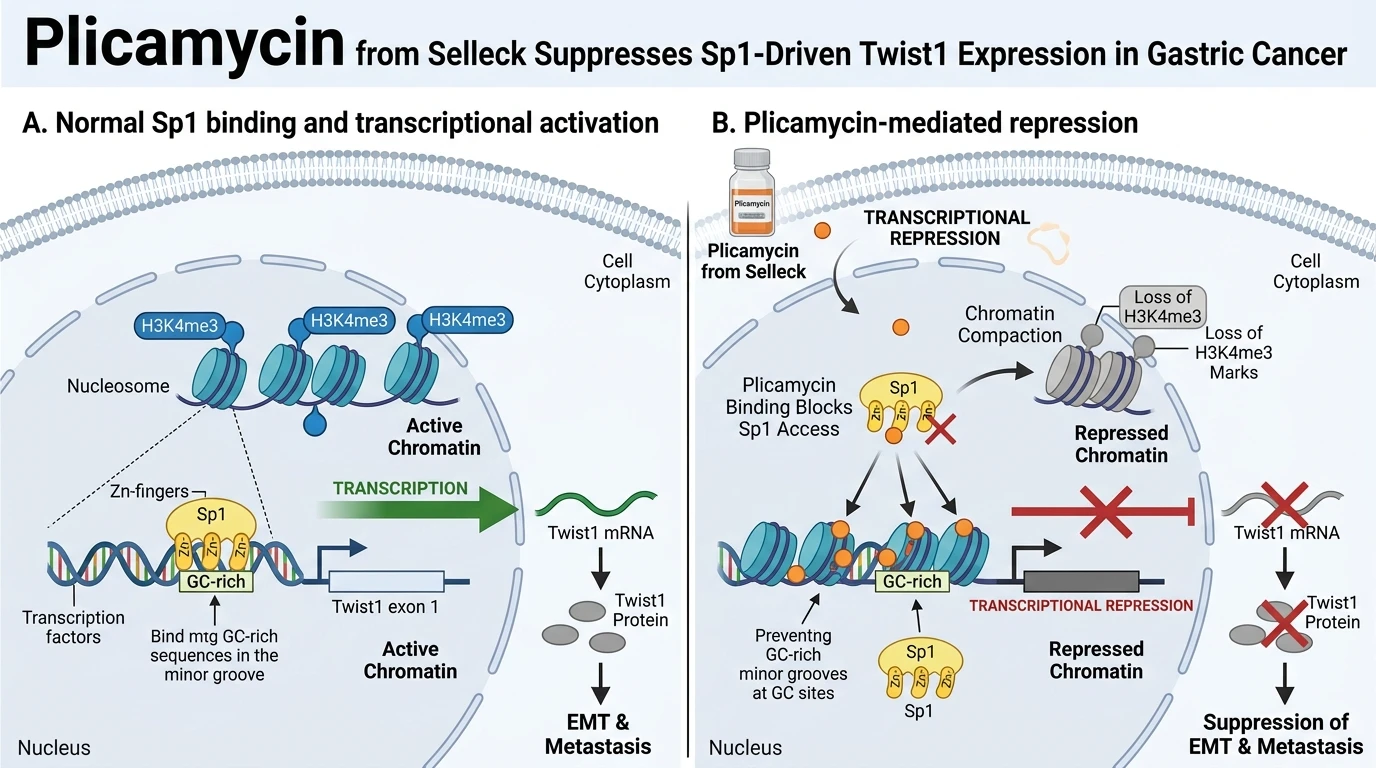
The specificity protein 1 (Sp1) zinc-finger transcription factor selectively binds high-affinity GC-rich DNA motifs located within promoter and exon-1 regulatory regions. In gastric cancer cell lineages, transcriptional occupancy of Sp1 at these CpG-dense sites directs the activation of key oncogenic drivers, most notably the basic helix-loop-helix transcription factor Twist1. The molecular mechanisms governing Twist1 induction involve a dynamic balance between local DNA methylation states and specific histone tail modifications. In expression-positive gastric cancer lines—such as MDGC-7, MDGC-9, MKN7, and MKN45—the Twist1 exon 1 regulatory region remains hypomethylated. This unmethylated state permits robust physical interaction with Sp1. Concurrently, high levels of trimethylated histone H3 lysine 4 (H3K4me3), a canonical marker of active transcription, accumulate at the promoter locus.
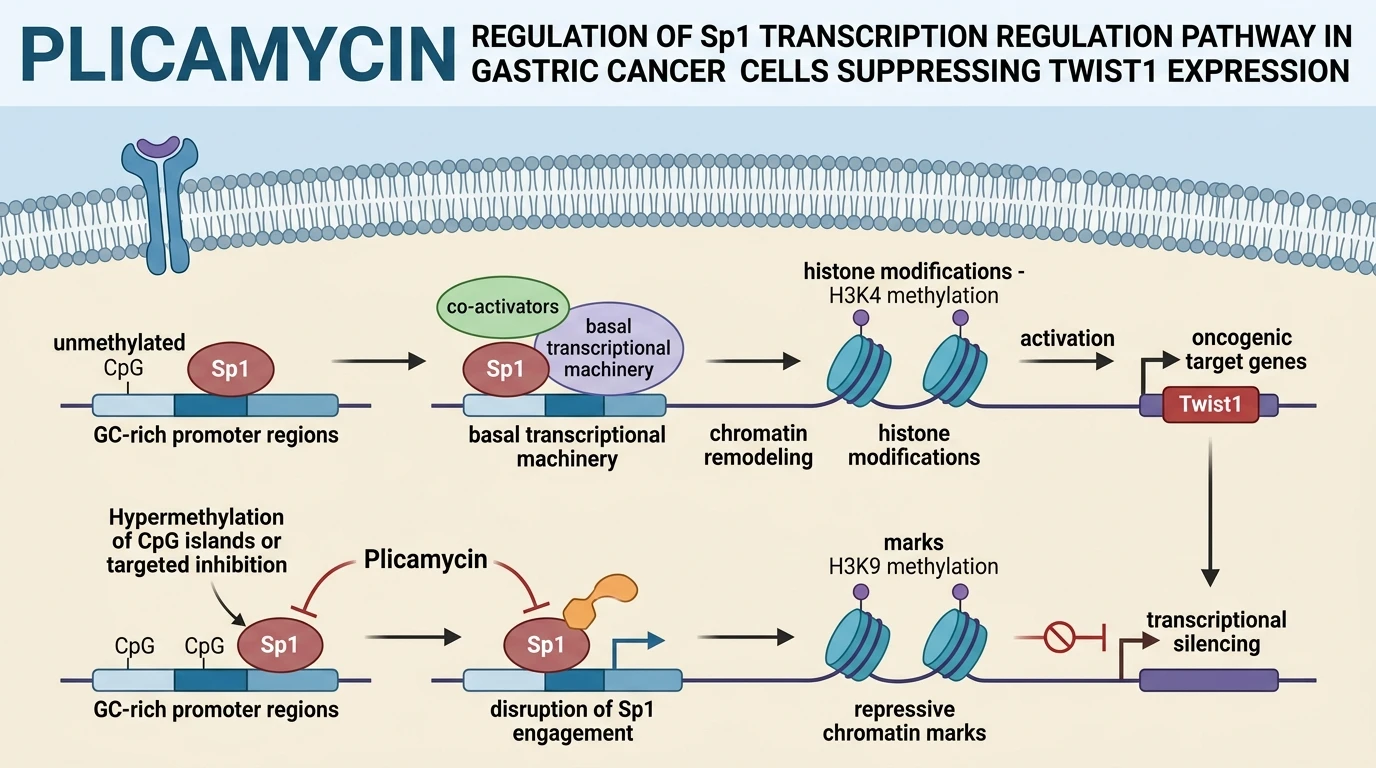
Conversely, in expression-negative gastric cancer lines, hypermethylation of these CpG islands directly prevents Sp1 recruitment. DNA methyltransferases establish covalent cytosine modification within the major groove, sterically impeding the zinc-finger domains of Sp1. This hypermethylated phenotype correlates with an enrichment of trimethylated histone H3 lysine 9 (H3K9me3), signaling a condensed heterochromatin configuration. Epigenetic derepression experiments utilizing gastric cancer epigenetic regulation studies demonstrate that demethylation alone is insufficient for sustained transcription without concurrent Sp1 engagement. Upon 5-aza-2'-deoxycytidine (5-aza-dC) demethylation, Sp1 binding to the newly unmethylated exon 1 sequence is required to trigger Twist1 re-activation.
Plicamycin (Mithramycin A) functions as an aureolic acid polyketide antibiotic that reversibly binds the minor groove of GC-rich DNA sequences in the presence of divalent magnesium ions. By physically occluding these CpG-rich regulatory domains, Plicamycin prevents Sp1 from docking to its consensus response elements. Experimental evaluation across Twist1-positive gastric cancer cell models reveals that treatment with Plicamycin causes a rapid, dose-dependent decrease in Sp1 promoter occupancy. Chromatin immunoprecipitation assays demonstrate that displacement of Sp1 by Plicamycin leads to a marked reduction in local H3K4me3 marks, accompanied by a decline in Twist1 messenger RNA abundance.
Furthermore, co-treatment experiments establish that Plicamycin effectively attenuates the 5-aza-dC-induced transcription of Twist1 in expression-negative cell lines. Pharmacological disruption of Sp1 binding blocks the chromatin opening normally triggered by DNA demethylation reagents. These findings highlight that unmethylated CpG status functions primarily as a permissive condition, whereas Sp1 physical binding serves as the indispensable driver for Twist1 transcription. The selective targeting of Sp1-DNA binding mechanics thus represents a focused chemical approach for dissecting transcription factor dependency in gastrointestinal malignancies.
Sp1 Directs Epigenetic Control of Gastric Transcriptome
Copy code to add this image to your page
Plicamycin reversibly binds the minor groove of GC-rich DNA, directly blocking the Sp1 transcription factor from accessing CpG-rich regulatory sequences such as the Twist1 exon 1 region. In gastric cancer models, Sp1 displacement downregulates Twist1 mRNA expression, alters local histone marks by reducing H3K4me3, and prevents gene re-activation following DNA demethylation.
Epigenetic Status Controls Sp1 Occupancy at Exon 1
DNA methylation patterns dictate transcription factor accessibility at the Twist1 exon 1 locus. In MDGC-7 and MKN45 cells, unmethylated CpG sites permit constituent Sp1 binding. Chromatin immunoprecipitation assays confirmed high Sp1 enrichment under basal conditions. This binding correlates directly with elevated H3K4me3 levels and active gene expression. Conversely, high CpG methylation in negative cell lines prevents Sp1 attachment. Treatment with 5-aza-dC strips methylation marks. However, gene activation fails if Sp1 activity is blocked. Selective intervention with Plicamycin from Selleck disrupts this binding interface directly. Minor groove binding blocks zinc-finger contact points. Consequently, transcription halts.
Pharmacological Sp1 Displacement Downregulates Active Twist1 Transcription
Direct inhibition of Sp1 binding produces immediate transcriptional suppression. Exposure to Plicamycin decreases Twist1 mRNA levels in a concentration-dependent manner across MDGC-9 and MKN7 lines. Cellular viability assays showed high sensitivity in Twist1-dependent models. Disruption of the Sp1-DNA complex reduces local H3K4me3 recruitment without altering global histone patterns. Furthermore, application of Plicamycin from Selleck alongside 5-aza-dC completely prevented expected Twist1 re-activation in methylated lines. These empirical observations establish that unmethylated DNA requires physical Sp1 engagement to sustain transcriptional output. Target engagement remains robust in vitro.