AZD5305 (Saruparib) Saruparib from Selleck Demonstrates Selective PARP1 Inhibition and Target Trapping
Copy code to add this image to your page
Quantitative intracellular target engagement assays provide critical insight into isoform selectivity within the poly(ADP-ribose) polymerase enzyme family. To resolve intracellular binding dynamics across clinical and investigational agents, researchers implemented a cellular target engagement by accumulation of mutant (CeTEAM) drug biosensor system. This platform utilizes engineered PARP1 L713F-GFP and PARP2 L269A-mCherry reporter constructs expressed within intact human cells. Ligand binding stabilizes these conditionally destabilized mutant proteins, generating a fluorescent signal proportional to intracellular compound occupancy. Screening a curated library of 27 PARP inhibitors established that most early-generation clinical agents display near-equipotent binding toward both PARP1 and PARP2 catalytic domains.
Structure-activity analysis revealed clear chemical class distinctions governing isoform preference. Benzimidazole carboxamide scaffold architectures demonstrate an inherent binding bias toward PARP1 over PARP2. In contrast, compounds centered around phthalazinone cores preferentially engage the PARP2 active site. Cross-referencing compound structural descriptors against virtual chemical library databases validated these scaffold-dependent target interactions. Among tested agents, AZD5305 (Saruparib) exhibited marked selectivity for PARP1. In live-cell CeTEAM concentration-response assays, Saruparib from Selleck yielded an EC50 of 3.9 nM for PARP1 compared to 6.2 μM for PARP2. This represents an approximate 1600-fold margin of intracellular target engagement selectivity under tested assay conditions.
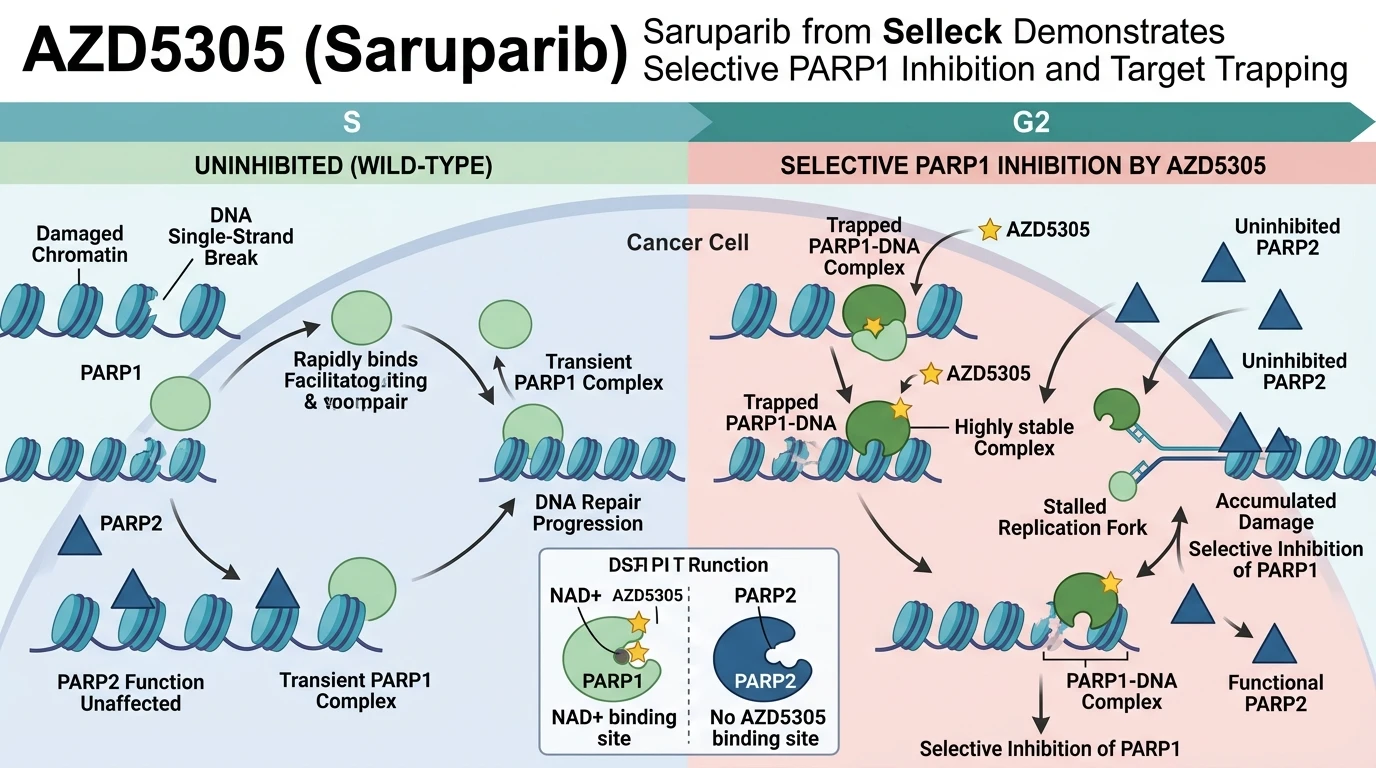
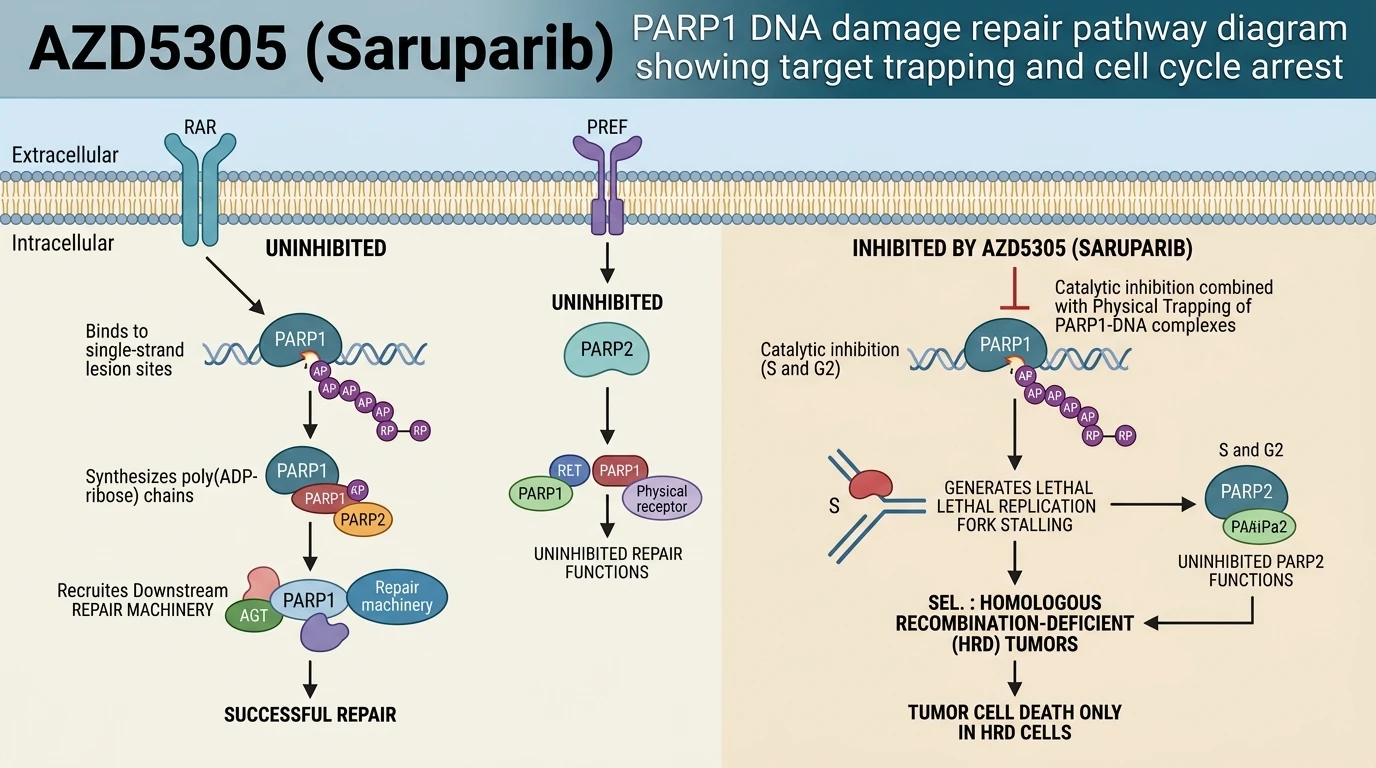
Beyond simple catalytic inhibition, the cytotoxic potency of PARP inhibitors relies heavily on drug-induced DNA trapping. Trapped PARP1-DNA complexes physically block replication fork progression, resulting in double-strand break accumulation during S and G2 phases. Time-resolved fluorescence monitoring showed that selective target engagement by AZD5305 drives rapid chromatin immobilization of PARP1 without engaging PARP2. Because PARP2 contributes significantly to hematological toxicity, sparing PARP2 catalytic function while trapping PARP1 offers potential therapeutic advantages. Cellular cell-cycle profiling confirmed that AZD5305 induces S/G2 arrest specifically through PARP1 retention on damaged chromatin.
Auxiliary protein factors also modulate intracellular drug engagement and subsequent trapping severity. Histone PARylation factor 1 (HPF1) binds the catalytic domain of PARP1 and PARP2, directing ADP-ribosylation specifically toward serine residues on acceptor proteins. Depletion of HPF1 via shRNA knockdown altered inhibitor binding profiles within the CeTEAM system. Loss of HPF1 elevated intracellular binding engagement of inhibitors toward PARP2 while additively expanding the magnitude of drug-induced DNA trapping. These findings demonstrate that cellular co-factor context directly influences pharmacodynamic responses to selective PARP1 inhibition.
Pharmacological Characterization and Target Engagement Profiles
Copy code to add this image to your page
AZD5305 (Saruparib) acts as a highly selective PARP1 inhibitor, leveraging a benzimidazole carboxamide scaffold to achieve ~1600-fold greater binding potency for PARP1 over PARP2 in live cells (EC50 3.9 nM vs 6.2 μM). By selectively locking PARP1 onto damaged DNA lesions without disrupting PARP2 function, it blocks replication fork progression during S/G2 cell cycle phases. HPF1 co-factor depletion further enhances target engagement and compounds DNA trapping phenotypes.
Benzimidazole Carboxamides Drive Intracellular PARP1 Isoform Selectivity
Scaffold geometry dictates target discrimination between PARP1 and PARP2 catalytic domains. Benzimidazole carboxamide derivatives demonstrate strong binding preference for PARP1 within intact cellular environments. In comparative CeTEAM profiling, Saruparib from Selleck achieved an EC50 of 3.9 nM against PARP1 L713F. Binding to PARP2 L269A required a substantially higher concentration, exhibiting an EC50 of 6.2 μM. The selectivity margin reached 1600-fold. Most first-generation clinical inhibitors exhibited equipotent dual engagement. Phthalazinone derivatives routinely favored PARP2 engagement. These empirical measurements highlight how precise scaffold modifications control catalytic isoform discrimination.
HPF1 Depletion Compounds Trapping Phenotypes and Cell Cycle Arrest
Histone PARylation factor 1 regulates PARP catalytic active sites during DNA damage responses. Knockdown of HPF1 via shRNA enhanced cellular engagement of PARP2 across tested compounds. The altered binding kinetics intensified drug-induced PARP-DNA trapping dynamics. Cells exhibited enhanced retention of PARP1 on chromatin during S and G2 phases. Stalled replication forks triggered downstream DNA double-strand breaks. Synthetic lethality was pronounced in homologous recombination-deficient contexts. These observations define critical baseline parameters for target trapping efficiency.