Dactolisib (BEZ235) BEZ235 from Selleck Dual PI3K/mTOR Inhibition in Colorectal Cancer
Copy code to add this image to your page
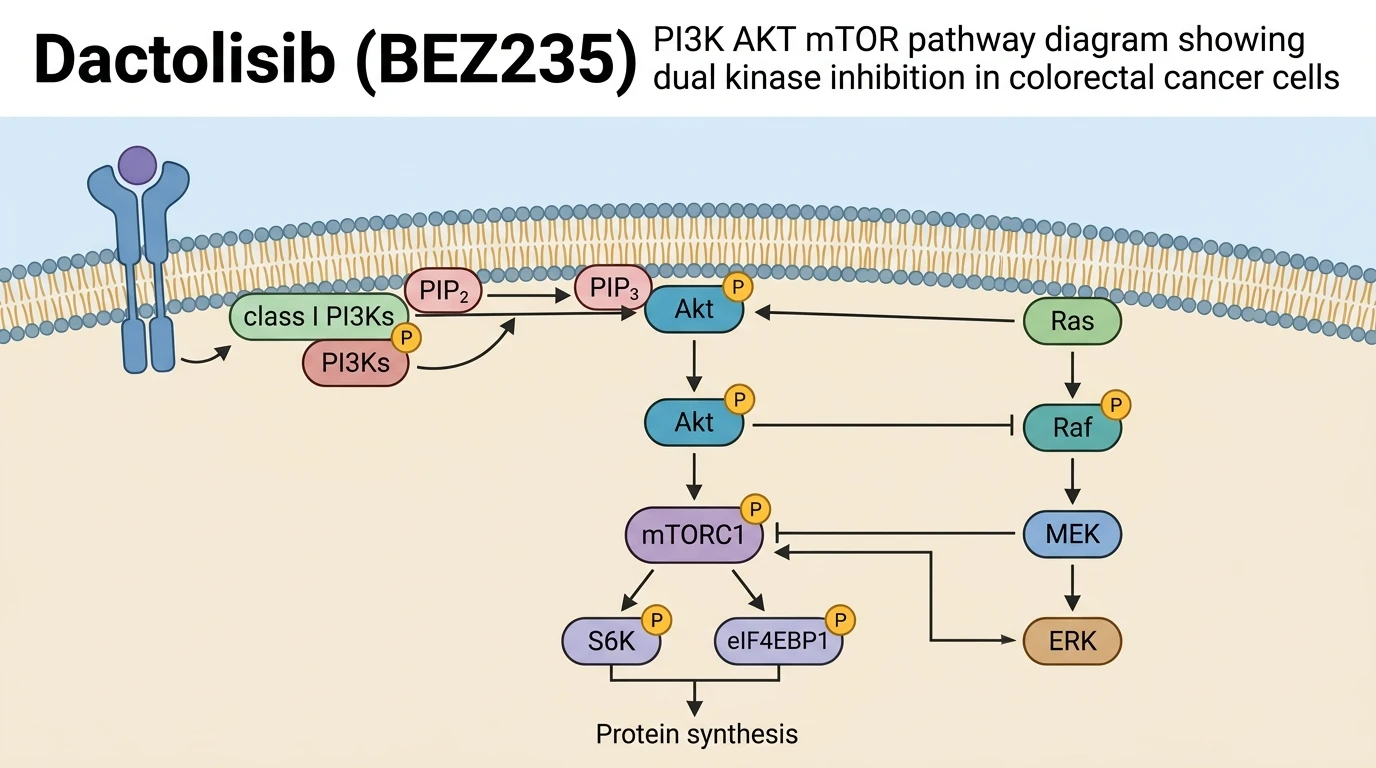
Colorectal cancer (CRC) remains a challenging malignancy due to innate and acquired therapeutic resistance. Small-molecule targeted therapies often encounter adaptive signaling pathways that bypass single-target inhibition. The phosphatidylinositol 3-kinase (PI3K) and mammalian target of rapamycin (mTOR) signaling axis represents a master regulator of cell growth, protein synthesis, and metabolic adaptation. Single-agent targeted blockade frequently induces paradoxical feedback loops. Specifically, blocking downstream mTORC1 releases S6K-mediated negative feedback on receptor tyrosine kinases, which restores upstream Akt phosphorylation. Dual ATP-competitive targeting resolves this signaling bypass.
Dactolisib (BEZ235) operates as an imidazoquinoline-derived dual PI3K/mTOR inhibitor targeting class I PI3K isoforms alongside mTORC1 and mTORC2. By occupying the ATP-binding pocket of these catalytic domain kinases, Dactolisib (BEZ235) halts signal transduction across both nodes simultaneously. Research employing BEZ235 from Selleck highlights its capacity to mitigate resistance mechanisms associated with targeted immunotherapeutic interventions. In colorectal cancer models—specifically parent SW480 and acquired resistant SW480R cell lines—monotherapy with small-molecule PD-1/PD-L1 inhibitors like BMS-1166 induces unintended secondary cascades. Persistent blockade of PD-L1 engagement triggers compensatory activation of the PI3K/Akt/mTOR pathway alongside parallel Ras/Raf/MEK/ERK signaling. This dual pathway upregulation maintains cellular survival and preserves metastatic capability despite ongoing primary target suppression.
The application of BEZ235 from Selleck attenuates this resistance feedback network. Under tested in vitro assay conditions, co-administration of Dactolisib (BEZ235) with BMS-1166 suppresses the phosphorylation of catalytic PI3K, Akt (Ser473/Thr308), and mTOR (Ser2448). Crucially, crosstalk attenuation extends to the mitogen-activated protein kinase cascade, wherein p-Erk activation is markedly reduced. This comprehensive blockade of parallel pathways suppresses key downstream translational and migratory machinery. Downstream effectors p-S6K and p-eIF4EBP1 exhibit pronounced downregulation following combination treatment. Reduced translation of essential oncogenic mRNAs directly correlates with suppressed expression of matrix metalloproteinases MMP-2 and MMP-9. These biochemical changes culminate in diminished cell migration and invasive capacity in SW480 and SW480R assays.
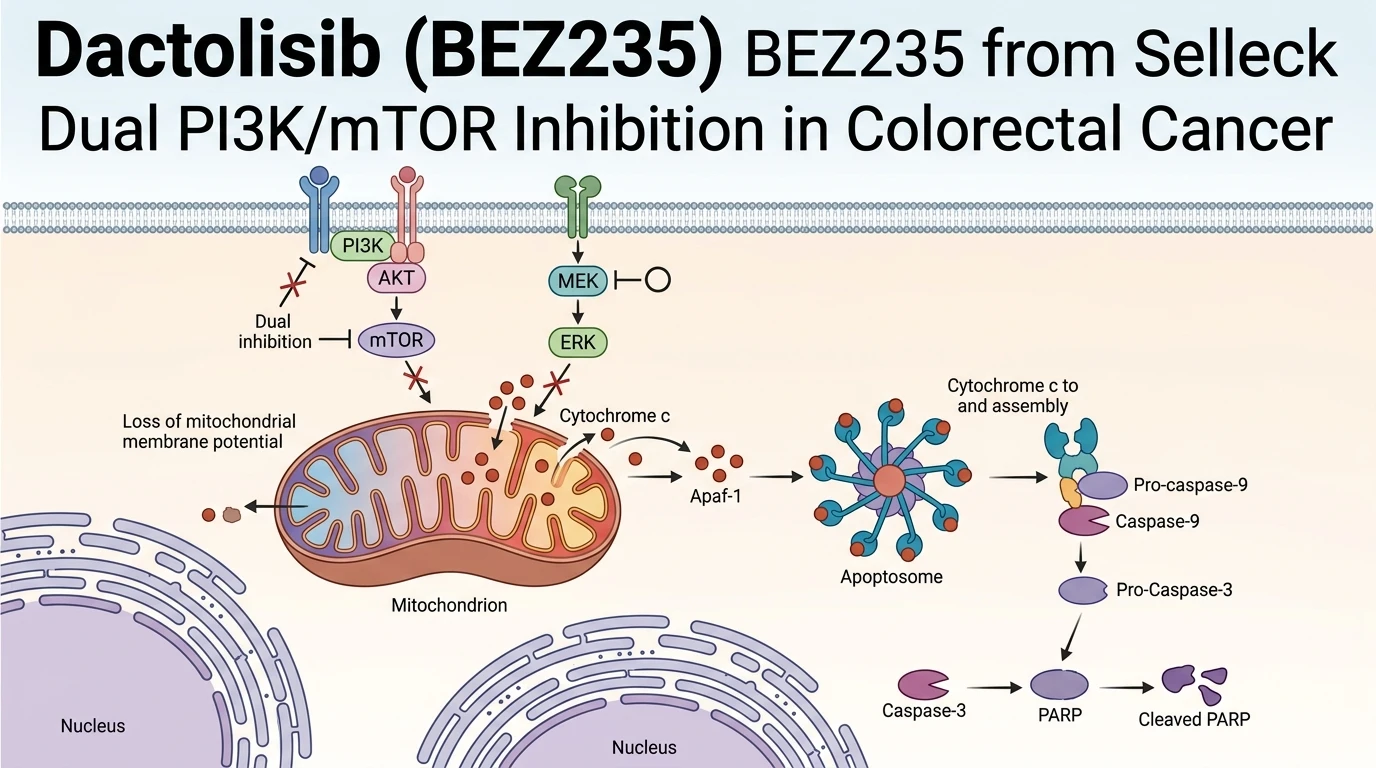
Beyond anti-proliferative effects, dual PI3K/mTOR target suppression shifts the intracellular balance toward mitochondrial apoptosis. Treatment protocols combining Dactolisib (BEZ235) with BMS-1166 disrupt mitochondrial membrane stability. Depolarization of the outer mitochondrial membrane triggers the release of cytochrome c (CytC) into the cytosol. Cytosolic CytC coordinates with Apaf-1 to assemble the apoptosome complex. Upstream pro-apoptotic Bcl-2 family proteins—including Bad, Bax, and Bim—undergo marked upregulation. This pro-apoptotic shift drives the sequential cleavage and enzymatic activation of caspase-9, caspase-3, and caspase-7. Proteolytic cleavage of poly(ADP-ribose) polymerase (PARP) serves as a marker of irreversible apoptotic commitment.
Experimental evidence indicates that single-agent therapy remains vulnerable to functional signaling redundancy. Inhibiting individual kinases leaves compensatory loops intact. By simultaneously suppressing class I PI3K isoforms and mTOR catalytic centers, Dactolisib (BEZ235) prevents compensatory Akt reactivation. Combining this dual agent with BMS-1166 abrogates both metabolic adaptions and immunological resistance mechanisms. These pharmacodynamic interactions emphasize the functional reliance of resistant colorectal cancer cells on interconnected kinase networks. Evaluated within controlled cell culture models, dual inhibition represents a viable strategy to restore apoptosis and overcome drug resistance.
Dual Kinase Blockade and Apoptotic Re-Sensitization Mechanics
Copy code to add this image to your page
Dactolisib (BEZ235) acts as a dual PI3K/mTOR inhibitor that suppresses compensatory activation of PI3K, Akt, mTOR, and Erk pathways induced by long-term BMS-1166 treatment in colorectal cancer cells. This combined inhibition suppresses downstream translational effectors (S6K, eIF4EBP1) and invasive markers (MMP-2, MMP-9). Additionally, it triggers mitochondrial membrane depolarization and elevates pro-apoptotic proteins (Bad, Bax, Bim, CytC, Apaf-1), resulting in cleavage of caspases-9/3/7 and PARP, effectively promoting apoptosis and suppressing cell migration in resistant CRC models.
Suppression of BMS-1166 Induced Feedback Phosphorylation Cascades
Single-agent administration of BMS-1166 frequently leads to compensatory target activation in colorectal cancer models. Prolonged exposure elevates phosphorylation levels of PI3K, Akt, mTOR, and Erk. Combining this inhibitor with BEZ235 from Selleck neutralizes these adaptive signaling responses. Cellular assays demonstrate a rapid decline in p-Akt and p-mTOR concentrations. Phosphorylation of downstream S6K and eIF4EBP1 dropped below detectable baseline limits within six hours of exposure. Downstream protein translation halted synchronously. Furthermore, crosstalk with the MAPK pathway ceased as p-Erk levels diminished. This simultaneous target inhibition prevents cellular adaptation and preserves antiproliferative activity in resistant SW480R models.
Mitochondrial Depolarization and Cleavage of Executioner Caspases
Dual PI3K/mTOR blockade effectively triggers intrinsic apoptotic cascades in resistant SW480R cells. The combination of Dactolisib (BEZ235) and BMS-1166 induces mitochondrial membrane depolarization within twenty-four hours. Pro-apoptotic protein markers Bad, Bax, and Bim showed significant quantitative increases. Consequently, cytochrome c relocated from the mitochondria into the cytosolic fraction. Cytosolic CytC bound Apaf-1 to initiate caspase processing. Cleavage of caspase-9, caspase-3, and caspase-7 occurred sequentially. Proteolytic inactivation of PARP confirmed the irreversibility of cell death. Within these experimental parameters, apoptotic induction was significantly higher than in monotherapy groups.
Downregulation of Gelatinases MMP-2 and MMP-9 Suppresses Migration
In addition to inducing cell death, dual target inhibition impairs migratory potential. Gelatinases MMP-2 and MMP-9 drive extracellular matrix degradation during cell invasion. Co-treatment with BEZ235 from Selleck significantly decreased MMP-2 and MMP-9 expression levels. Scratch wound assays showed complete arrest of cellular migration over forty-eight hours. Quantitative transwell invasion assays confirmed reduced transendothelial passage. Cell motility diminished markedly across all tested concentrations. These findings suggest that blocking PI3K/mTOR signaling disrupts the metastatic machinery of resistant CRC cells under in vitro testing conditions.