Tariquidar (XR9576) P-gp inhibitor Modulation of ABCB1 Endocytosis and Cytotoxic Chemosensitivity
Copy code to add this image to your page
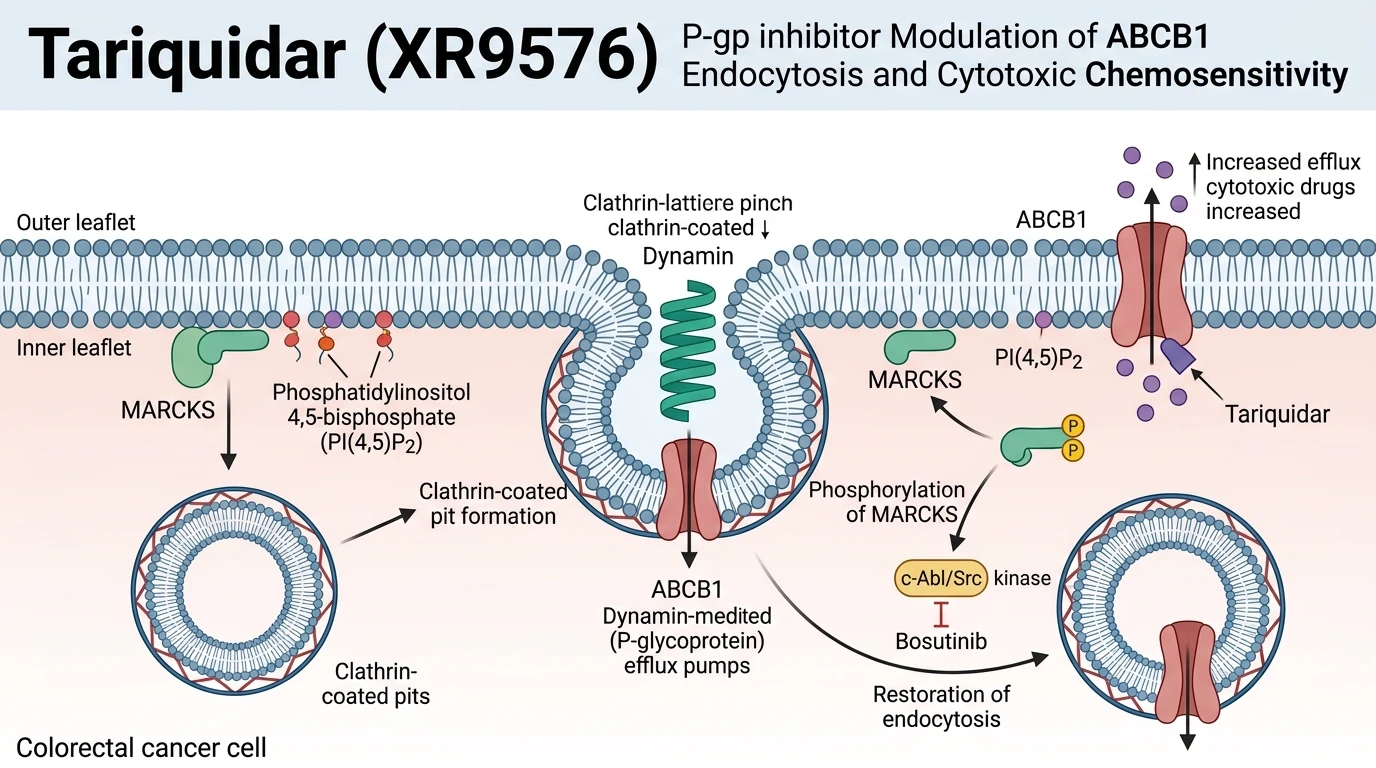
Multidrug resistance remains a primary obstacle in clinical oncology, frequently mediated by the ATP-binding cassette sub-family B member 1 transporter (ABCB1, also known as P-glycoprotein or MDR1). Surface density of ABCB1 directly governs the rate at which antineoplastic agents are actively extruded from the intracellular compartment. Recent functional studies demonstrate that membrane localization of ABCB1 is dynamically controlled by endocytic trafficking mechanisms rather than gene transcription alone. Specifically, the intrinsically disordered protein Myristoylated Alanine-Rich C-Kinase Substrate (MARCKS) acts as a critical molecular toggle for ABCB1 internalization.
Under physiological conditions, non-phosphorylated MARCKS inserts its N-terminal myristoyl anchor into the inner leaflet of the plasma membrane. Its basic effector domain sequesters phosphatidylinositol 4,5-bisphosphate (PI(4,5)P2), concentrating this essential phosphoinositide into specialized signaling microdomains. These localized PI(4,5)P2 pools are required to assemble clathrin adaptor proteins and recruit the GTPase dynamin, driving vesicular scission and endocytosis of surface-bound ABCB1. Internalization reduces total surface transporter abundance, effectively dampening drug efflux capability.
Pathological dysregulation occurs when MARCKS undergoes genomic deletion or site-specific hyperphosphorylation mediated by non-receptor tyrosine kinases such as c-Abl and Src. Phosphorylation introduces negative charges into the basic effector domain, driving MARCKS off the plasma membrane into the cytosol. This displacement depletes local membrane PI(4,5)P2 levels, neutralizing clathrin- and dynamin-dependent endocytosis. Consequently, ABCB1 becomes stabilized at the plasma membrane, resulting in elevated baseline drug efflux and marked resistance to chemotherapeutic agents including doxorubicin and 5-fluorouracil.
Restoration of this trafficking cascade offers an alternative therapeutic avenue. Pharmacological inhibition of c-Abl/Src with bosutinib prevents MARCKS hyperphosphorylation, allowing MARCKS to re-associate with the inner membrane leaflet. Re-established PI(4,5)P2 sequestration reactivates dynamin-dependent ABCB1 endocytosis, decreasing cell surface transporter levels and restoring drug sensitivity in colorectal cancer models. In experimental settings, evaluating ABCB1 efflux activity relies on established reference agents. The potent non-competitive ABCB1 target profile card confirms how compounds like Tariquidar (XR9576) and verapamil serve as definitive controls to benchmark functional calcein-AM uptake and retention metrics.
Pharmacological Modulation of ABCB1 Endocytosis and Efflux
Copy code to add this image to your page
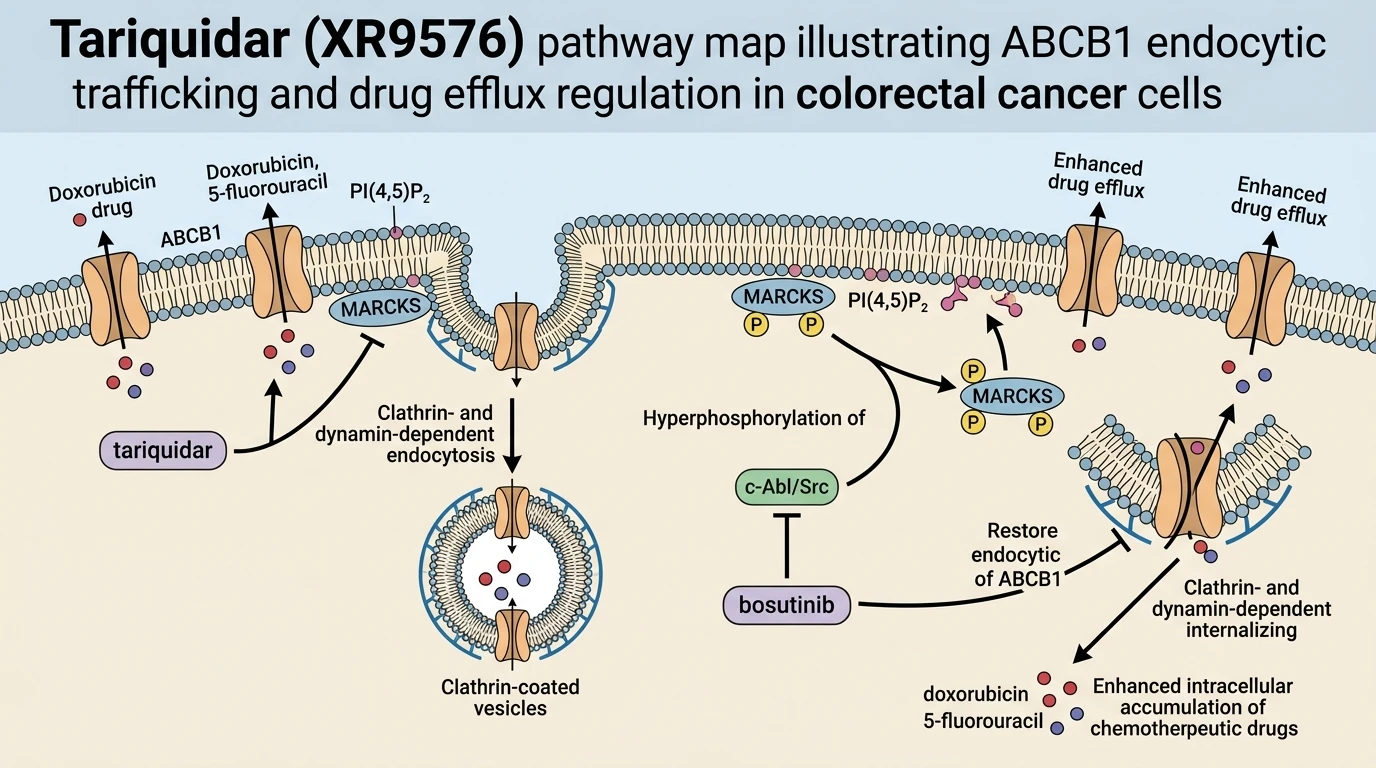
ABCB1 endocytic trafficking governs membrane transporter density and cytotoxic drug resistance in cancer cells. Non-phosphorylated MARCKS sequesters PI(4,5)P2, enabling dynamin- and clathrin-mediated ABCB1 internalization. Hyperphosphorylation of MARCKS blocks this endocytic route, retaining ABCB1 at the plasma membrane. Inhibiting c-Abl/Src with bosutinib prevents MARCKS phosphorylation, re-establishing endocytosis. Direct efflux blockade using reference inhibitors complements trafficking modulation, elevating intracellular drug accumulation.
MARCKS Phosphorylation Traps Surface ABCB1 Transporters
Plasma membrane density dictates ABCB1 transport capacity. MARCKS regulates this process through PI(4,5)P2 membrane sequestration. Under basal conditions, non-phosphorylated MARCKS anchors to inner leaflet lipids. This interaction concentrates local PI(4,5)P2 microdomains required for endocytic machinery assembly. Clathrin and dynamin execute routine transporter internalization. However, hyperphosphorylation by c-Abl/Src kinases disrupts MARCKS membrane binding. Electrostatic repulsion drives MARCKS into the cytosol. Consequently, depleted PI(4,5)P2 pools halt clathrin-mediated endocytosis. Transporters remain stranded on the cell surface. Efflux rates increase dramatically in this state.
Kinase Inhibition Restores Endocytic Internalization Routes
Targeting upstream kinases rescues endocytic flux. Bosutinib selectively blocks c-Abl and Src catalytic activity. This inhibition prevents MARCKS phosphorylation at key serine residues. Unphosphorylated MARCKS re-engages the plasma membrane efficiently. PI(4,5)P2 microdomains reassemble within minutes. Clathrin-coated pits recruit dynamin to complete vesicle scission. Internalization of surface ABCB1 resumes rapidly. Sensitization to doxorubicin and 5-fluorouracil improves in colorectal cancer models. Intracellular drug accumulation reaches therapeutic thresholds under these conditions.
Efflux Metrics Confirmed via Benchmark Inhibition
Functional transport assays require validated reference standards. The Tariquidar (XR9576) P-gp inhibitor serves as a high-affinity benchmark control. In calcein-AM retention assays, Tariquidar (XR9576) P-gp inhibitor blocks substrate extrusion completely at nanomolar concentrations. This direct inhibition verifies that observed retention changes stem from ABCB1 activity. Combining direct efflux blockade with trafficking reactivation yields additive cellular accumulation. These experimental observations clarify dual modes of transporter regulation.