Midostaurin (PKC412) PKC inhibitor Suppresses MYC and Overcomes Resistance in KRAS-Mutant Lung Adenocarcinoma
Copy code to add this image to your page
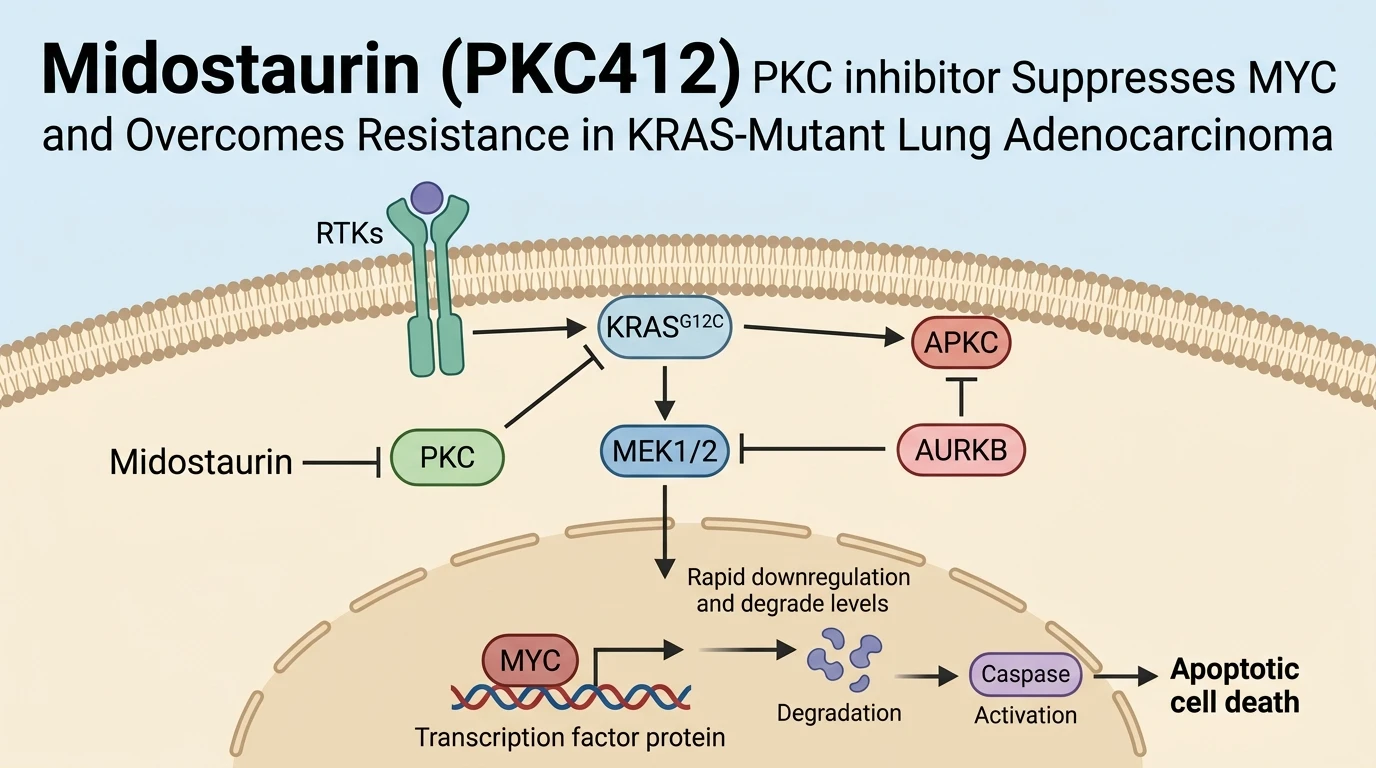
Targeted inhibition of KRAS-mutated lung adenocarcinoma (LUAD) remains a substantial clinical challenge due to rapid activation of compensatory signaling networks. Monotherapy targeting downstream effectors, such as MEK1/2 inhibition via Trametinib or direct allele-specific inhibition via KRASG12C inhibitors like Sotorasib, frequently results in incomplete responses and rapid onset of resistance. A primary biochemical driver of this intrinsic and acquired resistance is the persistence of MYC protein expression. MYC acts as a central transcriptional node sustaining cell cycle progression and metabolic reprogramming. Mitigating MYC expression through direct small-molecule targeting has proven pharmacologically challenging; thus, identifying upstream kinase targets that govern MYC stability represents a compelling therapeutic strategy.
To identify novel combinatorial partners capable of overcoming RAS pathway resistance, a signature-driven drug repurposing screen was deployed across KRAS-mutated LUAD cell lines. This screening paradigm evaluated broad pharmacological libraries to uncover agents that synthetically lethalize cancer cells when combined with MEK or KRASG12C inhibition. Midostaurin (PKC412), an orally bioavailable multi-tyrosine kinase and PKC inhibitor, emerged as a top candidate. Under tested in vitro assay conditions, Midostaurin (PKC412) demonstrated profound synergistic antiproliferative effects when combined with Trametinib or Sotorasib, converting cytostatic single-agent activity into robust cytotoxic apoptotic responses.
Biochemical characterization reveals that the therapeutic synergy of Midostaurin (PKC412) relies on its broad kinase inhibition profile, specifically targeting PKC isoforms alongside multi-tyrosine kinase targets, notably Aurora Kinase B (AURKB). AURKB activity is frequently elevated in KRAS-mutant malignancies, where it regulates chromosome alignment, segregation, and cell division. Co-inhibition of MEK1/2 or KRASG12C along with AURKB and PKC signaling nodes disrupts parallel survival networks. Crucially, this dual pharmacological pressure induces a pronounced downregulation of MYC protein levels. The destabilization of MYC suppresses transcriptional programs necessary for cell survival, directly triggering mitochondrial apoptosis pathways.
To confirm these findings beyond two-dimensional cell cultures, the combination regimen was evaluated across advanced pre-clinical cancer models. In patient-derived 3D organoid cultures, dual target engagement markedly impaired organoid growth and disrupted structural integrity at nanomolar to low-micromolar concentrations. In vivo validation was conducted using both cell-line-derived xenograft models and immunocompetent genetically engineered mouse (GEM) models harboring KRAS mutations. Within these animal models, combination therapy with Midostaurin and Trametinib or Sotorasib achieved significant tumor regression compared to vehicle or monotherapy arms. Histopathological and western blot analyses of harvested tumor tissues confirmed marked reductions in phosphorylated ERK, AURKB target engagement, and sustained loss of MYC protein expression. Importantly, the therapeutic responses were achieved at tolerable dosage levels without overt systemic toxicity, establishing a robust rational framework for clinical combination strategies in KRAS-driven lung carcinoma.
Pharmacological Evaluation and Synergistic Target Engagement
Copy code to add this image to your page
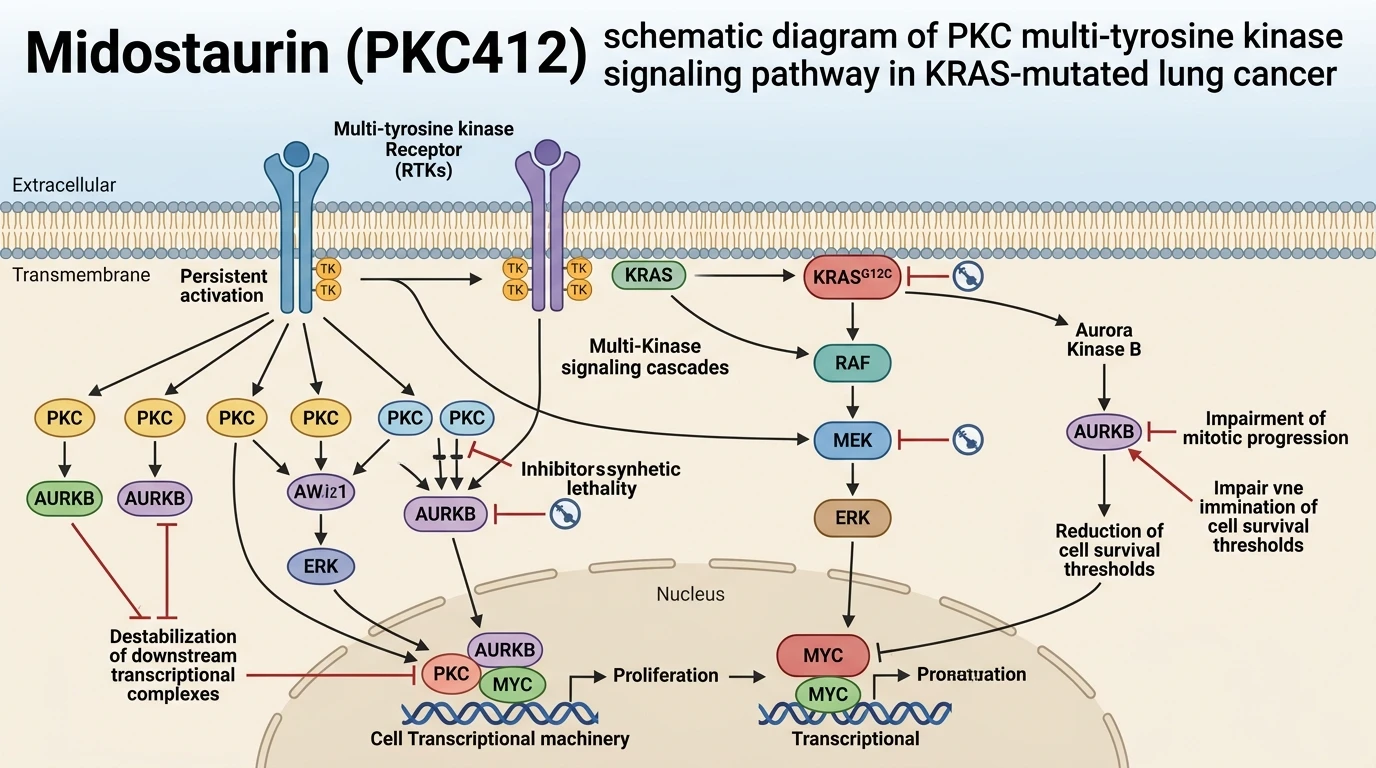
Midostaurin functions as a multi-tyrosine kinase and PKC inhibitor that acts synergistically with MEK1/2 inhibitor Trametinib or KRASG12C inhibitor Sotorasib in KRAS-mutant lung adenocarcinoma. Mechanistically, dual inhibition disrupts AURKB signaling and downregulates MYC expression, driving apoptosis and overcoming single-agent resistance in vitro, 3D organoid, and in vivo GEM models.
AURKB Target Engagement Suppresses Oncogenic MYC Expression
Synergistic inhibition depends on simultaneous targeting of parallel enzymatic cascades. Combined administration of the Midostaurin (PKC412) PKC inhibitor with Trametinib or Sotorasib induced rapid destabilization of MYC protein levels across KRAS-mutated LUAD cell lines. Single-agent MEK or KRASG12C inhibition produced transient ERK dephosphorylation without altering steady-state MYC levels. Adding Midostaurin inhibited AURKB autophosphorylation. MYC levels dropped within six hours of exposure. Downstream apoptotic signaling ensued promptly. Cleaved PARP and caspase-3 metrics confirmed cell death. This targeted dual blockade prevents compensatory transcriptional re-activation.
Combinatorial Efficacy in Xenograft and GEM Models
In vivo target validation confirmed efficacy in mouse models. Mice bearing KRAS-mutant xenografts were treated with oral combinations of the Midostaurin (PKC412) PKC inhibitor and Sotorasib. Monotherapy cohorts exhibited modest tumor growth retardation. Dual-agent cohorts showed marked tumor regression. Tumor volume decreased significantly over twenty-eight days. Pharmacodynamic markers in harvested tissue confirmed sustained MYC depletion. Animal body weights remained stable throughout the dosing schedule. Selectivity margins remained intact at therapeutic exposure levels.
Patient-Derived 3D Organoid Sensitivity to Dual Inhibition
Three-dimensional organoid cultures recapitulate parental architecture and heterogeneity. Patient-derived LUAD organoids harboring KRAS G12C mutations were exposed to multi-kinase and RAS pathway inhibitors. Single-agent treatment resulted in minimal structural degradation. Combination treatment caused organoid disintegration and viability loss. IC50 values dropped by orders of magnitude under dual treatment conditions. These preclinical data demonstrate that multi-kinase inhibition via PKC and AURKB targeting overcomes cell-autonomous resistance mechanisms in patient-derived models.