Bisindolylmaleimide I Inhibits PKCβ-Mediated Vasoconstriction in Frozen Embryo Transfer Umbilical Veins
Copy code to add this image to your page
Vascular tone regulation in human umbilical veins relies on precise enzymatic cascades. Protein Kinase C (PKC) isoforms serve as principal regulators of smooth muscle contractility. In assisted reproductive technology, frozen embryo transfer (frozen ET) alters fetal-placental vascular responsiveness. Ex vivo tissue bath preparations demonstrate elevated contractile sensitivity to histamine in human umbilical veins (HUV) following frozen ET compared to fresh or normal controls. Understanding the precise molecular transducers driving this enhanced vasoreactivity is essential for evaluating placental circulatory dynamics.
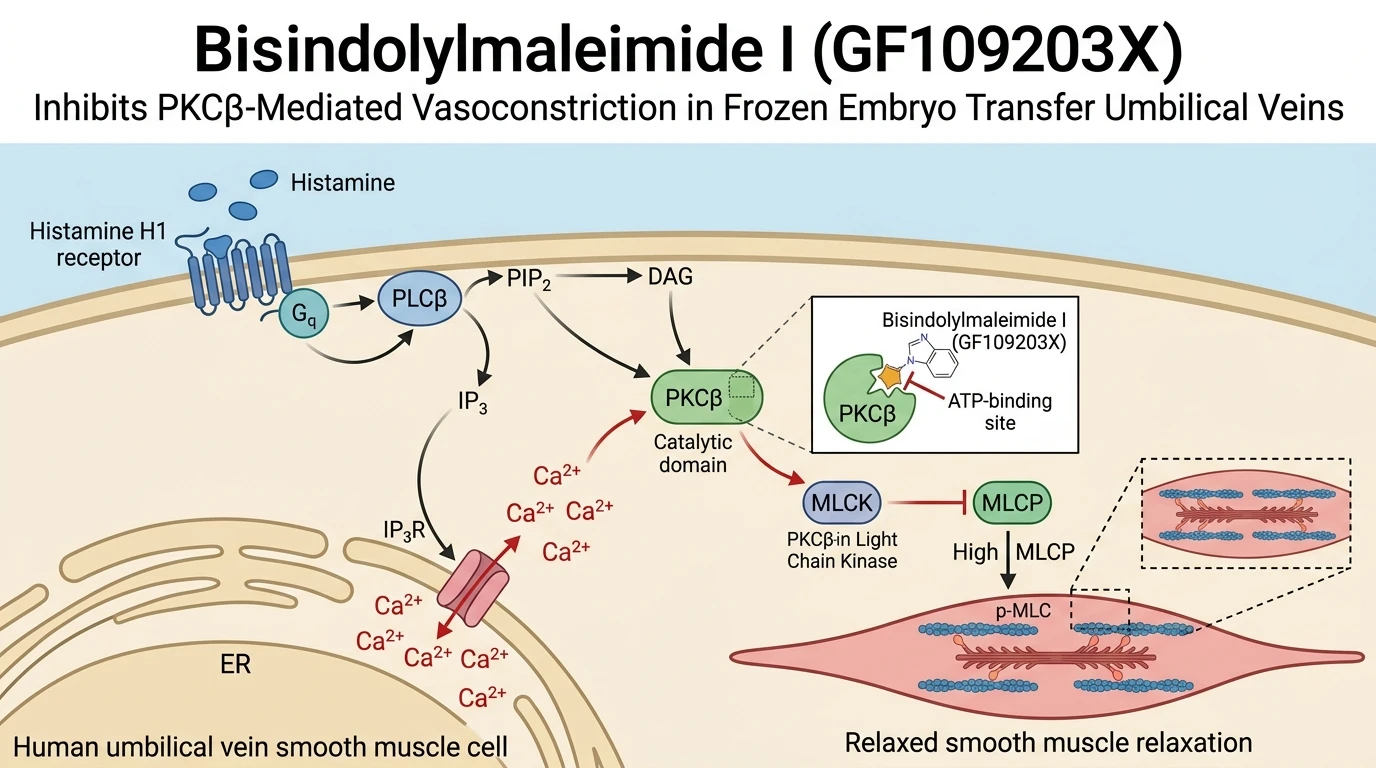
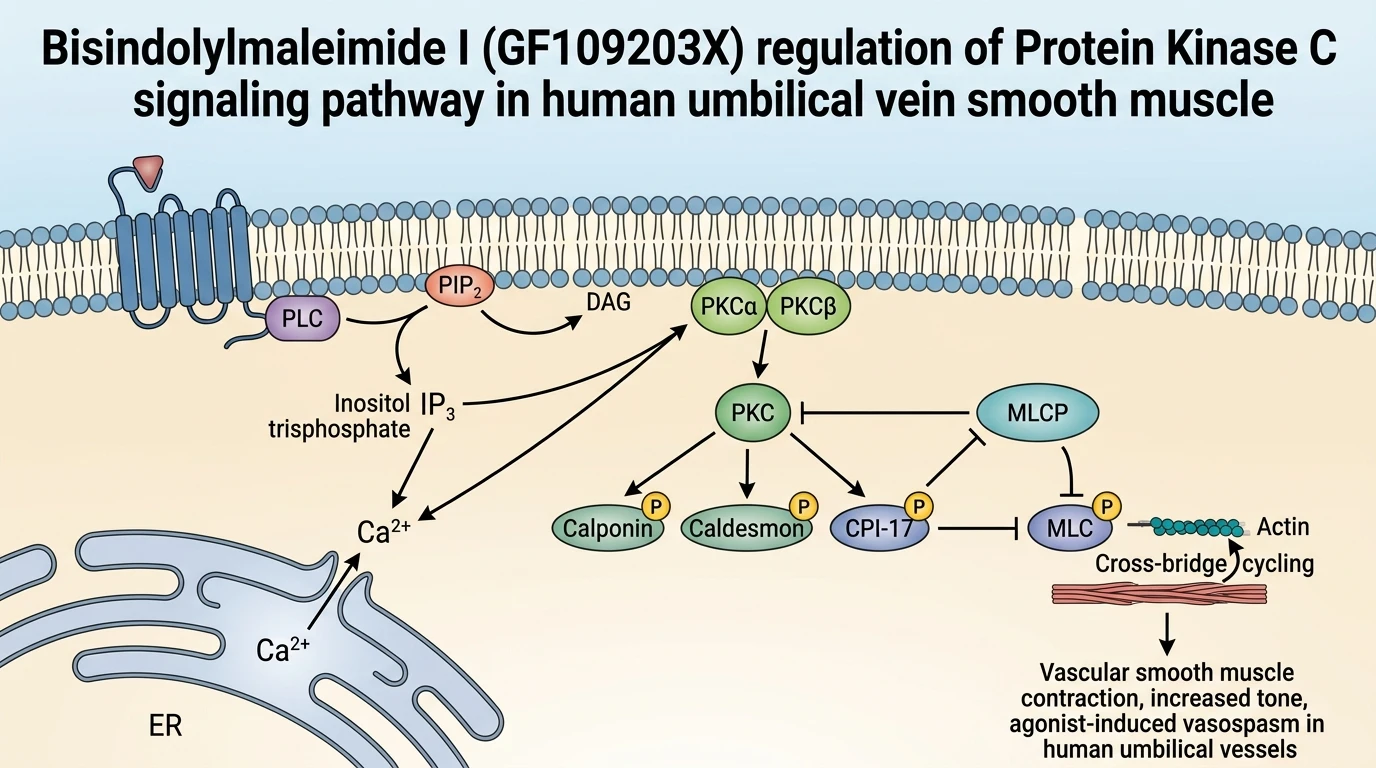
The pan-PKC inhibitor Bisindolylmaleimide I (GF109203X) functions as a competitive inhibitor at the ATP-binding catalytic domain across classical and novel PKC isoforms. By blocking ATP occupancy, Bisindolylmaleimide I halts downstream phosphorylation of regulatory targets such as CPI-17 and calponin. In isolated human umbilical vein rings, administration of Bisindolylmaleimide I blunts agonist-induced isometric tension development. Under resting baseline conditions, basal vascular tone remains largely unaltered by competitive ATP blockade. Upon stimulation with histamine, control vessel rings display standard concentration-dependent force generation. Conversely, vessels harvested from frozen ET pregnancies exhibit marked hyper-responsiveness, producing significantly higher active tension at identical histamine thresholds.
Application of Bisindolylmaleimide I (GF109203X) attenuates histamine-induced vasoconstriction across both control and frozen ET tissue cohorts. Crucially, competitive blockade with Bisindolylmaleimide I completely abolishes the differential tension amplification observed in the frozen ET group. This selective suppression aligns with observations using phorbol 12,13-dibutyrate (PDBu), a direct diacylglycerol mimetic and PKC agonist. PDBu administration elicits augmented contractile responses specifically in frozen ET HUV segments compared to non-frozen ET controls. The parallel shift in force development induced by direct enzymatic activation confirms hyper-functional signaling downstream of receptor engagement.
Western blot analysis of umbilical vein homogenates clarifies the molecular isoform specificities involved. Quantitative immunoblots demonstrate a significant upregulation of PKCβ protein expression in umbilical smooth muscle membranes isolated from frozen ET births. In contrast, expression levels of other classical and novel isoforms—including PKCα and PKCδ—remain largely stable across cohorts. These protein quantification metrics indicate that elevated PKCβ abundance drives the heightened vasoreactivity. The pharmacological actions of vascular smooth muscle signaling models confirm that catalytic inhibition of this pathway neutralizes pathological hyper-reactivity without impairing basal homeostasis.
Pharmacological characterization confirms that calcium-dependent PKC activation promotes cross-bridge cycling in human umbilical smooth muscle. Histamine binding to H1 receptors triggers phospholipase C activation, generating diacylglycerol and mobilizing intracellular calcium reserves. Free calcium and diacylglycerol cooperatively bind the C1 and C2 domains of PKCβ, recruiting the enzyme to the plasma membrane. Activated PKCβ phosphorylates CPI-17 at Thr38. Phosphorylated CPI-17 acts as a potent endogenous inhibitor of myosin light chain phosphatase (MLCP). Inhibition of MLCP prevents the dephosphorylation of the 20 kDa myosin regulatory light chain. Sustained myosin phosphorylation preserves actomyosin cross-bridge cycling, resulting in prolonged vessel contraction.
Ex vivo organ bath studies validate that Bisindolylmaleimide I intercepts this enzymatic pathway directly. By binding competitive catalytic pockets, the inhibitor suppresses Thr38 phosphorylation on CPI-17. Consequently, MLCP activity persists, facilitating myosin dephosphorylation and vessel relaxation. The complete reversal of frozen ET-associated hyper-responsiveness by targeted PKC inhibition highlights the central contribution of PKCβ overactivity. These empirical findings indicate that altered epigenetic or microenvironmental conditions during embryo cryopreservation may recalibrate fetal vascular gene expression patterns, selectively expanding PKCβ protein density in umbilical smooth muscle.
Pharmacological Characterization of Vascular Smooth Muscle Tone
Copy code to add this image to your page
Bisindolylmaleimide I (GF109203X) is an ATP-competitive pan-PKC inhibitor that selectively disrupts calcium-dependent signaling cascades in vascular smooth muscle. In human umbilical veins, histamine receptor activation triggers PKCβ recruitment, leading to CPI-17 phosphorylation and MLCP inhibition. By occupying the ATP-binding catalytic cleft of PKCβ, Bisindolylmaleimide I prevents downstream substrate phosphorylation, restoring MLCP activity and facilitating myosin light chain dephosphorylation. This mechanism abolishes the hyper-contractile vasospasms observed in umbilical vessels following frozen embryo transfer.
Competitive Kinase Inhibition Blocks Histamine-Induced Umbilical Vasospasm
Organ bath contractility assays demonstrate distinct force-generation profiles in isolated human umbilical vein rings. Histamine exposure induces concentration-dependent muscle contraction. In vessels derived from frozen embryo transfer procedures, peak isometric tension increases twofold compared to control tissues. Preincubation with Bisindolylmaleimide I significantly suppresses maximum contractile force in both experimental groups. Notably, the inhibitor normalizes the hyper-reactive response of frozen ET vessels to baseline control levels. The response to direct PKC activation via phorbol ester stimulation follows an identical pattern. These contractile responses confirm that enhanced signaling operates downstream of surface receptor binding.
Upregulated PKCβ Expression Drives Augmented Contractile Sensitivity
Densitometric analysis of smooth muscle lysates reveals targeted alterations in kinase expression. Protein levels of PKCβ show significant elevation in frozen ET samples relative to fresh controls. Other classical isoforms, such as PKCα, show no statistically significant shift in abundance. Application of Bisindolylmaleimide I reverses this elevated signal amplification without disrupting baseline cellular integrity. Under tested ex vivo assay conditions, these findings demonstrate that PKCβ upregulation is the primary driver of umbilical hyper-reactivity. Future studies must evaluate whether these molecular alterations persist in systemic fetal resistance microvessels.