Avapritinib (BLU-285) BLU285 Inhibits PDGFRA D842V Active Kinase Conformation in GIST
Copy code to add this image to your page
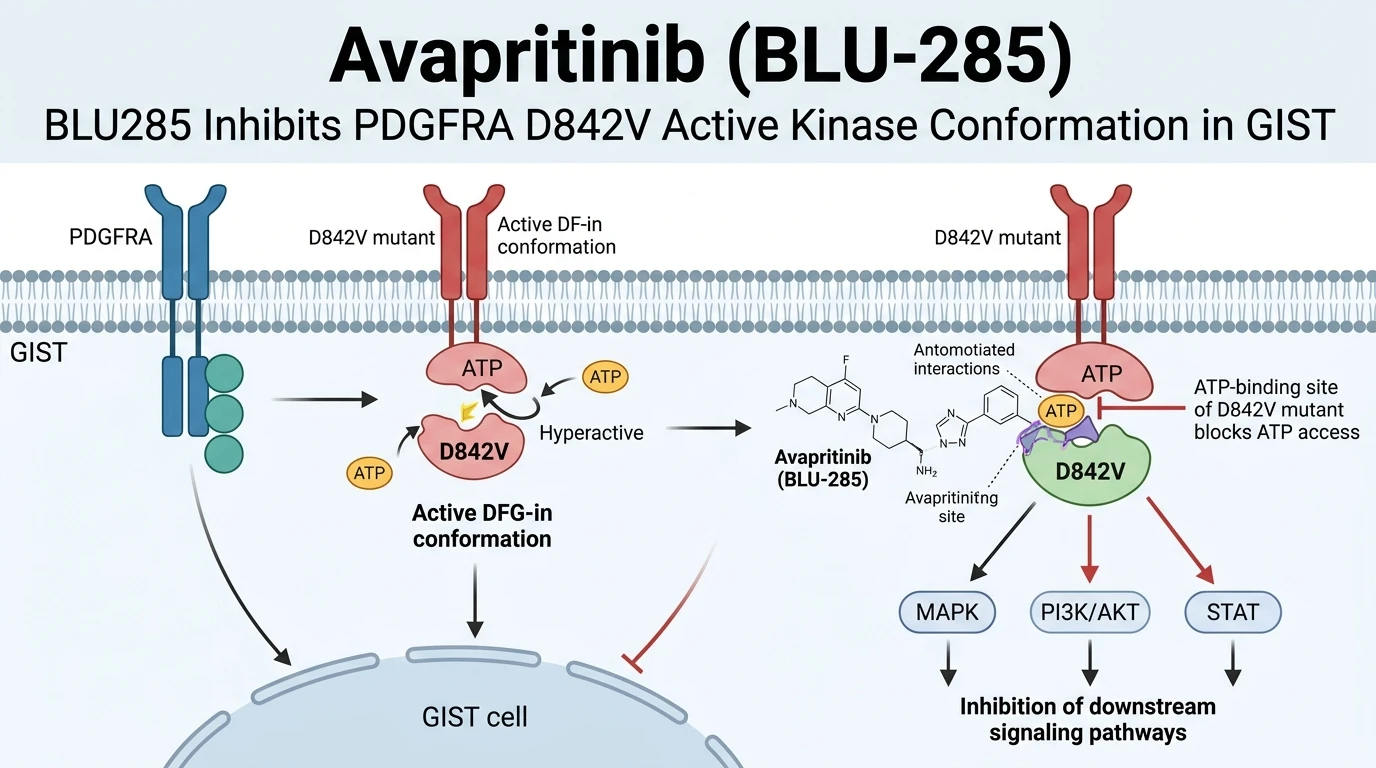
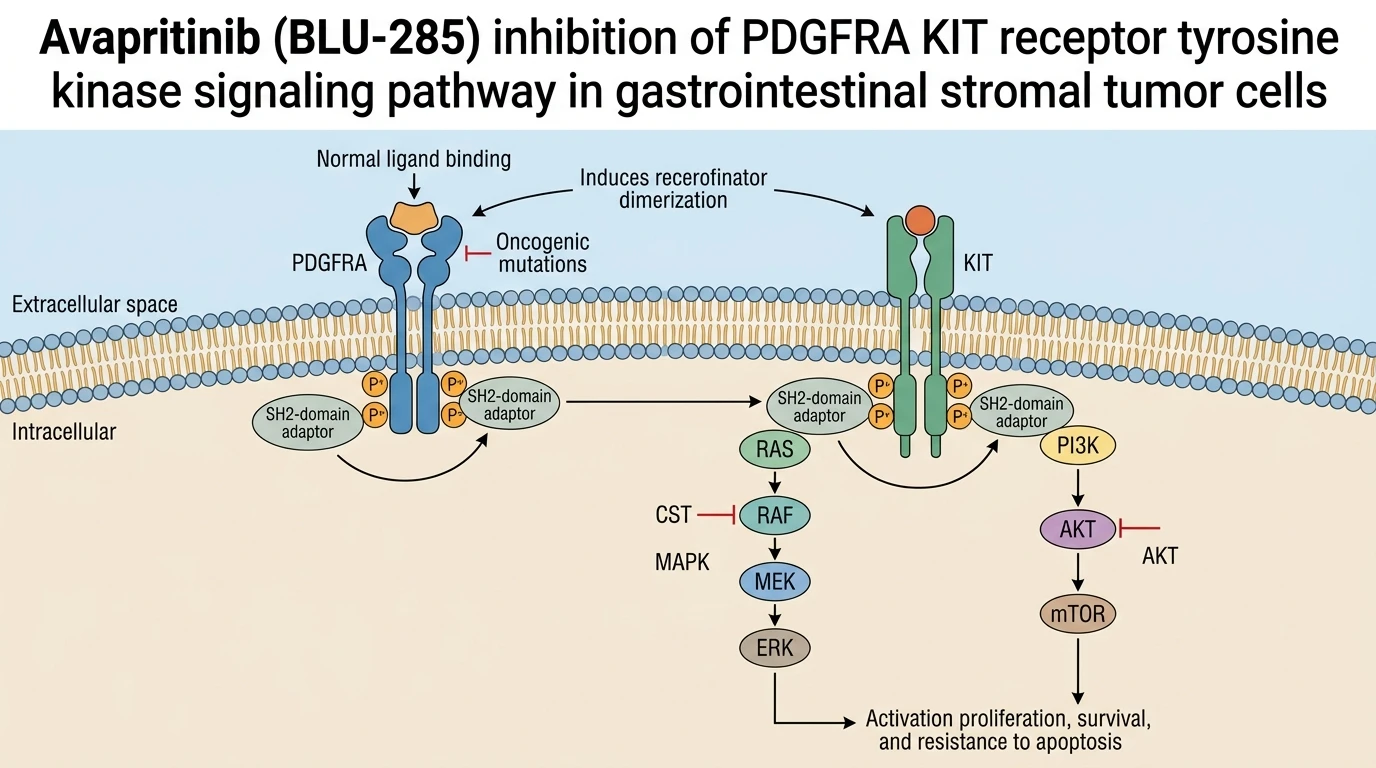
Gastrointestinal stromal tumors (GIST) are driven primarily by oncogenic gain-of-function mutations in the receptor tyrosine kinase genes KIT or PDGFRA. Under baseline physiological conditions, receptor dimerization and kinase activation are strictly regulated by ligand engagement. Pathogenic mutations disrupt these regulatory constraints, promoting constitutional kinase domain autophosphorylation and hyperactivation of downstream signaling cascades, including the MAPK and PI3K-AKT pathways. While first-generation tyrosine kinase inhibitors such as imatinib demonstrate clinical efficacy against classical KIT exon 11 mutations, primary structural mutations in the activation loop confer profound drug resistance.
Prominent among these primary resistant driver alterations is the substitution of valine for aspartic acid at amino acid position 842 (D842V) within exon 18 of PDGFRA. Mechanistically, the D842V point mutation alters the activation loop, shifting the thermodynamic equilibrium of the kinase domain strongly toward the active (DFG-in) conformation. Traditional type II tyrosine kinase inhibitors, including imatinib, sunitinib, and regorafenib, require the kinase domain to adopt an inactive (DFG-out) conformation to achieve high-affinity hydrogen bonding and hydrophobic pocket binding. The D842V substitution induces steric hindrance and stabilizes the active state, rendering conventional type II TKIs therapeutically ineffective in patients harboring this mutation.
To address this molecular vulnerability, targeted drug development yielded Avapritinib (BLU-285), a potent and highly selective type I tyrosine kinase inhibitor. Unlike type II inhibitors, type I TKIs bind directly to the active (DFG-in) conformation of the ATP-binding cassette. By targeting the active state, BLU285 bypasses the structural resistance imparted by activation loop mutations. Biochemical assays confirm sub-nanomolar inhibitory potency against PDGFRA D842V as well as potent activity against KIT exon 17 loop mutations. Detailed structural investigations published in ACS Infectious Diseases structural biochemistry reports demonstrate that the rigid central heterocycle of BLU285 forms specific hydrogen bonds within the active ATP pocket, avoiding the steric clashes encountered by earlier therapeutic compounds.
Translational validation of this active-conformation engagement model was demonstrated in the pivotal open-label NAVIGATOR clinical trial. In patient cohorts with advanced or metastatic GIST harboring the PDGFRA D842V mutation, Avapritinib (BLU-285) demonstrated remarkable clinical activity. The trial recorded an overall response rate (ORR) of 91% and a clinical benefit rate (CBR) of 98%. The median progression-free survival (PFS) reached 34 months, representing a dramatic therapeutic improvement for a patient population that historically exhibited median PFS durations of less than 3 months on conventional TKI regimens.
Despite its precise target selectivity, administration of Avapritinib (BLU-285) requires rigorous clinical surveillance due to a unique safety and adverse event profile. The most frequent treatment-emergent adverse events include nausea, fatigue, peripheral and periorbital edema, anemia, and diarrhea. Additionally, central nervous system effects—such as cognitive impairment, memory alterations, and mood disturbances—were reported in a subset of patients. These cognitive phenomena are dose-dependent and require close monitoring, baseline neuro-cognitive evaluations, and dosage adjustments when necessary to balance therapeutic efficacy with patient quality of life.
Pharmacological Dynamics and Clinical Efficacy Profile
Copy code to add this image to your page
Avapritinib (BLU-285) functions as a selective type I tyrosine kinase inhibitor that targets the active (DFG-in) kinase conformation of PDGFRA and KIT. By binding directly to the active state, it bypasses steric resistance mechanisms induced by activation loop mutations such as PDGFRA D842V. This inhibition shuts down downstream phosphorylation cascades, leading to marked cell cycle arrest and apoptosis in mutant GIST cells.
Type I Active Conformation Engagement Overcomes Structural Resistance
Type I kinase inhibitors engage the ATP-binding cassette during active signaling states. Traditional type II inhibitors bind exclusively to inactive kinase conformations. In PDGFRA D842V mutants, the activation loop remains locked in an active state. Consequently, standard agents fail to achieve stable binding kinetics. Avapritinib (BLU-285) avoids this conformational constraint entirely. The molecule occupies the active pocket without requiring rearrangement of the activation loop. As a result, phosphorylation of downstream signaling cascades is rapidly suppressed. In cell line models harboring PDGFRA exon 18 mutations, autophosphorylation ceased at nanomolar concentrations. Selectivity across non-target kinases remained high under tested in vitro conditions. This biochemical specificity minimizes off-target kinase inhibition.
Marked Antitumor Regression Observed in NAVIGATOR Clinical Trial
Clinical evaluation in patient cohorts demonstrated substantial antitumor activity. In the NAVIGATOR clinical trial, patients with advanced PDGFRA D842V-mutant gastrointestinal stromal tumors received daily oral therapy. The overall response rate reached 91% among evaluated subjects. Clinical benefit rate reached 98%, demonstrating near-universal tumor stabilization or shrinkage. Disease control persisted over extended treatment durations. Median progression-free survival reached 34 months within this specific clinical trial context. Tumor regression occurred rapidly, often recorded at the first radiological assessment. These findings establish BLU285 as an effective therapeutic agent for imatinib-resistant disease.
Characterization of Adverse Event Profiles and Cognitive Toxicities
Systemic exposure to small-molecule kinase inhibitors frequently induces distinct toxicological responses. Treatment with Avapritinib (BLU-285) produced manageable gastrointestinal and hematologic toxicities. Commonly reported adverse events included nausea, fatigue, anemia, diarrhea, and peripheral edema. Cognitive adverse events were observed in a subset of treated individuals. Patients experienced memory impairment, confusion, and altered attention spans during prolonged dosing schedules. These central nervous system effects are dose-dependent and typically resolve upon dose modification. Regular cognitive monitoring remains mandatory for clinical management. Pharmacodynamic titration ensures optimal target engagement while mitigating neuro-cognitive impairment.