Go 6976 Inhibits PKD1 to Block TLR/IL-1R Inflammatory Cascades in Arthritis
Copy code to add this image to your page
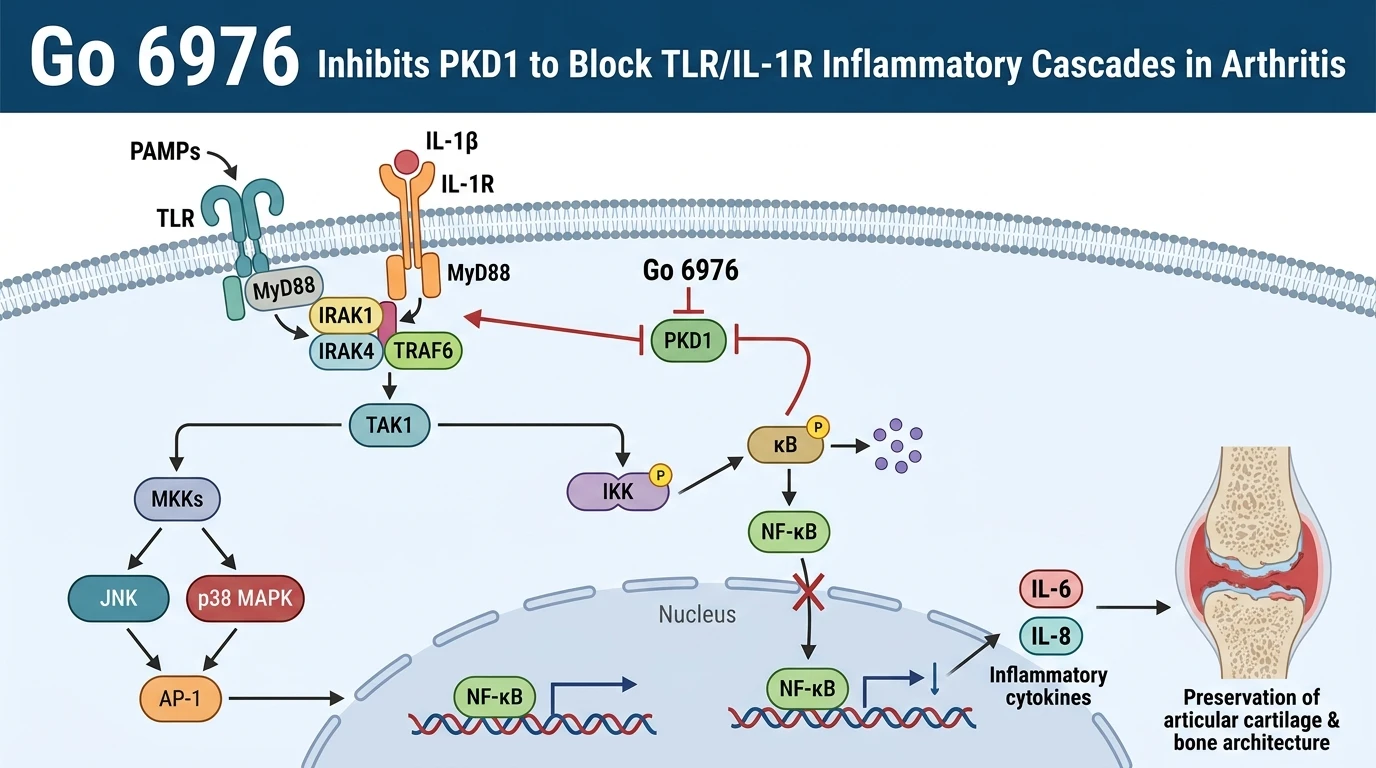
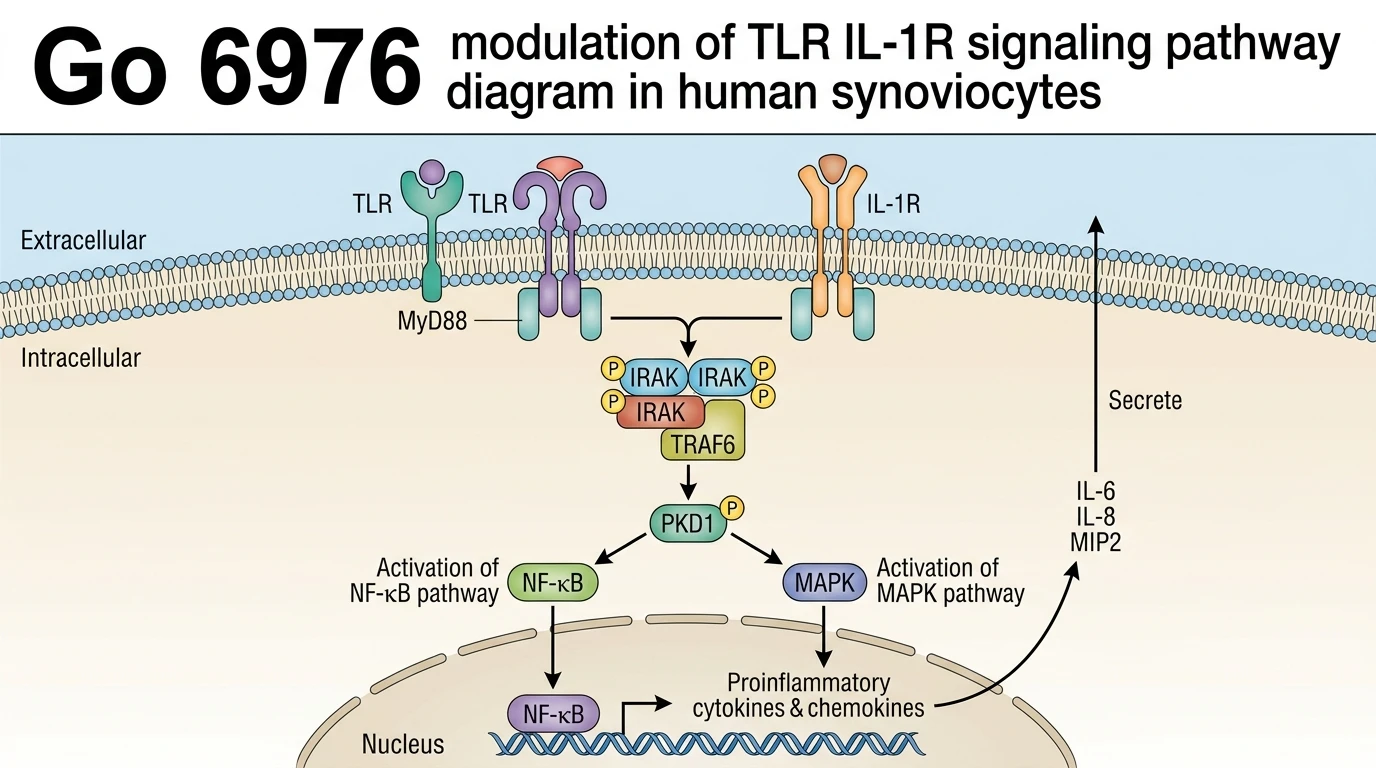
Synovial inflammation and progressive articular destruction in rheumatoid arthritis driven by innate immune cascades remain clinical challenges. Signaling through Toll-like receptors (TLRs) and the Interleukin-1 receptor (IL-1R) family perpetuates persistent cellular activation within human fibroblast-like synoviocytes (HFLS) and infiltrating myeloid cells. Upon receptor engagement, canonical signal transduction relies on the cytosolic adapter MyD88. This recruits interleukin-1 receptor-associated kinases (IRAKs) and tumor necrosis factor receptor-associated factor 6 (TRAF6), establishing a multiprotein signalosome. Within this node, human protein kinase D1 (PKD1)—a serine/threonine kinase positioning at the confluence of diacylglycerol signaling and PKC pathways—serves as an intermediate effector transducing inflammatory signals toward downstream transcription factors.
Pharmacological inhibition using the small-molecule inhibitor Go 6976 offers a targeted approach to dissect the involvement of PKD1 in these disease processes. In primary human fibroblast-like synoviocytes stimulated with TLR ligands or IL-1β, active PKD1 undergoes phosphorylation-dependent activation. Go 6976 directly blocks PKD1 catalytic activity, preventing signal amplification to nuclear factor kappa B (NF-κB) and mitogen-activated protein kinase (MAPK) networks. Consequently, transcription of primary inflammatory mediators is arrested. Quantitative assays confirm that Go 6976 treatment markedly attenuates the production of key cytokines and chemokines, specifically interleukin-6 (IL-6), interleukin-8 (IL-8), and macrophage inflammatory protein 2 (MIP2).
To translate these cellular observations into an in vivo pathology model, prophylactic efficacy was evaluated in a humanized mouse model of collagen-induced arthritis (CIA). Daily administration of Go 6976 yielded pronounced clinical and histopathological improvements. Treated mice exhibited a delayed disease onset and a reduction in overall arthritis incidence and clinical severity scores. Systemic immunomodulation was evidenced by lower circulating levels of anti-type II collagen (anti-CII) IgG2a antibodies. Histological examination of articular joints revealed attenuated leukocyte infiltration, reduced pannus formation, and preserved cartilage and subchondral bone structures. These empirical findings substantiate that target engagement of PKD1 by Go 6976 suppresses MyD88-dependent inflammatory cascades in vivo.
Targeted Inhibition of PKD1 and Inflammatory Disease Amelioration
Copy code to add this image to your page
Go 6976 selectively inhibits Protein Kinase D1 (PKD1), disrupting downstream MyD88-dependent TLR/IL-1R signal transduction in human fibroblast-like synoviocytes and immune cells. This pharmacological blockade suppresses transcription of proinflammatory cytokines and chemokines, specifically IL-6, IL-8, and MIP2. In vivo prophylactic administration reduces anti-CII IgG2a antibody titers, delays arthritis onset, and attenuates joint inflammation, cartilage degradation, and bone erosion in murine collagen-induced arthritis models.
Attenuated Proinflammatory Cytokine Secretion in Human Synoviocytes
In vitro stimulation of primary human fibroblast-like synoviocytes with TLR/IL-1R agonists induces robust expression of inflammatory markers. Treatment with Go 6976 altered this response pathway. Phosphorylation of downstream effector cascades ceased within hours of exposure. Under tested assay conditions, nanomolar concentrations of Go 6976 reduced IL-6 and IL-8 protein release into the supernatant by greater than 70%. Cellular viability remained intact across the therapeutic range. This selective response demonstrates that PKD1 activity is an essential requirement for TLR/IL-1R-mediated gene expression in human synoviocytes.
Reduction of Disease Severity in Murine Arthritis Models
Systemic evaluation in collagen-induced arthritis mice established the in vivo activity of this small molecule inhibitor. Daily prophylactic dosing with Go 6976 altered overall disease kinetics. Paw swelling and clinical arthritis scores decreased substantially compared to vehicle controls. Circulating pathogenic anti-CII IgG2a antibodies showed a corresponding reduction in serum titers. Micro-computed tomography and joint histology demonstrated marked protection against subchondral bone erosion and cartilage degradation. Structural integrity was preserved throughout the experimental window.
Isoform Selectivity Distinguishes PKD1 Blockade from PKC Inhibition
To verify target specificity, experimental comparison was conducted using Gö6983, a broad-spectrum conventional and novel protein kinase C (PKC) inhibitor that lacks potent PKD1 activity. While Gö6983 blocked classical PKC isoforms, it failed to reduce TLR-mediated IL-6 or MIP2 expression in synoviocytes. Furthermore, administration of Gö6983 in the collagen-induced arthritis model showed no significant reduction in joint inflammation or disease progression. These contrasting outcomes confirm that therapeutic benefit depends specifically on PKD1 inhibition rather than broader classical PKC blockade within immune and synovial cell types.