Onvansertib (NMS-1286937, NMS-P937) inhibits PLK1 and induces S-phase arrest in colorectal cancer spheroids
Copy code to add this image to your page
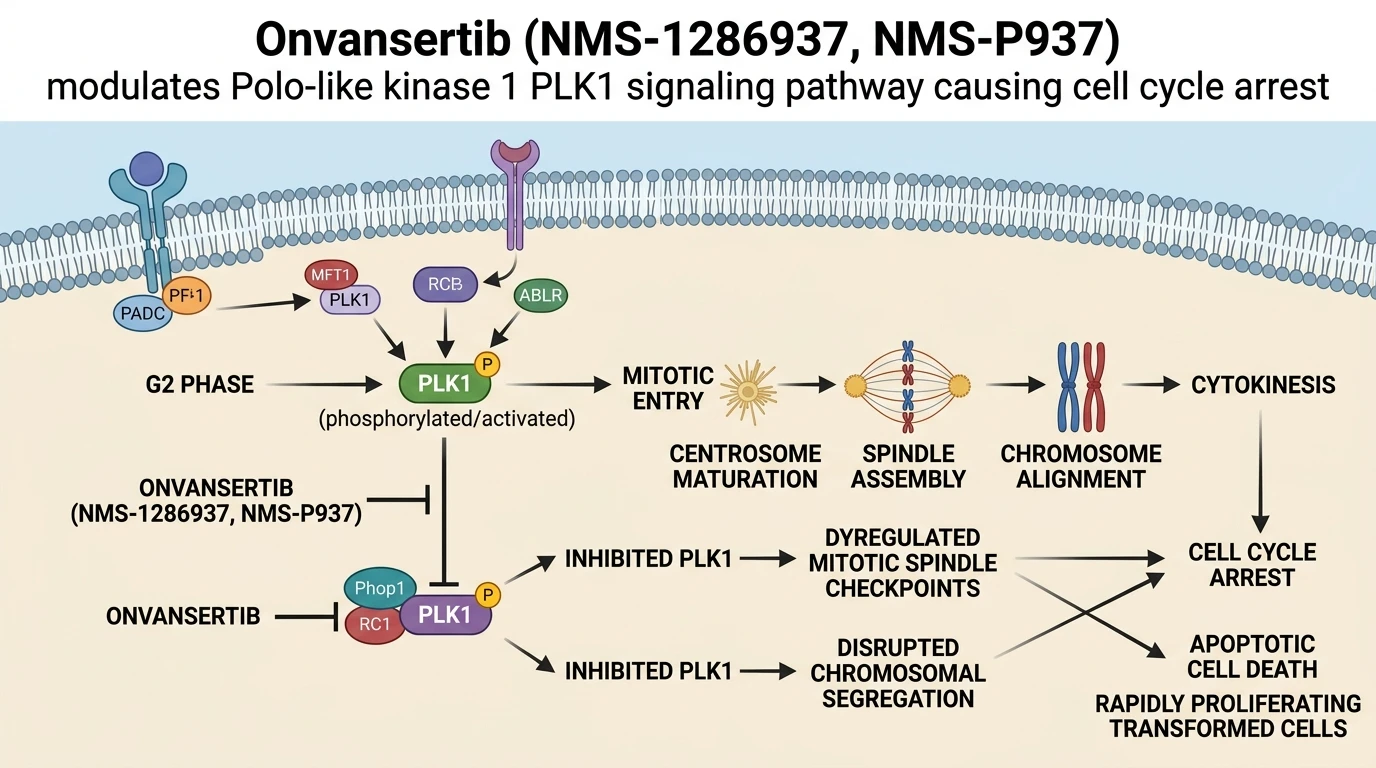
Polo-like kinase 1 (PLK1) acts as a principal Ser/Thr kinase governing mitotic entry, centrosome maturation, bipolar spindle assembly, and cytokinesis in proliferating human tissues. Aberrant PLK1 overexpression correlates with aggressive oncogenic phenotypes and reduced overall survival across solid tumors, particularly colorectal carcinoma. Onvansertib (NMS-1286937, NMS-P937) is an oral, highly selective ATP-competitive PLK1 inhibitor engineered to bind the conserved ATP-binding pocket of the catalytic domain. Occupancy of this active site blocks ATP binding, preventing target autophosphorylation at Thr210 and subsequent substrate phosphorylation across downstream targets like TPX2 and CDC25C. Consequently, PLK1 signal transduction ceases, impairing centrosomal maturation and spindle assembly machinery in rapidly dividing transformed cells.
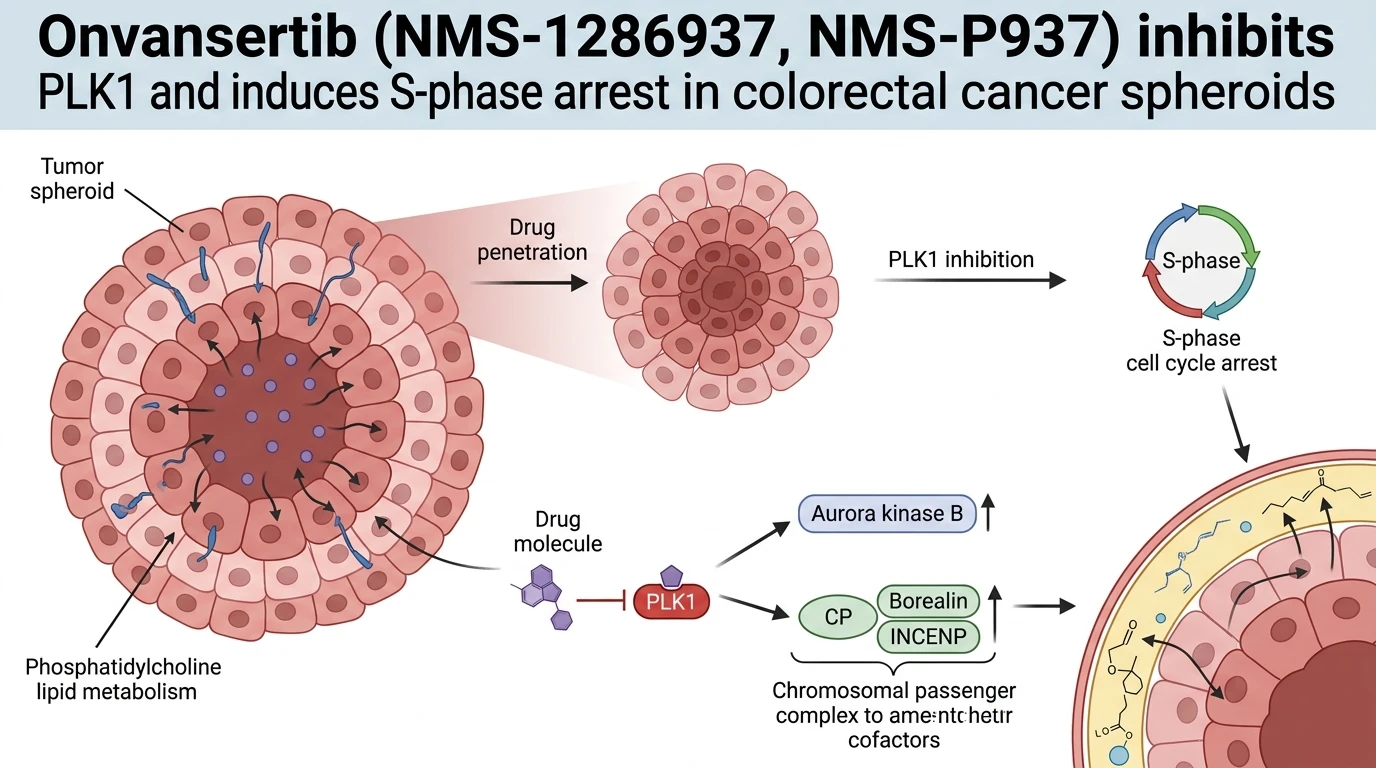
Assessing small-molecule disposition within three-dimensional tumor models yields critical pharmacodynamic data superior to conventional two-dimensional monolayer systems. In HCT 116 colorectal cancer spheroids, spatial mass spectrometry imaging (MSI) paired with data-independent acquisition (DIA) proteomics provided high-resolution spatial and temporal kinetic profiles. MSI quantification established that Onvansertib (NMS-1286937, NMS-P937) exhibits time-dependent tissue penetration across the outer proliferating rim into the internal core over 72 hours of continuous exposure. Matrix-assisted ionization confirmed drug uptake within early timepoints, reaching prominent internal accumulation by 12 hours. Drug distribution profiles stabilized across the central core at 48 to 72 hours under tested in vitro conditions, demonstrating effective tissue permeability through tight cell-cell junctions.
Deep-scale DIA proteomic profiling identified extensive proteomic remodeling accompanying PLK1 inhibition within the spheroid model. Rather than inducing an immediate M-phase arrest across all spatial zones, target engagement primary arrested HCT 116 colorectal cancer cells during the S phase under these specific 3D culturing conditions. Mitotic regulation dynamics shifted as target inhibition sustained over time. Quantitative proteomics identified a progressive, significant upregulation of Aurora kinase B (AURKB), an essential catalytic component of the chromosomal passenger complex (CPC). Parallel elevation occurred in key CPC structural cofactors, including Borealin and inner centromere protein (INCENP/INCE). This coordinated upregulation reflects a compensatory molecular adaptation where tumor cells attempt to counter PLK1 inhibition by fortifying AURKB-mediated mitotic surveillance pathways.
In parallel with proteomic alterations, matrix-assisted spatial lipidomics revealed substantial phospholipid restructuring across the spheroid cross-sections. Target engagement by Onvansertib (NMS-1286937, NMS-P937) altered concentrations of specific phosphatidylcholine species, altering membrane lipid composition within treated spheroids. Downstream modulation of key lipid metabolism enzymes occurred alongside these structural lipid shifts, linking kinase suppression to lipid homeostasis dysregulation.
Integrating mass spectrometry imaging with quantitative DIA proteomics establishes a multi-omic framework for characterizing small-molecule kinase inhibitors in complex tumor architectures. The empirical evidence demonstrates that target engagement by Onvansertib (NMS-1286937, NMS-P937) triggers time-dependent tissue accumulation, S-phase cellular arrest, upregulation of AURKB/CPC complex components, and dynamic lipidomic remodeling within HCT 116 colorectal cancer spheroids. These multi-layered observations provide clear pharmacodynamic metrics regarding compound penetration and compensatory cell signaling, though clinical translation warrants further evaluation in patient-derived organoid platforms and randomized clinical cohorts.
Spatiotemporal Pharmacology and Proteomic Compensatory Dynamics
Copy code to add this image to your page
Onvansertib is a selective ATP-competitive Polo-like kinase 1 (PLK1) inhibitor. Binding to the catalytic ATP site prevents PLK1 kinase activity, disrupting downstream substrate phosphorylation. In 3D colorectal cancer spheroids, Onvansertib penetrates deep into spheroid tissue over 72 hours, triggering primary S-phase cell cycle arrest. Prolonged PLK1 inhibition prompts compensatory upregulation of Aurora kinase B (AURKB) and chromosomal passenger complex cofactors (Borealin, INCENP), accompanied by spatial alterations in phosphatidylcholine lipid distribution.
Time-Dependent Spheroid Penetration and S-Phase Accumulation
Penetration kinetics govern drug concentration gradients inside solid tumor microenvironments. Mass spectrometry imaging mapped the spatial distribution of Onvansertib (NMS-1286937, NMS-P937) across HCT 116 colorectal cancer spheroids over a 72-hour period. Compound signal emerged at the outer cellular rim within hours. Signal intensity expanded substantially into central core regions by 12 hours post-treatment; spatial equilibrium was reached between 48 and 72 hours under tested assay conditions. Contrary to conventional monolayer predictions of M-phase arrest, target engagement in 3D spheroids primarily halted cell cycle progression during S phase. Cellular viability dropped steadily across the spheroid mass.
Proteomic Induction of Aurora Kinase B Compensatory Signaling
Sustained PLK1 inhibition induces specific protein expression adjustments across mitotic regulatory networks. Quantitative DIA proteomic profiling demonstrated selective alterations in cell cycle proteins following treatment with Onvansertib (NMS-1286937, NMS-P937). Aurora kinase B (AURKB) expression increased progressively over the 72-hour exposure window. Chromosomal passenger complex cofactors—including Borealin and INCENP—exhibited parallel protein accumulation. This elevated expression represents a functional compensatory response within the chromosomal alignment machinery. Target selectivity remained intact despite compensatory signaling.
Spatial Lipidomic Restructuring and Phosphatidylcholine Alterations
Kinase suppression alters cellular lipid metabolism and membrane composition. High-resolution mass spectrometry imaging recorded dynamic spatial changes in phosphatidylcholine lipids across treated spheroid sections. Abundance of specific phosphatidylcholine species decreased in drug-penetrated zones, while key enzymes governing lipid biosyntheses showed altered abundance in DIA proteomic datasets. Phospholipid remodeling correlated with structural changes during cell cycle arrest. These empirical observations highlight metabolic restructuring accompanying small-molecule kinase inhibition in 3D tumor models.