IPI-145 (Duvelisib) Dual PI3Kγ/δ Inhibition Blocks B-Cell Receptor Signaling in Lymphoid Malignancies
Copy code to add this image to your page
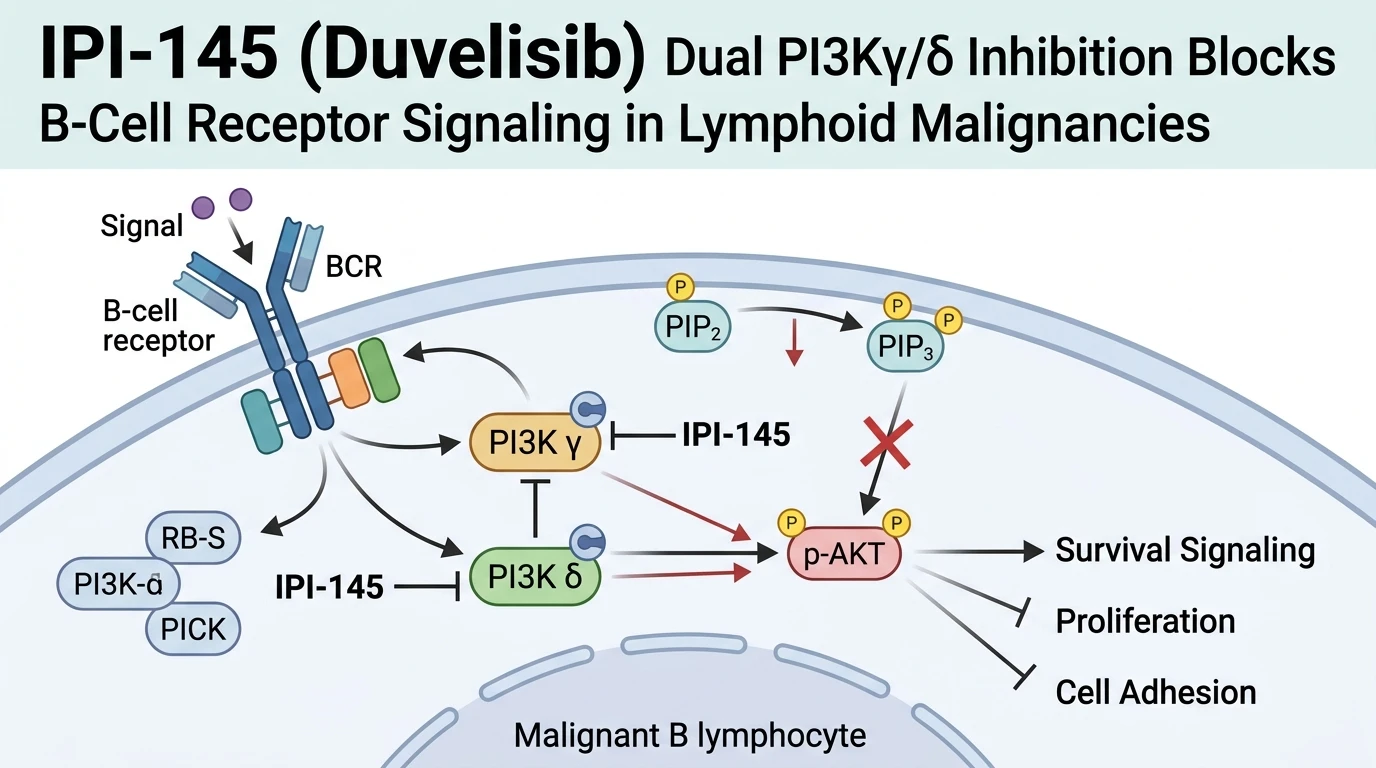
Phosphoinositide 3-kinase (PI3K) lipid signaling acts as a central mediator of intracellular transductions in B-cell receptor (BCR) pathways. In malignant B lymphocytes, dysregulated PI3K signaling drives persistent cellular survival, proliferation, and resistance to apoptosis. Class I PI3Ks exist as heterodimeric complexes composed of a p110 catalytic subunit and a p85 or p101/p84 regulatory subunit. Among the four class I catalytic isoforms (α, β, γ, δ), p110δ and p110γ exhibit restricted expression profiles predominantly localized to hematopoietic lineages. The p110δ subunit transduces signals directly downstream of the BCR and chemokine receptors (such as CXCR4 and CXCR5). Meanwhile, the p110γ subunit operates primarily downstream of G-protein coupled receptors (GPCRs), driving microenvironmental cytokine secretion and macrophage polarizations.
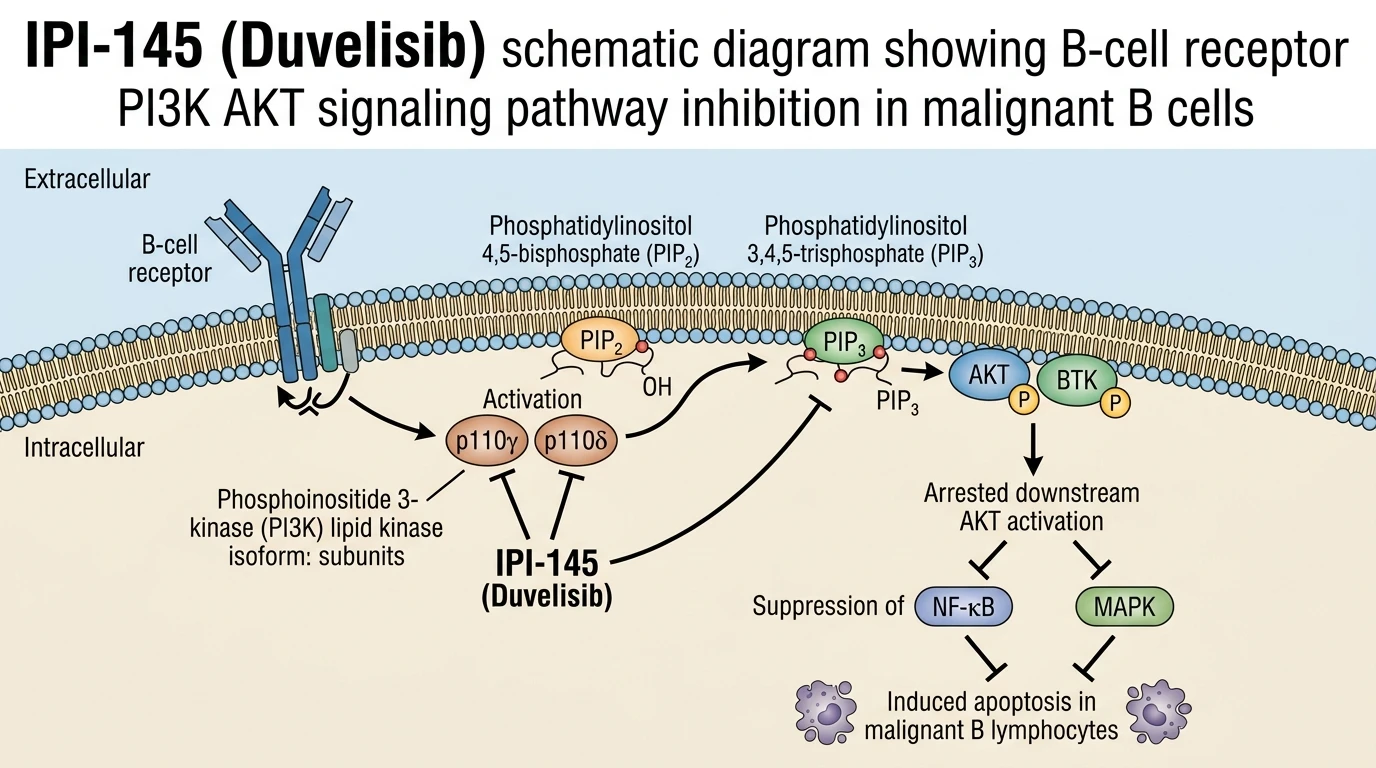
Dual targeting of these specific catalytic entities addresses therapeutic limitations observed with monospecific delta inhibitors. The small-molecule inhibitor IPI-145 (Duvelisib) was developed as an oral selective antagonist targeting both PI3Kγ and PI3Kδ isoforms. By occupying the ATP-binding pocket of p110γ and p110δ, IPI-145 prevents the phosphorylation of phosphatidylinositol 4,5-bisphosphate (PIP2) into phosphatidylinositol 3,4,5-trisphosphate (PIP3). PIP3 depletion blocks the membrane recruitment and subsequent activation of pleckstrin homology (PH) domain-containing effector proteins, including AKT (protein kinase B) and Bruton tyrosine kinase (BTK). Downstream phosphorylation events at AKT Ser473 and Thr308 diminish rapidly following target engagement. Consequently, survival signals transmitted through mammalian target of rapamycin (mTOR) and nuclear factor kappa B (NF-κB) pathways are attenuated.
In preclinical B-cell malignancy models, dual inhibition of p110γ/δ disrupted both intrinsic survival signaling within tumor cells and extrinsic supportive cues from the lymphoid microenvironment. Suppression of p110γ impaired chemokine-mediated migration and adhesion of malignant cells to stromal niches. Concurrent suppression of p110δ directly triggered apoptotic cascades through the upregulation of pro-apoptotic BH3-only proteins (such as BIM) and down-regulation of anti-apoptotic proteins (including MCL-1 and BCL-xL). To examine target interactions in complex patient-derived tumor architectures, platforms such as those established by the Clevers laboratory demonstrate how primary cell models provide essential insights into drug sensitivity.
Translational progress from preclinical characterization to clinical evaluation validated the pharmacological utility of dual PI3Kγ/δ targeting. In a Phase 1 dose-escalation trial enrolling patients with relapsed or refractory indolent non-Hodgkin lymphoma (iNHL), IPI-145 achieved an overall response rate (ORR) of 65%. Pharmacodynamic assays confirmed robust target occupancy and reduction of circulating inflammatory cytokines at clinically achievable plasma concentrations.
Subsequent clinical validation occurred in the pivotal Phase II DYNAMO trial, which evaluated oral duvelisib monotherapy in 129 patients with iNHL refractory to both rituximab and chemotherapy or radioimmunotherapy. The study successfully met its primary efficacy endpoint, demonstrating an investigator-assessed overall response rate across diverse indolent subtypes. Subgroup evaluations demonstrated variable response magnitudes depending on underlying disease histology: patients with follicular lymphoma (FL) achieved an ORR of 41%, those with small lymphocytic leukemia (SLL) achieved an ORR of 68%, and patients with marginal zone lymphoma (MZL) recorded an ORR of 33%.
Safety analyses across clinical cohorts demonstrated that adverse events associated with dual gamma/delta inhibition were clinically manageable and largely reversible upon treatment interruption or dose modification. Common toxicities included immune-mediated colitis, transaminitis, neutropenia, and pneumonitis. These toxicities stem from the physiological role of PI3Kγ and PI3Kδ in regulatory T-cell function and immune homeostasis. Proactive monitoring protocols enable sustained compound administration while preserving therapeutic benefit in relapsed disease settings.
Clinical Efficacy and Isoform-Selective Pharmacodynamic Profiles
Copy code to add this image to your page
IPI-145 (Duvelisib) functions as a dual oral inhibitor of phosphoinositide 3-kinase isoforms p110γ and p110δ. By competitive binding to ATP-binding pockets on these catalytic subunits, IPI-145 prevents conversion of PIP2 to PIP3. This blockade abrogates downstream phosphorylation of AKT, interrupting pro-survival signaling cascades driven by B-cell receptor engagement and microenvironmental chemokine cues.
Isoform-Selective Kinetic Profile Disrupts Downstream Lymphoid Signaling
In enzymatic assays, IPI-145 demonstrates nanomolar inhibitory potency against purified p110γ and p110δ catalytic subunits. Binding occurs competitively at the ATP-binding pocket. Cellular PIP3 levels drop precipitously following drug exposure. Downstream AKT phosphorylation at Ser473 ceased within 60 minutes in primary B-cell assays. The dual activity profile differentiates this agent from monospecific delta inhibitors. By simultaneously inhibiting p110γ, IPI-145 attenuates GPCR-mediated migration driven by CXCL12 and CXCL13 chemokines. Cellular viability in resistant lymphoid lines decreased significantly under co-culture conditions.
Response Rates in Relapsed Indolent non-Hodgkin Lymphoma Cohorts
Clinical characterization in the Phase II DYNAMO study evaluated 129 patients with refractory iNHL. Objective responses varied by disease histology. Patients with small lymphocytic leukemia exhibited an ORR of 68%. The follicular lymphoma cohort achieved an ORR of 41%, while marginal zone lymphoma subjects demonstrated a 33% response rate. In earlier Phase 1 dose-escalation trials, IPI-145 yielded an ORR of 65%. Toxicities were largely immune-mediated. Neutropenia and transaminitis were common. Adverse events remained clinically manageable and reversible with temporary hold protocols.