Zotatifin (eFT226) Zotatifin Others Target EIF4A1 in Osteosarcoma Lung Metastasis
Copy code to add this image to your page
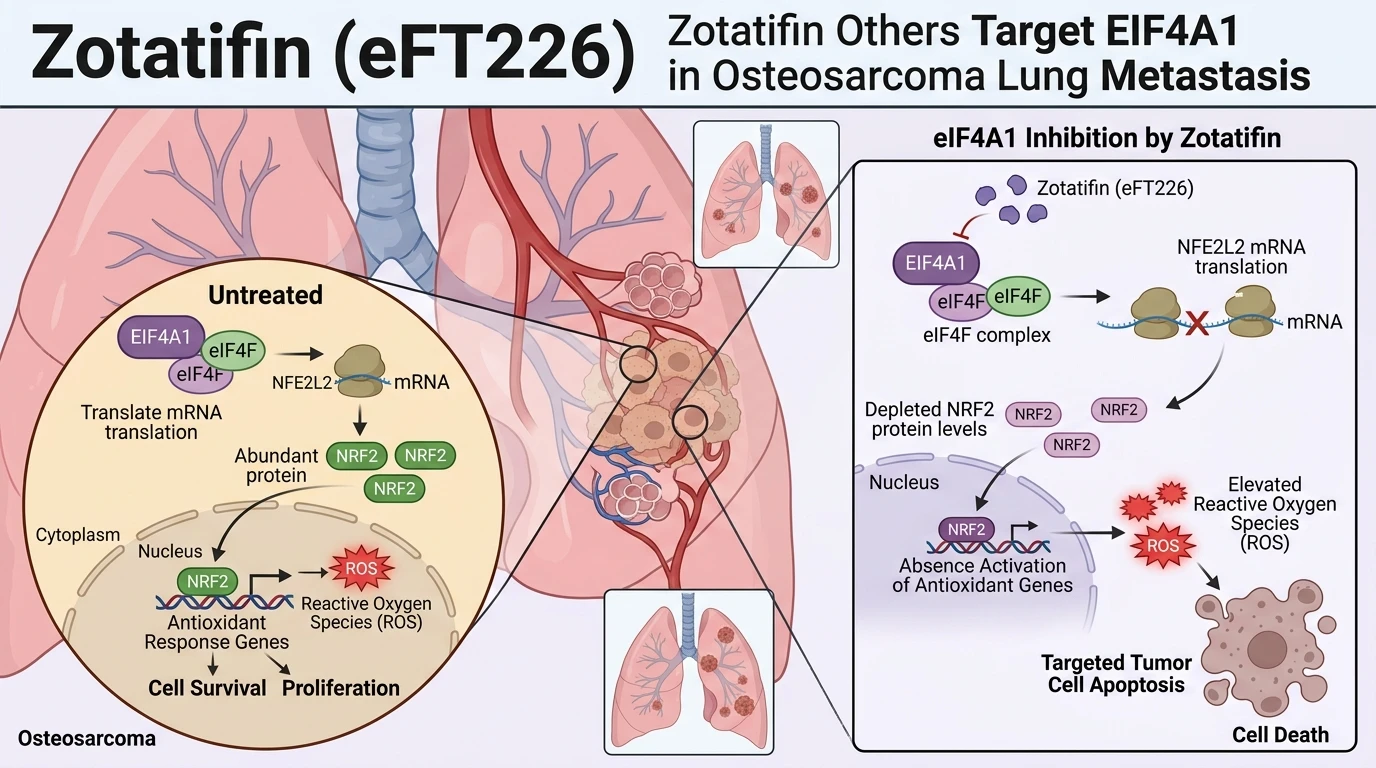
Osteosarcoma (OS) remains the primary malignant bone tumor affecting pediatric and young adult populations. Despite aggressive surgical resection and multi-agent chemotherapy regimens, metastatic disease—predominantly seeding the lung parenchyma—presents a major clinical barrier to long-term survival. Disseminated OS cells encountering the hyperoxic pulmonary environment experience severe oxidative stress. Survival in this metastatic niche requires immediate metabolic adaptation, specifically through the elevation of cell-autonomous antioxidant defenses. Central to this adaptive mechanism is the transcription factor NRF2 (encoded by NFE2L2), which governs the expression of phase II detoxifying enzymes and glutathione biosynthetic machinery. Investigative efforts demonstrate that osteosarcoma cells depend on non-canonical, translational regulation of NFE2L2 mRNA rather than traditional transcriptional activation to withstand acute redox stress during pulmonary colonization.
The eukaryotic translation initiation factor 4A1 (EIF4A1) functions as an ATP-dependent RNA helicase within the heterotrimeric eIF4F complex. EIF4A1 unwinds complex secondary structures in the 5 prime untranslated regions (5 prime UTRs) of selective mRNAs, enabling efficient scanning by the 43S pre-initiation complex. Transcriptomic and proteomic profiling across patient-derived osteosarcoma tissue panels reveals marked overexpression of EIF4A1, which correlates directly with poor event-free and overall patient survival. Mechanistic assays demonstrate that NFE2L2 transcripts harbor highly structured 5 prime UTR sequence motifs requiring EIF4A1 unwinding for efficient translation. When metastatic OS cells undergo pulmonary extravasation, EIF4A1 activity drives rapid, preferential translation of NFE2L2 mRNA, elevating NRF2 protein abundance within minutes without alterations in steady-state transcript levels.
Pharmacological intervention using small-molecule EIF4A1 inhibitors, including the sequence-selective clinical candidate Zotatifin (eFT226) and related molecular probes in the class of Zotatifin Others, disrupts this adaptive axis. Zotatifin (eFT226) acts as an allosteric translation inhibitor that promotes sequence-specific binding between EIF4A1 and specific polypurine sequences in target mRNAs, effectively trapping the helicase on the transcript and stalling translation initiation. In preclinical assays, low-nanomolar administration of Zotatifin (eFT226) blunts NRF2 protein synthesis in OS cell lines. Notably, this inhibitory effect occurs at concentrations that preserve global protein translation rates, establishing a distinct therapeutic index.
The downstream biological consequences of EIF4A1 blockade are directly tied to the oxidative burden of the metastatic microenvironment. In vitro culture under normoxic conditions or exogenous hydrogen peroxide challenge reveals that EIF4A1 inhibition causes rapid accumulation of intracellular reactive oxygen species (ROS). Without de novo synthesis of NRF2, OS cells fail to induce essential antioxidant effectors, including heme oxygenase-1 (HO-1) and NAD(P)H quinone dehydrogenase 1 (NQO1). This failure of redox buffering triggers lipid peroxidation, mitochondrial membrane depolarization, and activation of caspase-dependent apoptotic pathways.
In orthotopic and intravenous xenograft mouse models of osteosarcoma, administration of Zotatifin (eFT226) effectively impedes lung colonization and suppresses the expansion of established micrometastases. Quantitative bioluminescence and histological analyses demonstrate a significant reduction in pulmonary metastatic burden compared to vehicle-treated controls. Crucially, normal host tissues exhibit minimal toxicity under effective dosing schedules, reflecting the unique dependency of colonizing tumor cells on EIF4A1-mediated NRF2 synthesis. These findings highlight EIF4A1 as a key translational bottleneck and demonstrate the efficacy of targeted helicase inhibition in preventing metastatic outgrowth in osteosarcoma.
Translational Control of Redox Homeostasis in Metastatic Outgrowth
Copy code to add this image to your page
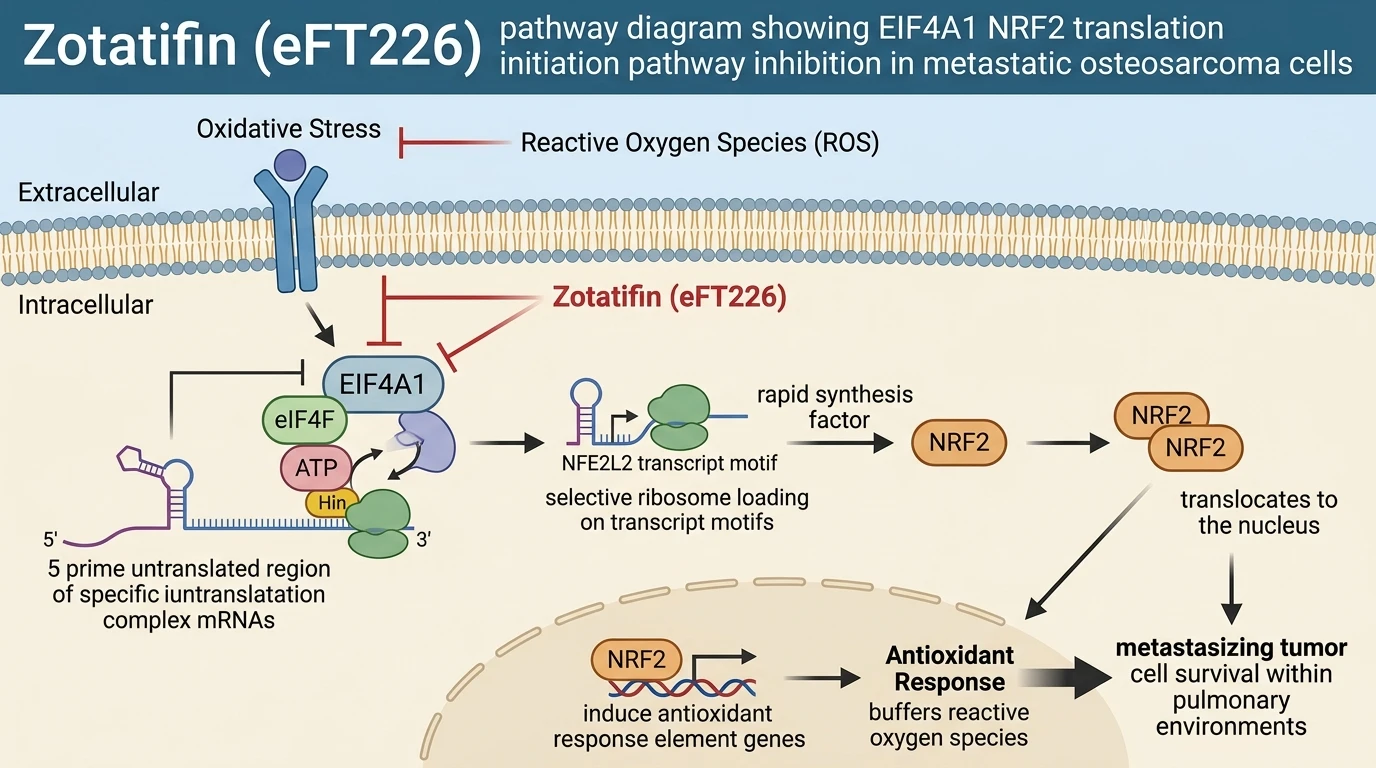
Zotatifin (eFT226) selectively inhibits the ATP-dependent RNA helicase EIF4A1, blocking ribosome unwinding of structured NFE2L2 mRNA leader sequences. This selective blockade halts NRF2 protein translation without inducing global protein synthesis suppression at therapeutic doses. Deficient NRF2 synthesis impairs the transcription of antioxidant genes, elevating cellular reactive oxygen species within the oxidative lung microenvironment. Consequently, osteosarcoma cells fail to adapt to oxidative stress during metastatic seeding, leading to selective induction of apoptosis and inhibition of lung colonization.
EIF4A1 Helicase Activity Directs NFE2L2 mRNA Translation
Osteosarcoma cells face severe oxidative stress during pulmonary colonization. Disseminated metastatic clusters adapt by accelerating de novo synthesis of NRF2 through EIF4A1-dependent translation initiation rather than transcriptional upregulation. Helicase activity unwinds complex mRNA leader sequences. Under standard physiological conditions, normal somatic tissues maintain minimal baseline expression of this translation factor, limiting non-specific translational toxicity. Target selectivity remains high at nanomolar concentrations. Treatment with Zotatifin (eFT226) stalls ribosome assembly specifically on polypurine motifs present within the NFE2L2 5 prime untranslated region.
Selective Translational Inhibition Sensitizes Colonizing Cells to Redox Stress
Pharmacological inhibition blunts the endogenous antioxidant response. In murine tail-vein pulmonary metastasis models, administration of Zotatifin (eFT226) alongside related analogs classified under Zotatifin Others markedly decreased metastatic lung burden without overt system toxicity. Intracellular reactive oxygen species levels surged rapidly. Deprived of NRF2-mediated cytoprotection, osteosarcoma cells exhibit increased lipid peroxidation and subsequent apoptotic signaling within the oxidative alveolar microenvironment. Global translation rates remained largely unperturbed. These empirical findings establish that target engagement of EIF4A1 creates a therapeutic window based on differential translational dependency.