Enzastaurin Inhibits PKCβ and JAK1 Signaling Cascades in Non-Small-Cell Lung Cancer
Copy code to add this image to your page
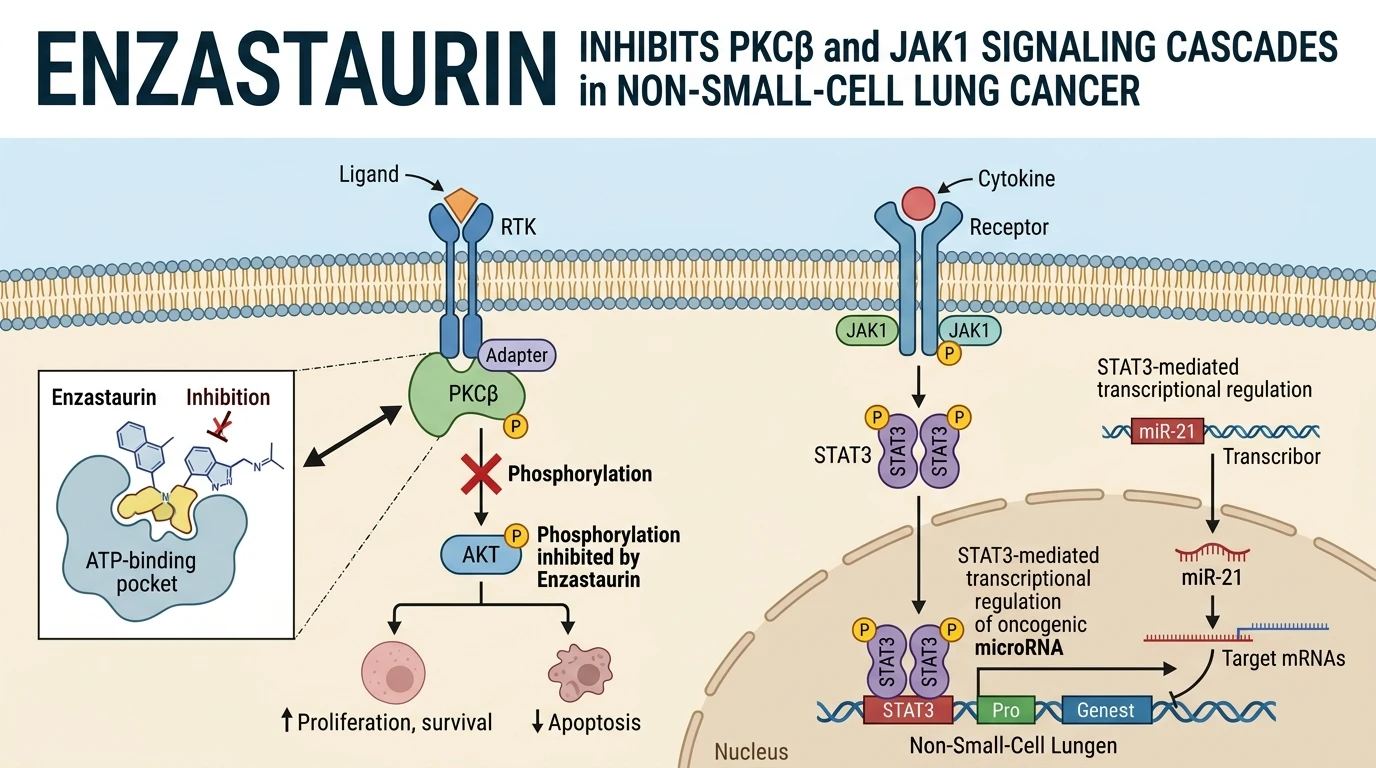
Enzastaurin (LY317615) is an acyclic bisindolylmaleimide compound synthesized as an ATP-competitive inhibitor of serine/threonine protein kinases, exhibiting preferential affinity for the beta isoform of protein kinase C (PKCβ). Biochemical characterization in cell-free kinase assays demonstrates low nanomolar inhibitory activity against PKCβ, with selective binding within the ATP-binding cleft of the kinase domain. The canonical signaling pathway downstream of PKCβ involves activation of phosphatidylinositol 3-kinase (PI3K) effector nodes, which subsequently catalyze the phosphorylation of AKT at serine 473. Attenuation of AKT phosphorylation disrupts intracellular survival signals, promoting mitochondrial membrane depolarization and initiating caspase-dependent apoptotic pathways in dependent tumor models.
In non-small-cell lung cancer (NSCLC) preclinical models, functional drug responsiveness extends beyond isolated PKCβ suppression. Screening across diverse human NSCLC cell lines demonstrated significant variance in antiproliferative susceptibility. Systematic transcriptomic profiling and signal pathway mapping revealed a critical interaction involving the Janus kinase (JAK) and signal transducer and activator of transcription (STAT) signaling axis. Specifically, elevated baseline expression of Janus kinase 1 (JAK1) correlates strongly with enhanced sensitivity to target inhibition. Cell populations characterized by active JAK/STAT3 signaling exhibit distinct vulnerability to drug treatment, challenging the assumption that single-target expression alone determines therapeutic response.
Comprehensive bioinformatic analysis identified a distinct eight-gene expression signature capable of predicting sensitivity to kinase suppression. This predictive panel comprises JAK1, DUSP1, ILF3, LITAF, COPS7B, RAD23A, TNFAIP1, and MIRN21 (encoding microRNA-21/TMEM49). Within this transcript network, STAT3-mediated activation of miR-21 functions as a key molecular driver of cell survival. High baseline expression of miR-21, alongside elevated transcript levels of vascular endothelial growth factor receptors VEGFR2 and VEGFR3, defines a cellular phenotype highly sensitive to growth inhibition. Functional validation experiments confirmed the mechanistic requirement of JAK1 in conferring drug sensitivity. Forced ectopic expression of JAK1 in resistant NSCLC lines restored sensitivity to growth arrest. Conversely, short hairpin RNA (shRNA) knockdown or small-molecule co-inhibition of JAK1 reduced drug-induced growth arrest, establishing that JAK1 expression functions as an active predictive biomarker rather than a passive marker of tumorigenesis.
These functional observations indicate that elevated JAK1 signaling establishes an oncogenic dependence state that sensitizes cells to secondary target blockade. Historical data from clinical trials evaluating kinase signaling inhibitors highlight the necessity of biomarker-guided patient selection strategies in oncology. Rather than functioning exclusively as an isolated PKCβ inhibitor, the molecule disrupts an integrated signaling node where PKCβ-driven AKT phosphorylation and JAK/STAT3 activation intersect. In patient-derived lung cancer models under tested in vitro assay conditions, baseline expression profiling of the eight-gene panel delivered superior predictive accuracy compared to single-gene evaluation.
Cellular responses to kinase inhibitors depend heavily on internal signaling topology and compensatory feedback circuits. In NSCLC models overexpressing JAK1, exposure to the compound induces rapid dephosphorylation of downstream AKT at Ser473, accompanied by reduced transcriptional output of anti-apoptotic miR-21. This combined suppression of survival cascades leads to sustained cell cycle arrest at the G1/S transition boundary. Quantitative Western blot analysis confirmed rapid suppression of signaling downstream of PKCβ at physiologically relevant concentrations. These findings clarify target selectivity mechanics in complex cellular systems, illustrating how cross-pathway signaling density dictates pharmacological susceptibility.
Predictive Biomarkers and Mechanism of Targeted Growth Inhibition
Copy code to add this image to your page
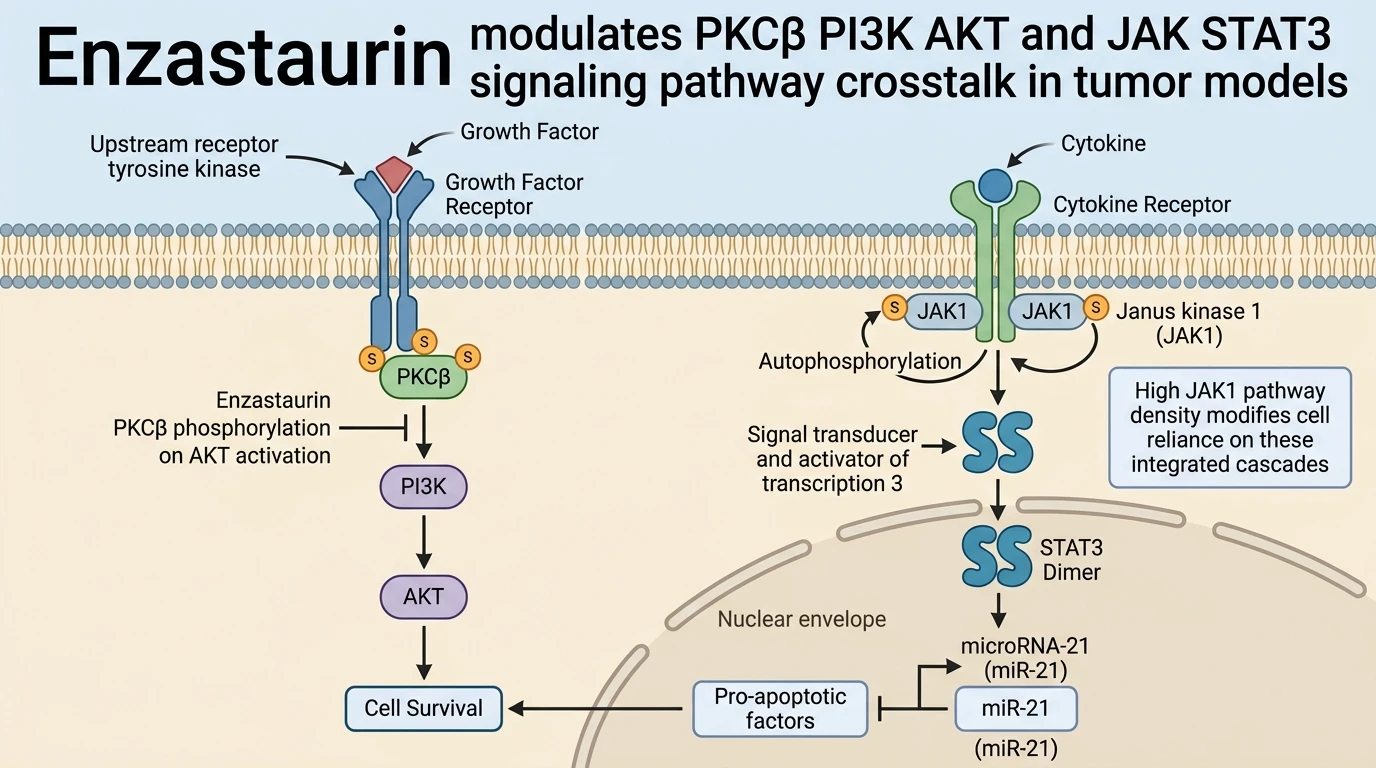
Enzastaurin suppresses tumor growth by inhibiting PKCβ ATP-binding, directly blocking downstream PI3K/AKT activation and phosphorylation. In non-small-cell lung cancer models, high baseline expression of JAK1 and STAT3-mediated induction of miR-21 amplifies cellular reliance on this signaling hub, enhancing sensitivity to kinase inhibition. An eight-gene expression signature—including JAK1, DUSP1, and MIRN21—serves as a predictive marker, where elevated JAK1, VEGFR2, and VEGFR3 levels correlate with enhanced growth suppression and apoptotic induction under experimental conditions.
JAK1 Expression Levels Govern Cellular Sensitivity to Kinase Inhibition
Cellular context dictates small-molecule efficacy. In non-small-cell lung cancer models displaying elevated JAK1 expression, Enzastaurin achieved marked growth arrest at sub-micromolar concentrations. Downstream phosphorylation of AKT at Ser473 decreased sharply upon drug exposure. Conversely, knock-down of JAK1 via short hairpin RNA attenuated the antiproliferative response. The dependency on JAK1 suggests an oncogenic addiction state tied to hyperactive cytokine signaling. This biochemical coupling creates a distinct therapeutic vulnerability in selected cell populations under tested assay conditions.
An Eight-Gene Expression Signature Predicts Drug Sensitivity in Vitro
Transcriptomic profiling delineated a discrete multigene response panel. The eight-gene signature—comprising JAK1, DUSP1, ILF3, LITAF, COPS7B, RAD23A, TNFAIP1, and MIRN21—correlated tightly with drug response across tested cell panels. Elevated levels of miR-21 directly mirrored STAT3 transactivation metrics. Inhibitor challenge disrupted this regulatory loop effectively. Consequently, apoptotic markers increased within 48 hours of administration in sensitive lines. These empirical observations establish a functional framework for transcript-based patient selection.
Vascular Endothelial Growth Factor Receptors Parallel Sensitivity Profiles
Co-expression of angiogenic targets mirrors overall drug responsiveness. Specifically, VEGFR2 and VEGFR3 transcript levels exhibited positive correlation with Enzastaurin sensitivity metrics. Target binding assays confirmed primary activity against PKCβ, while collateral attenuation of receptor tyrosine kinase cascades occurred. Xenograft models sustained reduced microvascular density following structured dosing schedules. Tumor volume progression slowed measurably. These experimental outcomes reinforce the functional interplay between kinase inhibition and microenvironmental signaling.