BRM/BRG1 ATP Inhibitor-1 (BRM014) BRM/BRG1 ATP Inhibitor-1 inhibitor selective target engagement of tick RmTIM
Copy code to add this image to your page
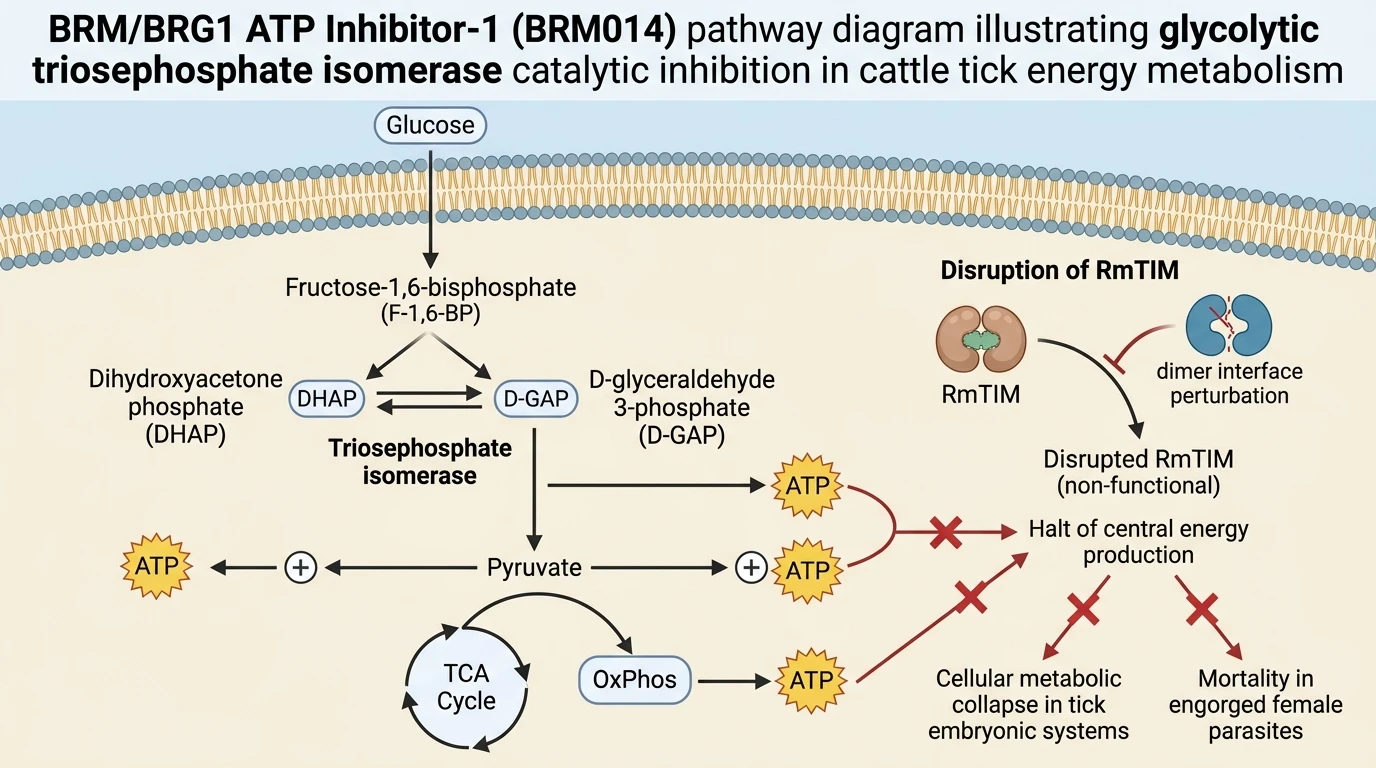
Targeting essential metabolic enzymes in vectors offers a precise biochemical route for antiparasitic intervention. Triosephosphate isomerase from Rhipicephalus microplus (RmTIM) plays an indispensable role in maintaining glycolytic throughput during cattle tick development. In this pathway, RmTIM catalyzes the interconversion of dihydroxyacetone phosphate and D-glyceraldehyde 3-phosphate. Inhibiting this enzymatic step deprives parasite tissues of downstream pyruvate production and oxidative ATP generation. The compound BRM/BRG1 ATP Inhibitor-1 (BRM014) serves as a key reference entity in pharmacological screening platforms. When evaluating target specificity, researchers assessed BRM/BRG1 ATP Inhibitor-1 inhibitor analogues against a library of 227 synthetic small molecules to identify potent RmTIM modulators.
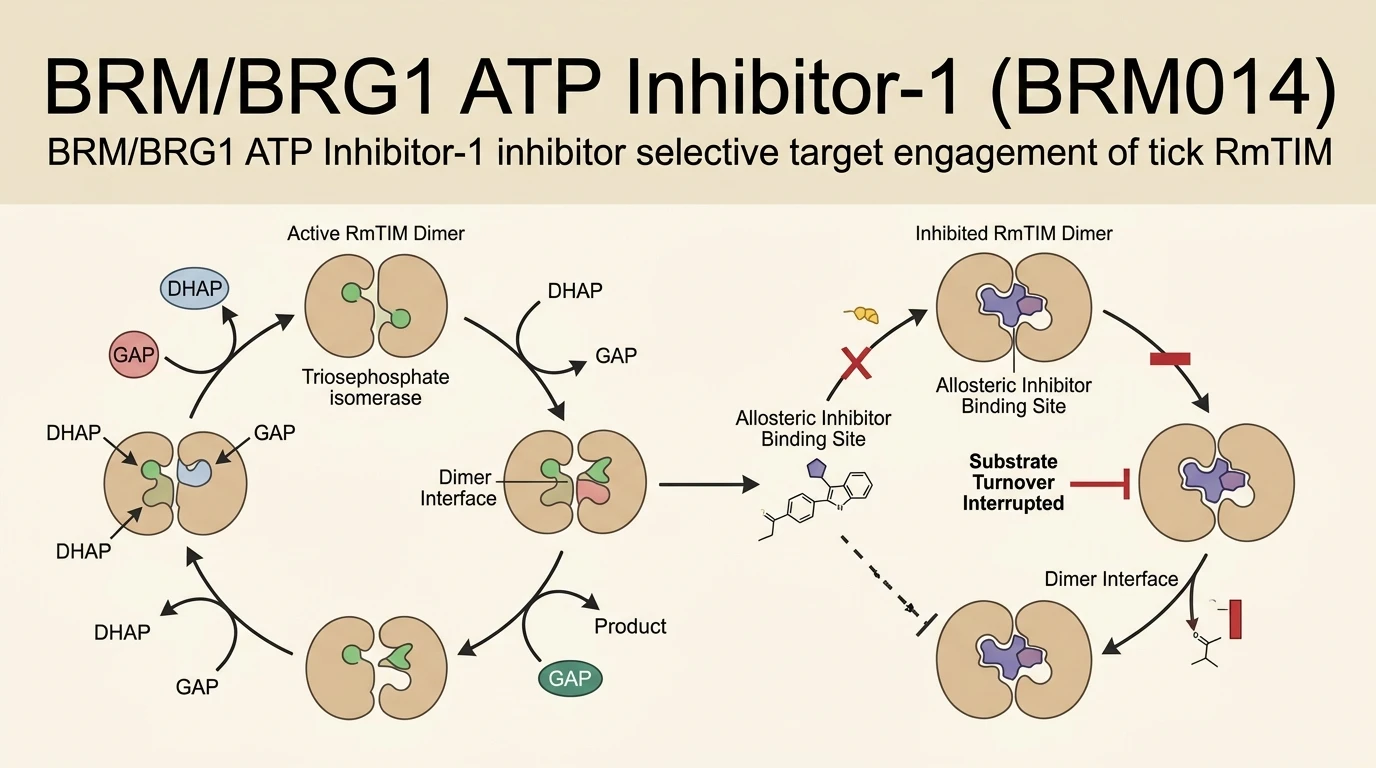
Assay screens identified four primary hit molecules—compounds 14, 50, 98, and 161—that inhibited recombinant RmTIM enzymatic activity with IC50 values spanning 25 to 50 µM under standard buffer conditions. Crucially, these molecules exhibited minimal cross-reactivity against orthologous mammalian enzymes, including human and rabbit TIM isoforms. High selectivity margins were maintained at test concentrations up to 100 µM. Advanced structural analysis of protein interfaces indicated that target selectivity stems from critical residue variations along the dimer interface between species. Molecular docking of compound 14 demonstrated preferential binding into an allosteric pocket located at the interface of the two identical polypeptide chains of the RmTIM homodimer.
Disruption of dimer association alters catalytic loop mobility, destabilizing active site geometry without requiring direct active site occupation. In tick embryonic cell lines (BME26), treatment with compounds 14, 50, and 98 at 50 µM decreased cellular viability by more than 50% after 48 hours of continuous exposure. To evaluate physiological efficacy in whole organisms, in vivo capillary feeding assays were executed using partially engorged female Rhipicephalus microplus ticks. Administration of compound 14 led to 100% mortality within the cohort, confirming that metabolic blockade of RmTIM produces fatal phenotypic outcomes in active parasite populations.
Selective Enzyme Inhibition and In Vivo Acaricidal Validation
Copy code to add this image to your page
Selective inhibition of Rhipicephalus microplus triosephosphate isomerase (RmTIM) targets tick energy metabolism. Compound 14 binds at the homodimer interface, perturbing active site geometry and blocking glycolytic flux. This selective interface engagement yields potent acaricidal efficacy while sparing host orthologs.
Selective Inhibition of RmTIM Across Synthetic Compound Libraries
Enzymatic screening of 227 synthetic small molecules identified four lead candidates displaying selective activity against recombinant RmTIM. Compounds 14, 50, 98, and 161 inhibited catalytic substrate conversion with half-maximal inhibitory concentration (IC50) values measured between 25 and 50 µM. Comparative kinetic profiling against rabbit and human triosephosphate isomerase orthologs revealed negligible inhibitory effects at equivalent dosing ranges. Mammalian enzymes remained largely uninhibited under identical assay buffers; this high selectivity ratio highlights structurally distinct binding sites specific to the tick enzyme.
Dimer Interface Binding and Embryonic Cytotoxicity Profiles
Molecular docking simulations established that compound 14 targets a hydrophobic cavity situated precisely at the protein's homodimeric interface. Engagement at this non-catalytic contact region alters the quaternary stability of the enzyme complex. Cellular viability assays using the BME26 embryonic tick cell line demonstrated marked cytotoxic sensitivity. Treatment with compounds 14, 50, and 98 at a uniform concentration of 50 µM reduced embryonic cell survival by over 50%. The observed cell death aligns with severe glycolytic suppression following structural interface perturbation.
Acaricidal Efficacy in Parasitic Capillary Feeding Assays
Translational studies evaluated compound 14 in an active organism model using capillary feeding techniques on partially engorged female ticks. Direct oral ingestion of compound 14 yielded complete cohort mortality at tested experimental doses. Phenotypic mortality occurred within a defined 72-hour observation window. Treated female ticks exhibited systemic tissue breakdown secondary to energetic collapse. The complete lethality observed in vivo establishes interface-directed RmTIM inhibitors as viable prototypes for acaricide development.