IWR-1-endo Wnt/beta-catenin inhibitor Sustains Pluripotency via Tankyrase-Mediated AXIN Stabilization in ESCs
Copy code to add this image to your page
Derivation and long-term expansion of pluripotency-competent embryonic stem cells (ESCs) in non-rodent mammalian species have historically presented significant technical hurdles. In sheep models, maintaining embryonic stem cells in an undifferentiated, naive-like state requires precise control over cellular signaling pathways that govern self-renewal and lineage specification. Canonical WNT/β-catenin signaling serves as a central molecular switch in embryonic development. Activation of this pathway typically promotes lineage commitment or cell-type specific differentiation, depending on cellular context and microenvironmental cues. To suppress unwanted spontaneous differentiation, targeted inhibition of canonical WNT signaling has emerged as a crucial pharmacological strategy.
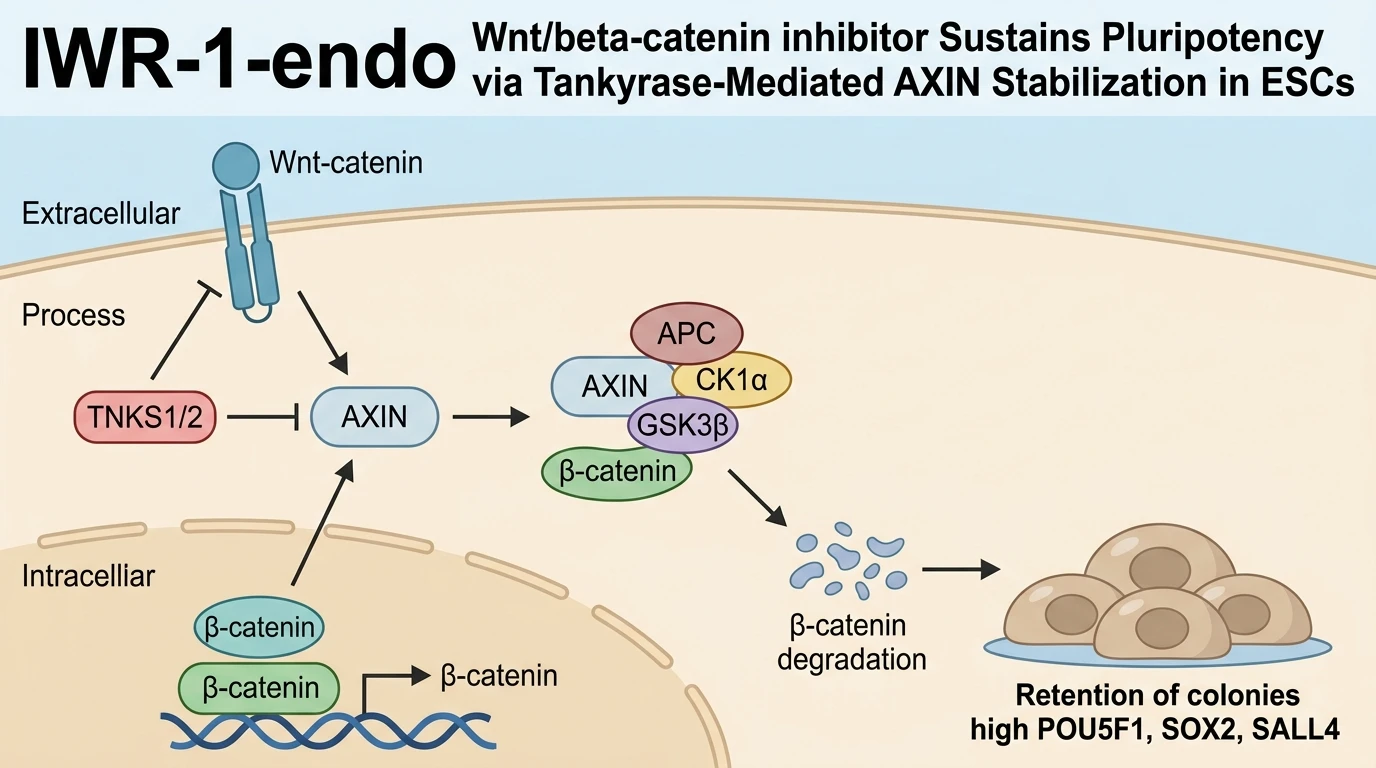
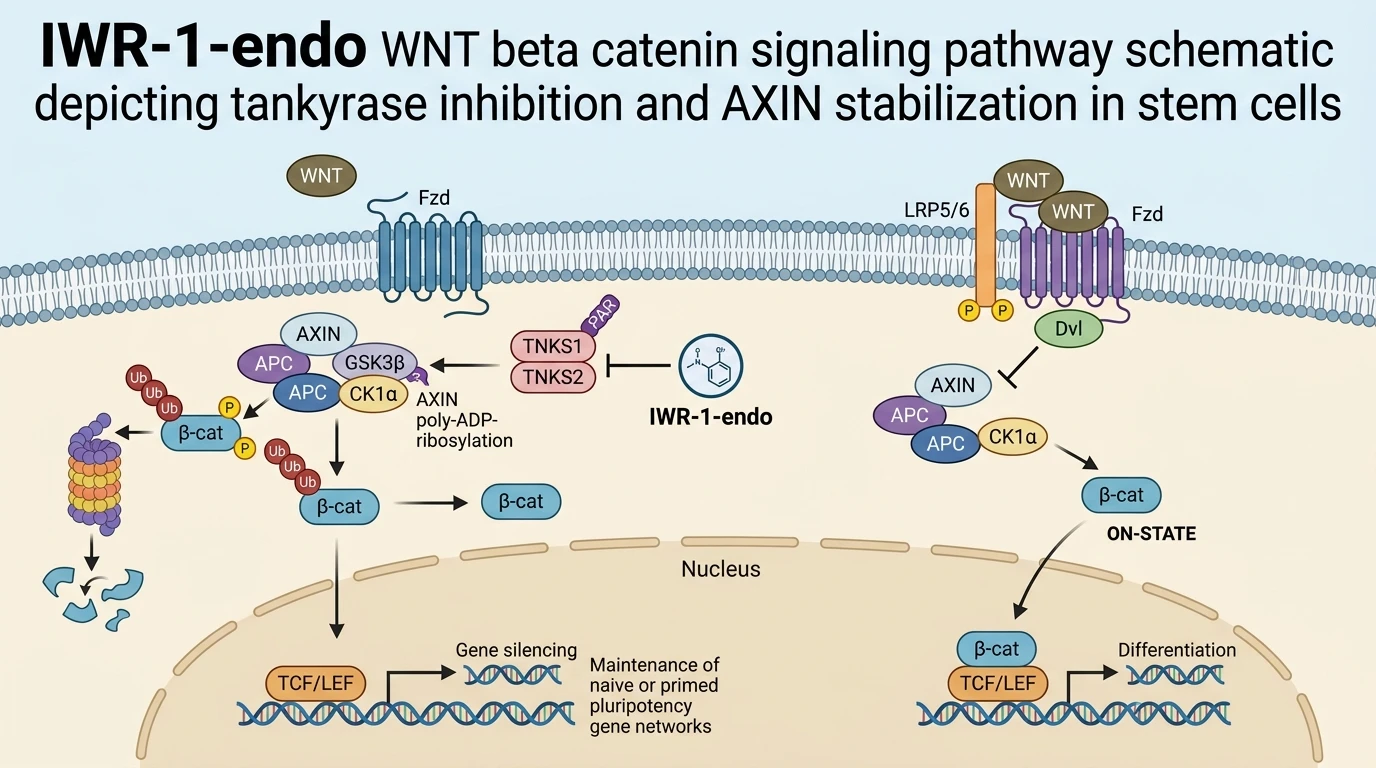
At the center of this pathway regulation are tankyrase 1 and tankyrase 2 (TNKS1/TNKS2), enzymes belonging to the poly(ADP-ribose) polymerase (PARP) superfamily. Under basal conditions with active tankyrase function, TNKS1/2 catalyze the poly-ADP-ribosylation (PARsylation) of AXIN, the rate-limiting scaffold protein within the β-catenin destruction complex. PARsylated AXIN is subsequently recognized by the E3 ubiquitin ligase RNF146, directing AXIN toward proteasomal degradation. The resulting destruction of AXIN disrupts assembly of the multi-protein destruction complex—composed of AXIN, adenomatous polyposis coli (APC), glycogen synthase kinase 3 beta (GSK3β), and casein kinase 1 alpha (CK1α). Without functional destruction complex assembly, unphosphorylated β-catenin accumulates in the cytoplasm, translocates to the nucleus, and forms transcriptionally active complexes with TCF/LEF factors to initiate lineage-specific gene programs.
Pharmacological interception using IWR-1-endo alters this signaling cascade by binding selectively to the catalytic domain of TNKS1 and TNKS2. By inhibiting tankyrase-mediated PARsylation, IWR-1-endo prevents AXIN degradation, leading to a marked intracellular accumulation of functional AXIN scaffold proteins. The stabilized AXIN efficiently recruits APC, GSK3β, and CK1α, restoring assembly of the β-catenin destruction complex. Cytoplasmic β-catenin is sequentially phosphorylated at Ser45 by CK1α and at Thr41/Ser37/Ser33 by GSK3β. Phosphorylated β-catenin is recognized by the β-TrCP ubiquitin ligase complex, facilitating its rapid degradation via the 26S proteasome. Consequently, nuclear transactivation of TCF/LEF target genes is effectively blunted.
In recent experimental studies, this biochemical inhibition was exploited to establish stable sheep embryonic stem cells, designated TePR-sESCs. Culture conditions utilized a simplified medium (TePR) comprised of commercial mTeSR PLUS supplemented with the small molecule IWR-1-endo. Under these optimized conditions, ovine ESCs maintained a classic naive-like, undifferentiated dome-shaped colony morphology. The cells demonstrated robust self-renewal kinetics and maintained genomic stability across extended propagation exceeding 100 continuous passages. Molecular analysis confirmed sustained, high-level expression of core pluripotency transcription factors, including POU5F1 (OCT4), SOX2, and SALL4.
The essential requirement for continuous TNKS1/2 inhibition was validated through chemical withdrawal experiments. When IWR-1-endo was removed from the TePR culture medium, sheep ESCs lost their characteristic dome-shaped morphology within four days, undergoing rapid cellular differentiation. This morphological shift was accompanied by a severe decline in POU5F1, SOX2, and SALL4 gene expression. Importantly, substituting IWR-1-endo with XAV939—a chemically distinct tankyrase inhibitor—fully preserved cell morphology, proliferation rates, and pluripotency gene expression profiles. These comparative observations confirm that tankyrase inhibition and subsequent canonical WNT pathway blockade represent a specific, reproducible mechanism for stabilizing stem cell pluripotency in ovine models.
Pharmacological Tankyrase Inhibition in Ovine Pluripotency Maintenance
Copy code to add this image to your page
IWR-1-endo inhibits tankyrases 1 and 2 (TNKS1/2), preventing the poly-ADP-ribosylation and subsequent proteasomal degradation of the scaffold protein AXIN. Stabilized AXIN preserves the intracellular β-catenin destruction complex, driving constitutive phosphorylation and degradation of free β-catenin. Suppressing canonical WNT/β-catenin transcriptional activation preserves undifferentiated dome-shaped morphology, genomic stability, and pluripotency marker expression (POU5F1, SOX2, SALL4) in sheep embryonic stem cells.
AXIN Stabilization Drives β-Catenin Degradation in Ovine ESCs
Targeting tankyrase isoforms TNKS1 and TNKS2 attenuates canonical signaling. By binding the catalytic PARP domain of tankyrases, the small molecule IWR-1-endo Wnt/beta-catenin inhibitor blocks poly-ADP-ribosylation of the critical scaffold protein AXIN. AXIN degradation is markedly suppressed. Stabilized AXIN promotes assembly of the destruction complex—comprising APC, GSK3β, and CK1α—which systematically phosphorylates free cytosolic β-catenin. Phosphorylated β-catenin undergoes ubiquitin-dependent proteasomal degradation. Attenuated nuclear accumulation of β-catenin prevents TCF/LEF transcriptional activation under tested culture conditions, thereby suppressing differentiation programs.
Sustained Self-Renewal and Genomic Integrity Across Passages
Long-term propagation of sheep embryonic stem cells requires rigid pathway control. Supplementation of mTeSR PLUS medium with IWR-1-endo generates the simplified TePR formulation, which reliably maintains undifferentiated, dome-shaped colony morphology. Proliferation rates remained steady across 100 passages. Cytogenetic evaluations demonstrated persistent chromosomal stability—with no observed aneuploidy—while high expression of pluripotency factors POU5F1, SOX2, and SALL4 persisted throughout extended culture. Stemness markers dropped rapidly upon compound removal.
Reversible Pluripotency Maintenance and Parallels With XAV939
Withdrawal of target inhibition alters cell fate rapidly. Eliminating the inhibitor from culture media triggered spontaneous morphological differentiation accompanied by swift transcriptional downregulation of POU5F1, SOX2, and SALL4 within ninety-six hours. Pluripotency was restored by chemical substitution. Replacing the compound with XAV939—a structurally distinct tankyrase antagonist—fully preserved self-renewal capacity, confirming that TNKS1/2 inhibition drives the observed biological phenotype.