Ralimetinib dimesylate p38 MAPK Inhibition Suppresses Rac3-Driven Invasion in Lung Adenocarcinoma
Copy code to add this image to your page
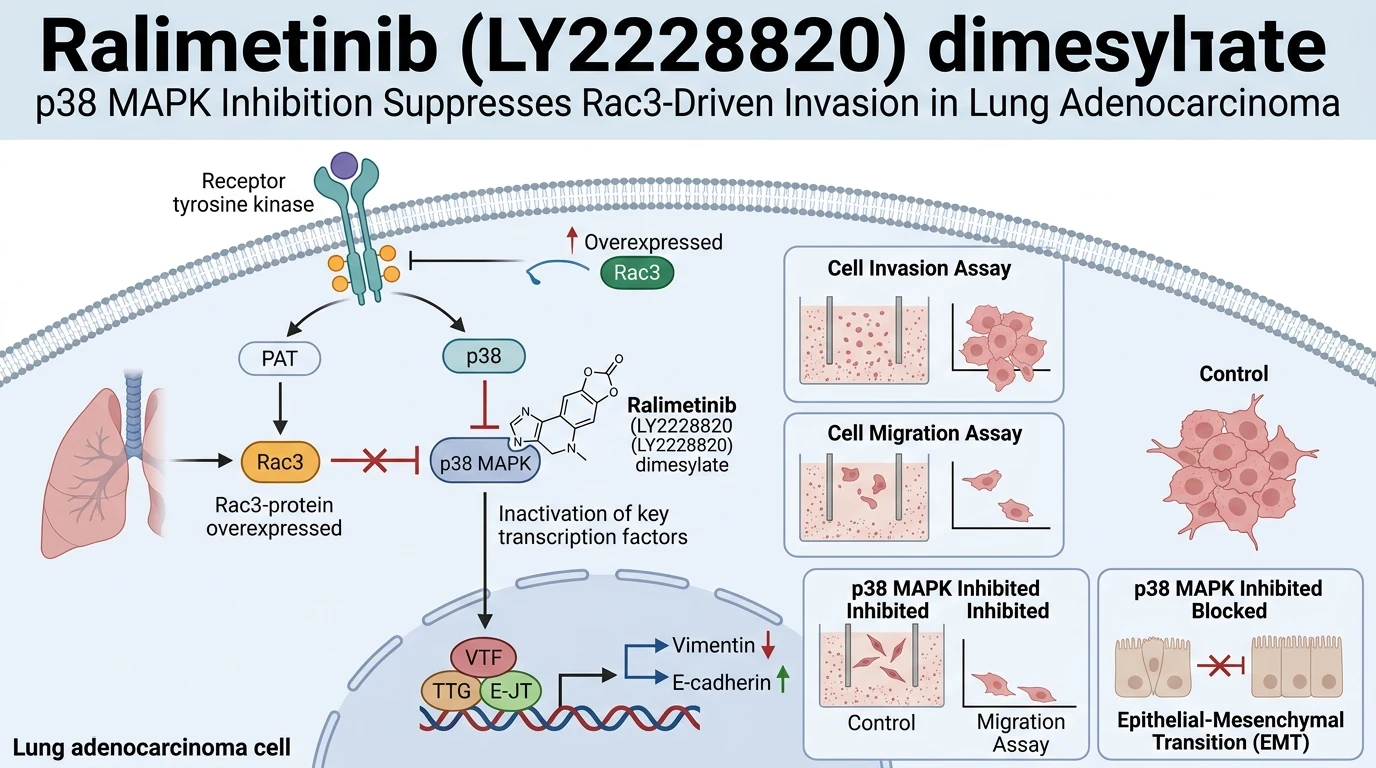
Lung adenocarcinoma exhibits pronounced phenotypic heterogeneity and a high propensity for early metastatic dissemination. Within this malignancy, the small GTPase Rac3—a member of the Rho family of GTP-binding proteins—acts as a key regulator of cytoskeletal dynamics, cell polarization, and motility. Clinical tissue profiling confirms that Rac3 is frequently overexpressed in lung adenocarcinoma specimens compared to adjacent non-neoplastic pulmonary tissue. Elevated Rac3 expression correlates significantly with lymph node involvement, advanced pathological staging, and reduced overall survival metrics in patient cohorts.
Mechanistically, Rac3 hyperactivation stimulates downstream kinase networks that execute epithelial-mesenchymal transition (EMT). EMT represents a fundamental morphogenetic process wherein polarized epithelial cells lose specialized cell-cell junctions, undergo cytoskeletal reorganization, and acquire enhanced invasive potential. In lung adenocarcinoma cell line models, specifically A549 and H1299, elevated Rac3 expression suppresses the transmembrane cell-cell adhesion protein E-cadherin while upregulating the intermediate filament protein vimentin. These altered molecular signatures coincide with heightened cell elongation, membrane ruffling, pseudopod formation, and accelerated migration through Matrigel matrix barriers.
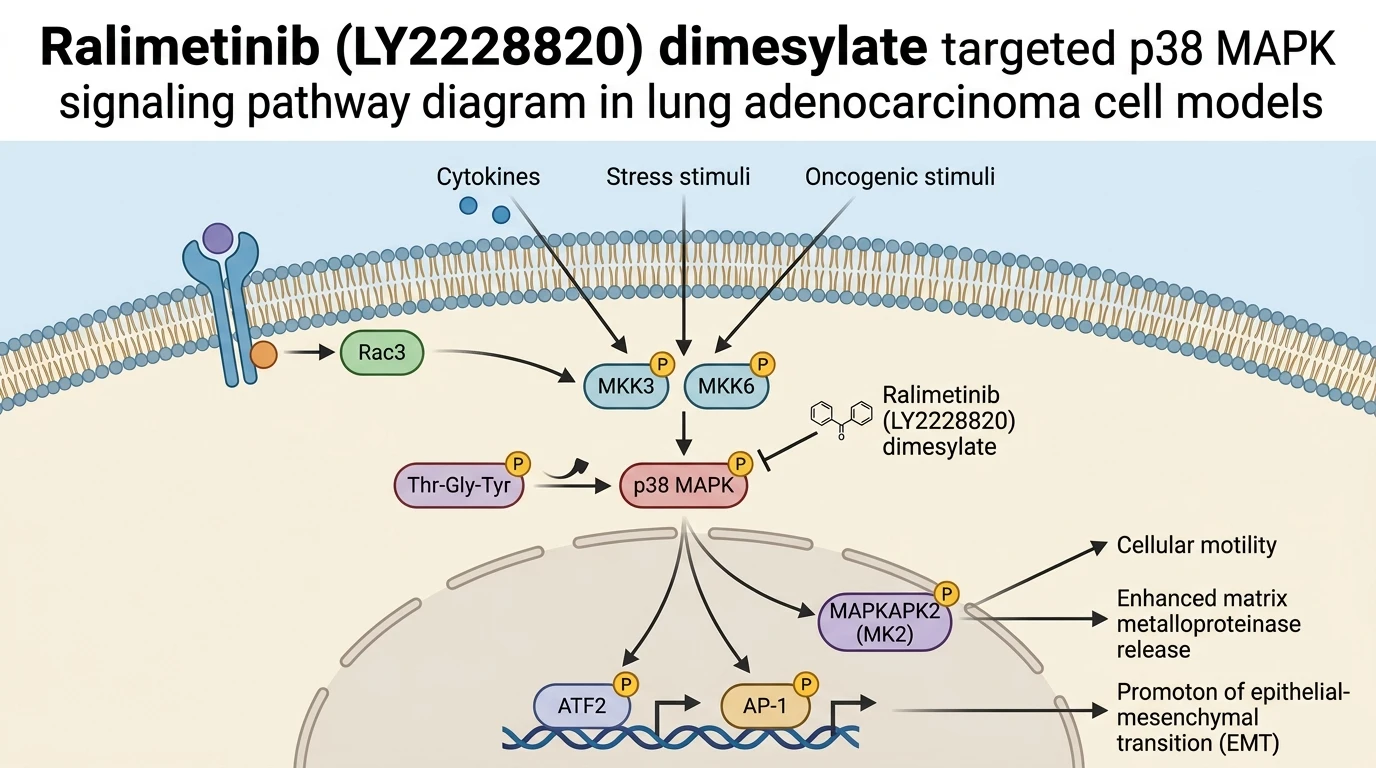
Signal transduction mapping identifies the p38 mitogen-activated protein kinase (p38 MAPK) cascade as the principal effector axis downstream of Rac3. Activated GTP-bound Rac3 promotes upstream kinase signaling, leading to dual phosphorylation of p38 MAPK at its canonical Thr180/Tyr182 activation loop. Once activated, p38 MAPK translocates to cellular subcompartments or directly phosphorylates cytosolic targets such as MAPK-activated protein kinase 2 (MAPKAPK2 or MK2). MK2 downstream targets, including heat shock protein 27 (HSP27), regulate actin filament remodeling, focal adhesion turnover, and transcriptional programs governing cell motility.
Pharmacological intervention targeting this axis has been realized through the small-molecule inhibitor Ralimetinib (LY2228820) dimesylate. As an orally bioavailable, potent ATP-competitive inhibitor, Ralimetinib targets the p38α (MAPK14) and p38β (MAPK11) kinase isoforms with high selectivity. Direct binding of Ralimetinib dimesylate p38 MAPK complexes prevents ATP binding, blocking catalytic phosphorylation of substrate proteins without altering total p38 MAPK expression levels. Under tested in vitro assay conditions, treatment with Ralimetinib (LY2228820) dimesylate yields rapid, dose-dependent inhibition of downstream MK2 phosphorylation in lung adenocarcinoma models.
Structural characterization indicates that Ralimetinib occupies the ATP-binding pocket of p38 MAPK, inducing a localized conformational change that stabilizes the inactive kinase state. Bioreactive assays demonstrate low nanomolar IC50 values against p38α and p38β isoforms, with high selectivity over related mitogen-activated protein kinases including ERK1/2 and JNK isoforms. At physiologically relevant concentrations in cellular models, this high target selectivity minimizes off-target kinase inhibition. Consequently, the observed suppression of migration and mesenchymal marker expression can be definitively attributed to target-specific p38 MAPK inhibition rather than collateral kinase blockade.
In experimental paradigms utilizing Rac3-overexpressing A549 and H1299 cells, treatment with LY2228820 effectively reverses Rac3-induced phenotypic changes. Quantitative immunoblotting and immunofluorescence analyses confirm that LY2228820 administration upregulates E-cadherin expression, re-establishing cell-cell boundary architecture. Simultaneously, the inhibitor reduces vimentin expression levels, disrupting the intermediate filament structural network required for mesenchymal cell migration.
Functional cell motility assays further substantiate these biochemical observations. In transwell invasion and scratch-wound closure experiments, treatment with LY2228820 markedly decreases cell migration velocities and invasive cell counts in both A549 and H1299 cell lines. Genetic knockdown experiments using small interfering RNA (siRNA) targeting Rac3 mirror the phenotypic outcomes achieved through p38 MAPK inhibition. Parallel studies combining Rac3 silencing with LY2228820 treatment reveal no additive inhibitory effects, indicating that Rac3 operates through the same p38 MAPK pathway to promote cellular motility.
These experimental observations establish that Rac3 drives epithelial-mesenchymal transition and invasive potential predominantly through p38 MAPK signaling. Small-molecule inhibition using Ralimetinib (LY2228820) dimesylate effectively uncouples Rac3 overactivation from downstream invasive phenotype execution, highlighting the clinical relevance of targeting p38 MAPK in Rac3-overexpressing lung adenocarcinomas.
Pharmacological Evaluation and Mechanistic Characterization in Lung Adenocarcinoma
Copy code to add this image to your page
Rac3 overexpression in lung adenocarcinoma activates the p38 MAPK signaling axis, triggering epithelial-mesenchymal transition (EMT), cellular migration, and tissue invasion. Small-molecule inhibition using Ralimetinib (LY2228820) dimesylate selectively disrupts p38 MAPK activity. This target engagement blocks downstream phosphorylation cascades, leading to the upregulation of the epithelial marker E-cadherin and the downregulation of mesenchymal vimentin. Consequently, pharmacological p38 MAPK inhibition reverses Rac3-driven metastatic phenotypes in A549 and H1299 lung adenocarcinoma models, establishing p38 MAPK as a viable therapeutic target.
Rac3 Overexpression Promotes Mesenchymal Phenotypes in LUAD
In cell culture models of lung adenocarcinoma, high expression of Rac3 correlates directly with enhanced cell motility. A549 and H1299 cells overexpressing Rac3 exhibit distinct morphological alterations. Cell borders lose tight junction contacts; concurrently, cytoplasmic extensions elongate significantly. Quantitative protein analyses show marked downregulation of E-cadherin in Rac3-high cellular contexts. Conversely, vimentin levels rise sharply. Cellular invasion through synthetic basement membranes increases by more than twofold under these conditions. These cellular changes reflect classical epithelial-mesenchymal transition dynamics.
Targeted p38 MAPK Inhibition Restores Epithelial Marker Expression
Application of Ralimetinib (LY2228820) dimesylate blocks p38 MAPK catalytic activity in a concentration-dependent manner. Downstream MK2 phosphorylation ceased rapidly following inhibitor administration. In A549 and H1299 models, treatment with the small molecule reverses Rac3-driven gene expression programs. E-cadherin protein levels increase significantly within 24 hours of exposure. Vimentin expression decreases concomitantly. Utilizing Ralimetinib dimesylate p38 MAPK target engagement effectively restores epithelial characteristics in treated cell populations. Cell-cell junctional integrity is visibly re-established in immunofluorescence microscopy assays.
Attenuation of Transwell Migration and Matrigel Invasion
Functional invasion assays confirm the phenotypic consequences of kinase inhibition. Ralimetinib treatment reduces A549 cell migration across scratch wounds in vitro. In H1299 cells, Matrigel transwell invasion drops markedly at nanomolar inhibitor concentrations. Selectivity assays confirm that these anti-migratory effects depend on p38 MAPK blockade rather than generalized cytotoxicity. Cellular viability remained intact across experimental treatment windows. Observations in these cell lines validate p38 MAPK as an essential node driving Rac3-mediated metastatic behaviors in lung adenocarcinoma models.