dTAG-13 dTAG13 from Selleck Mediates Targeted CDK2 and CDK5 Degradation In Vivo
Copy code to add this image to your page
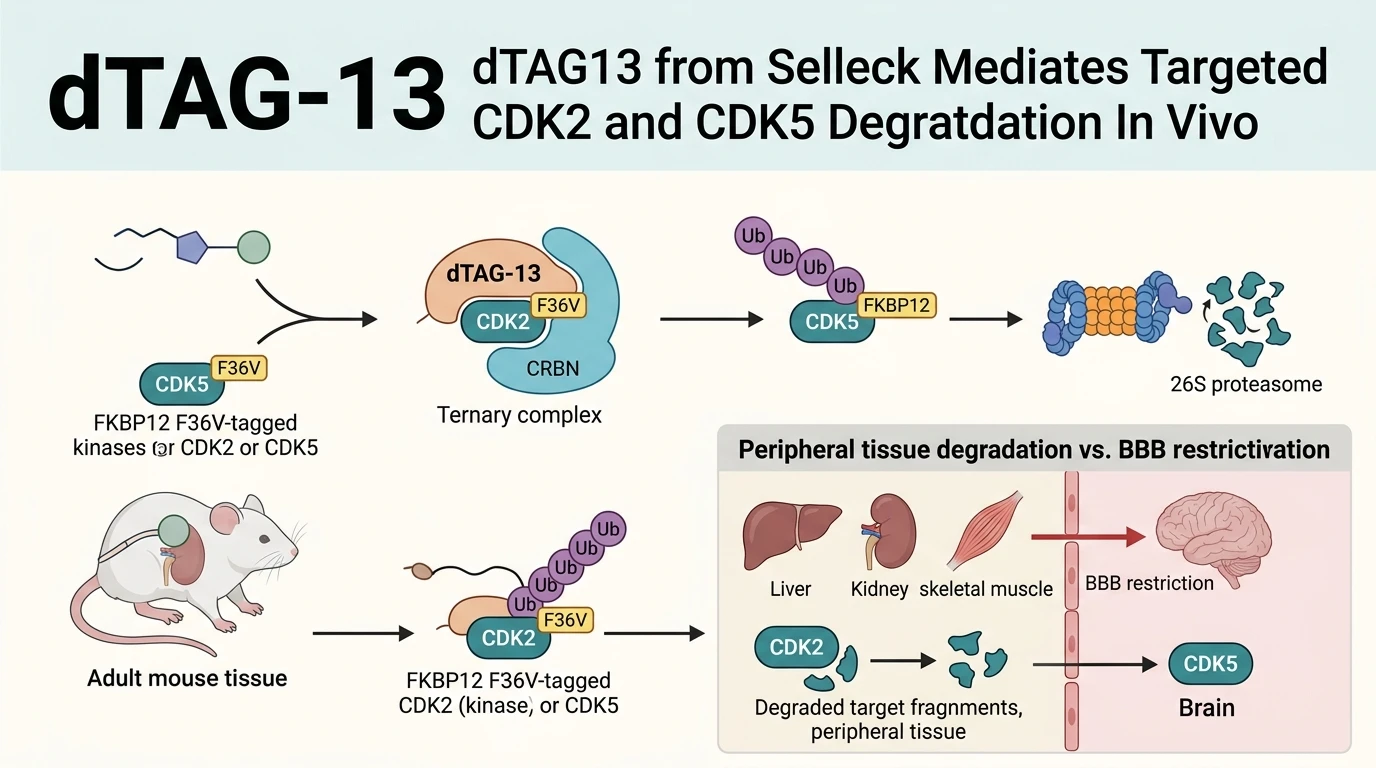
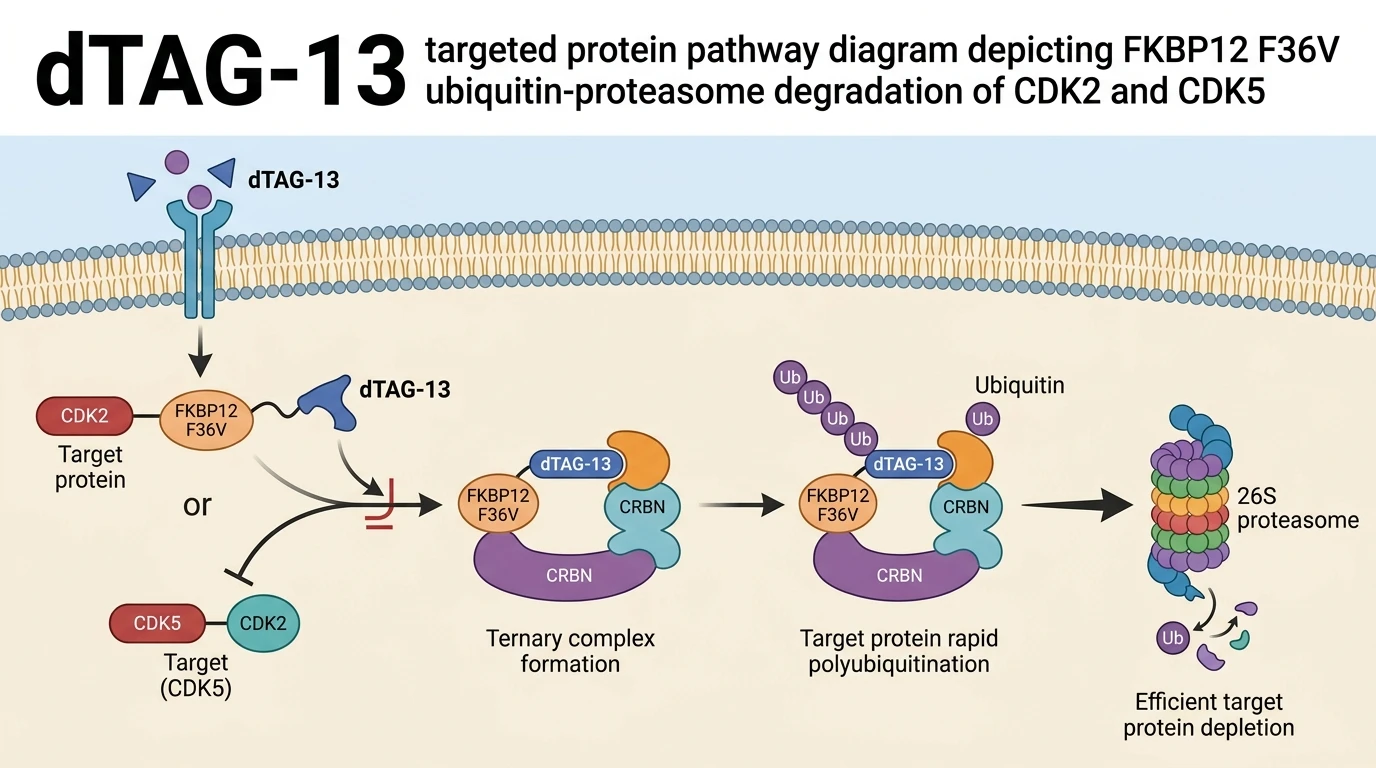
Targeted protein degradation through the degradation TAG (dTAG) system provides a powerful approach for acute target validation. The heterobifunctional molecule dTAG-13 selectively engages the mutated FKBP12 F36V domain fused to target proteins—such as cyclin-dependent kinase 2 (CDK2) or cyclin-dependent kinase 5 (CDK5)—and recruits the E3 ubiquitin ligase component cereblon (CRBN). This event initiates proximity-induced polyubiquitination followed by rapid 26S proteasome-mediated degradation. Detailed molecular structural data regarding the chemical properties of dTAG-13 outline its bifunctional Architecture, which bridges the mutant FKBP12 domain with CRBN.
In recent in vivo studies utilizing adult CDK2-dTAG and CDK5-dTAG knock-in mouse lines, daily subcutaneous administration of dTAG-13 produced marked target protein depletion across multiple peripheral organs. Systemic exposure resulted in efficient target degradation within hepatic, renal, cardiac, and splenic tissues. Target depletion occurred rapidly following administration. Notably, immunoblotting of brain tissue lysates revealed that target protein levels remained stable within central nervous system compartments. This outcome confirms that dTAG-13 does not cross the intact blood-brain barrier at the administered dose levels; peripheral tissues, however, exhibited profound target depletion.
Evaluating target dispensability in adult organisms is critical for assessing potential safety liabilities prior to clinical lead optimization. Systemic degradation of CDK2 or CDK5 in adult knock-in mice failed to induce unexpected macroscopic toxicity or lethality. Histological examination of somatic tissues confirmed normal tissue architecture following multi-week dosing regimens. Furthermore, high-throughput RNA sequencing of peripheral organs showed negligible transcriptional alterations, indicating that acute degradation of CDK2 or CDK5 does not provoke widespread transcriptional stress or off-target gene expression compensation under tested assay conditions.
The phenotypic alterations observed following dTAG-13 administration were highly tissue-specific and fully consistent with genetic knock-out paradigms. Continuous CDK2 depletion in adult male mice resulted solely in testicular germ cell depletion—a phenotype previously established in germline CDK2 null models. Other somatic tissues showed no microstructural anomalies. Similarly, systemic CDK5 degradation was well tolerated across non-neuronal adult organs. These findings demonstrate that CDK2 and CDK5 function is largely dispensable in adult peripheral tissues under physiological conditions. Consequently, the dTAG platform represents a robust, highly specific tool for target derisking and functional characterization in vivo.
In Vivo Pharmacological Evaluation and Tolerability Profiles
Copy code to add this image to your page
dTAG-13 acts as a bifunctional degrader recruiting the CRBN E3 ubiquitin ligase complex to FKBP12 F36V-tagged target proteins, such as CDK2 or CDK5. This binding induces proximity-dependent polyubiquitination and subsequent 26S proteasomal degradation, enabling precise in vivo target validation.
Systemic Proteasomal Clearance Excludes Central Nervous System Tissues
Daily subcutaneous administration of dTAG13 from Selleck induced rapid target protein degradation across peripheral organ systems. Hepatic and renal tissues showed robust target depletion. Brain parenchymal samples, in contrast, retained baseline CDK5-dTAG levels. This divergence reflects the compound's inability to cross an intact blood-brain barrier at tested therapeutic doses; consequently, central nervous system targets remain pharmacologically shielded.
Targeted Disruption Identifies Tissue-Specific On-Target Testicular Toxicity
Proteomic and transcriptomic profiling demonstrated that systemic CDK2 and CDK5 clearance induced minimal transcriptomic disruption in adult somatic organs. Hepatic, renal, and cardiac tissues maintained normal histological architecture throughout the administration period. However, prolonged CDK2 degradation produced profound testicular germ cell depletion—an expected phenotype aligned with germline ablation studies. These empirical findings confirm that adult somatic tissues tolerate acute CDK2 or CDK5 loss without compensatory transcriptional rewiring.