RMC-7977 Pan-RAS Inhibition Suppresses MAPK Signaling in Acral Melanoma
Copy code to add this image to your page
Acral melanoma (AM) represents a distinct subtype of melanoma characterized by unique genomic alterations and clinical behavior. In an admixed Brazilian cohort, genomic and functional profiling reveals a relatively low burden of single-nucleotide variants. Instead, AM genomes display striking focal copy-number amplifications, frequently termed genomic hailstorms. These amplified regions harbor key oncogenic drivers that sustain tumor growth. Establishing patient-derived xenograft (AM-PDX) models and matched cell lines allowed high-throughput functional screenings. Through CRISPR/Cas9 loss-of-function and targeted pharmacological assays, researchers identified core cellular dependencies. Tumors exhibited distinct sensitivities to perturbations in CDK4/6, MDM2, WEE1, and the mitogen-activated protein kinase (MAPK) pathway.
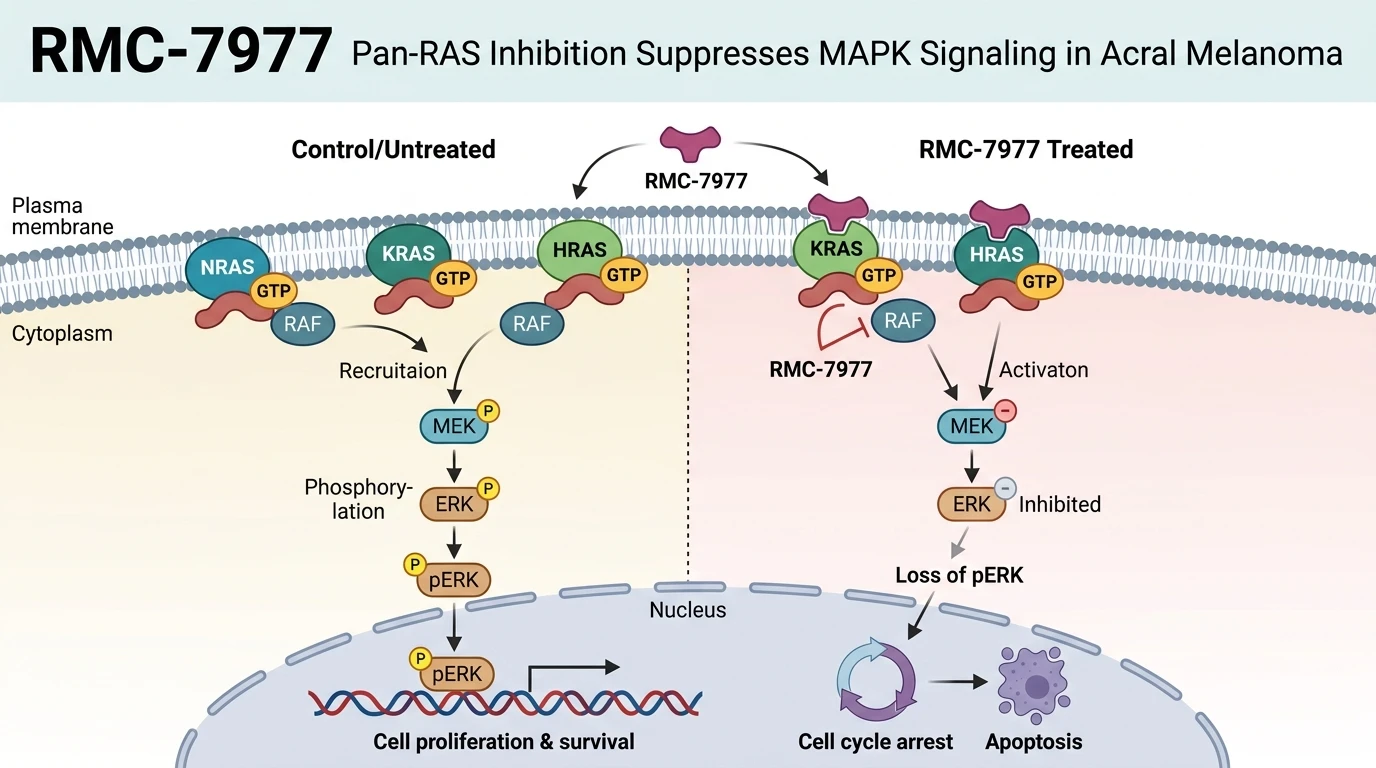
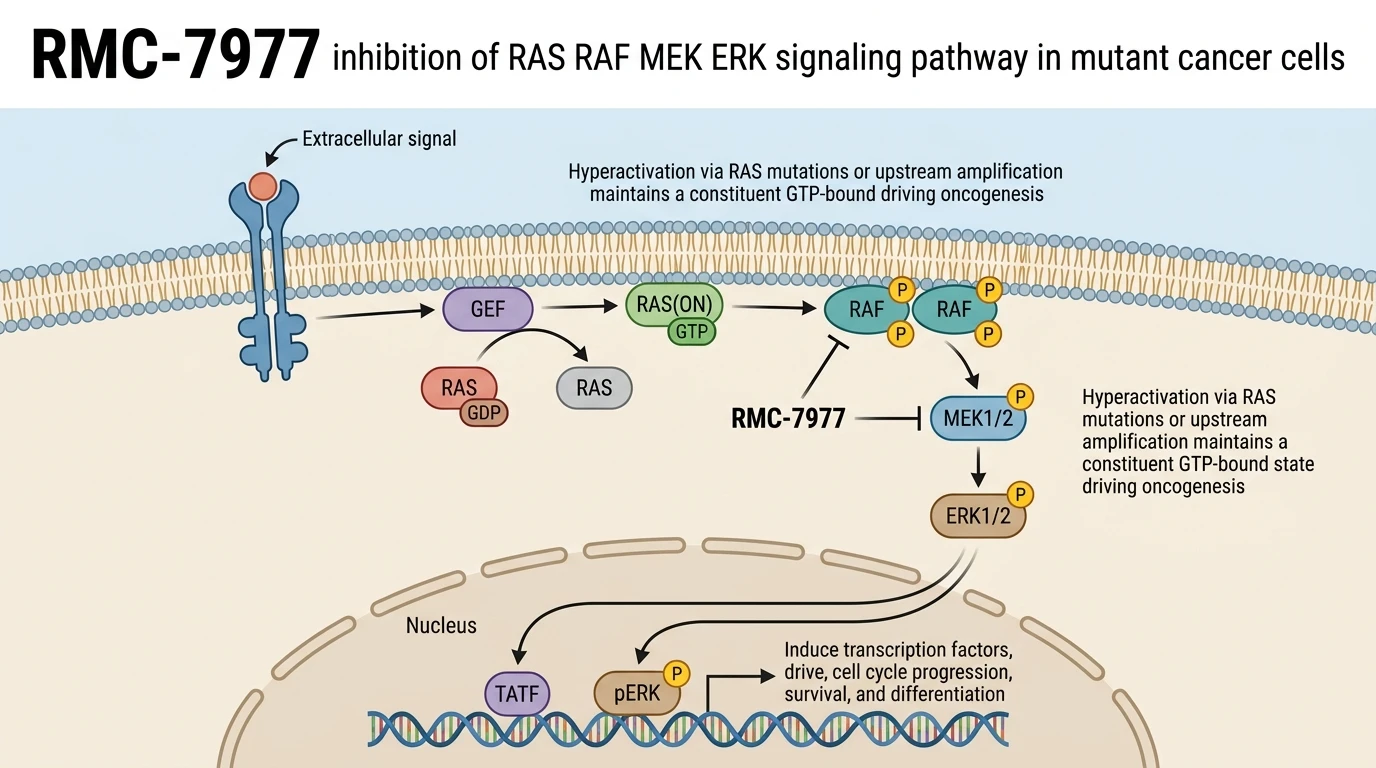
Downstream signaling through the canonical MAPK cascade remains a critical executioner of proliferation in AM. Canonical activation relies on GTP-bound state transition across classical RAS isoforms—NRAS, KRAS, and HRAS. Small-molecule intervention using RMC-7977 targets this active RAS(ON) conformation. Unlike isoform-selective monovalent inhibitors restricted to GDP-bound states, RMC-7977 engages active GTP-bound RAS across all major isoforms. Mechanistically, this broad-spectrum active-state engagement breaks effector recruitment. Binding to GTP-bound NRAS, KRAS, or HRAS sterically blocks interaction with RAF kinase domain monomers. Consequently, downstream phosphorylation of MEK1/2 and ERK1/2 ceases rapidly.
Quantitative biochemical assays demonstrate profound suppression of phosphorylated ERK (pERK) following treatment with RMC-7977. At nanomolar concentrations, the inhibitor depletes pERK levels in patient-derived models harboring NRAS, KRAS, or KIT mutations. KIT-mutant lines often rely on receptor tyrosine kinase activation to drive downstream RAS GTP loading. Interruption of active RAS complexes downstream of mutant KIT confirms that active-state RAS inhibition bypasses upstream receptor heterogeneity. Suppression of MAPK activity triggers cell cycle arrest. Furthermore, sustained pERK depletion engages apoptotic machinery, modulating key survival regulators such as BCL2 family proteins.
In patient-derived xenograft cell models, pharmacological suppression of active RAS translates directly into diminished clonogenic growth and reduced cellular viability. In vitro proliferation assays show dose-dependent growth arrest across distinct mutational subsets. Observations within these patient-derived cell models suggest that active RAS state inhibition overcomes redundant signaling loops that often compromise single-node kinase inhibitors. The broad efficacy observed in NRAS-, KRAS-, and KIT-mutant backgrounds highlights pan-RAS(ON) inhibition as a mechanistically sound therapeutic approach for acral melanoma, where alternative targeted options remain scarce.
Pharmacological Characterization and Target Dependency in Acral Melanoma
Copy code to add this image to your page
RMC-7977 is a reversible pan-RAS inhibitor targeting the active, GTP-bound ON state of NRAS, KRAS, and HRAS. By binding active RAS complexes, RMC-7977 disrupts interaction with downstream RAF effectors, preventing MEK and ERK phosphorylation. In acral melanoma models, this target engagement leads to rapid loss of pERK accumulation, cell cycle arrest, and initiation of apoptotic cell death across NRAS-, KRAS-, and KIT-mutant genetic backgrounds.
Focal Amplifications and Core MAPK Dependencies in Acral Melanoma
Genomic architecture in acral melanoma differs substantially from cutaneous subtypes. High-resolution profiling reveals low point-mutation frequency coupled with focal chromosomal hail storms. Functional CRISPR/Cas9 screens identified driver dependencies along the MAPK axis, beside secondary nodes including CDK4/6, MDM2, and WEE1. Disruption of MAPK signaling severely impairs tumor expansion. Small-molecule inhibition of this cascade demonstrates high selectivity in patient-derived models.
Potent pERK Depletion in Mutant Melanoma Lines
The pan-RAS(ON) inhibitor RMC-7977 engages GTP-bound RAS isoforms directly. Active GTP-bound NRAS, KRAS, and HRAS are bound with high affinity within the effector binding domain. Under tested in vitro assay conditions, treatment with RMC-7977 completely eliminated pERK accumulation. Downstream signal transduction stalled within hours of exposure. This blockade holds across NRAS-mutant, KRAS-mutant, and KIT-amplified cell lines. In contrast to inactive-state inhibitors, active-state targeting prevents receptor-mediated GTP loading feedback.
Apoptotic Cell Death Induction Across Variable Mutational Contexts
Continuous suppression of MAPK signaling precipitates profound biological consequences in acral melanoma cell lines. Exposure to RMC-7977 triggers G1 phase cell cycle arrest followed by activation of caspase cascades. Viability assays confirmed marked reduction in colony formation and cell survival. These observations reflect target-specific activity rather than general off-target cytotoxicity. Within this cellular context, blocking active RAS state provides a potent strategy against biologically aggressive acral melanoma phenotypes.