E7080 (Lenvatinib) VEGFR inhibitor targeting multi-kinase signaling cascades in advanced hepatocellular carcinoma
Copy code to add this image to your page
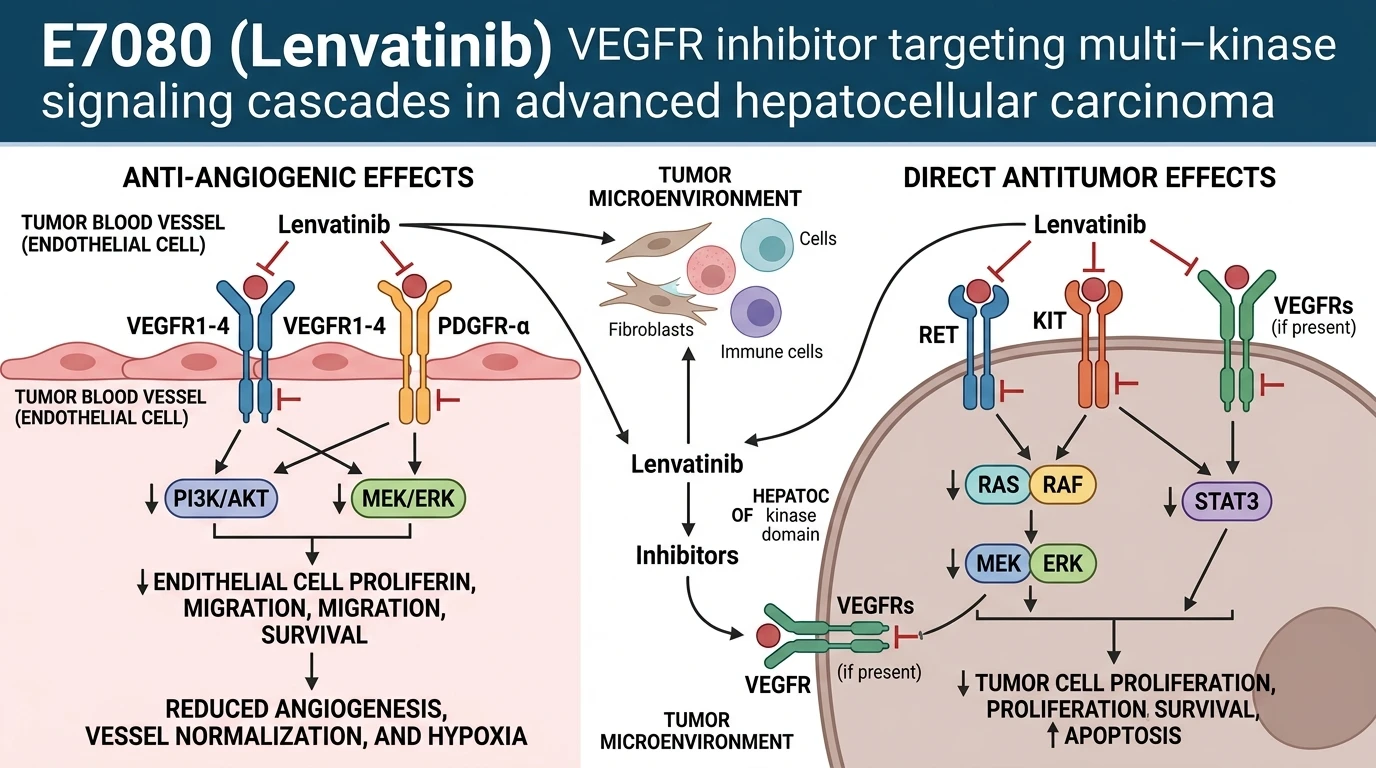
Receptor tyrosine kinase signaling drives tumor vascularization and oncogenic cell proliferation in unresectable hepatocellular carcinoma (u-HCC). Vascular endothelial growth factor receptors (VEGFR1-4), platelet-derived growth factor receptor alpha (PDGFR-alpha), RET, and KIT constitute key catalytic nodes governing these pathogenic cascades. Small-molecule inhibition of these enzymatic domains disrupts extracellular signal transduction into intracellular phosphorylation networks. Within this target spectrum, the multi-target tyrosine kinase inhibitor E7080 (Lenvatinib) demonstrates distinct binding kinetics across VEGFR1-4, PDGFR-alpha, RET, and KIT kinase domains. Structural studies indicate a binding mode that locks the kinase domain in an inactive conformation, leading to prolonged target residence time relative to traditional ATP-competitive inhibitors.
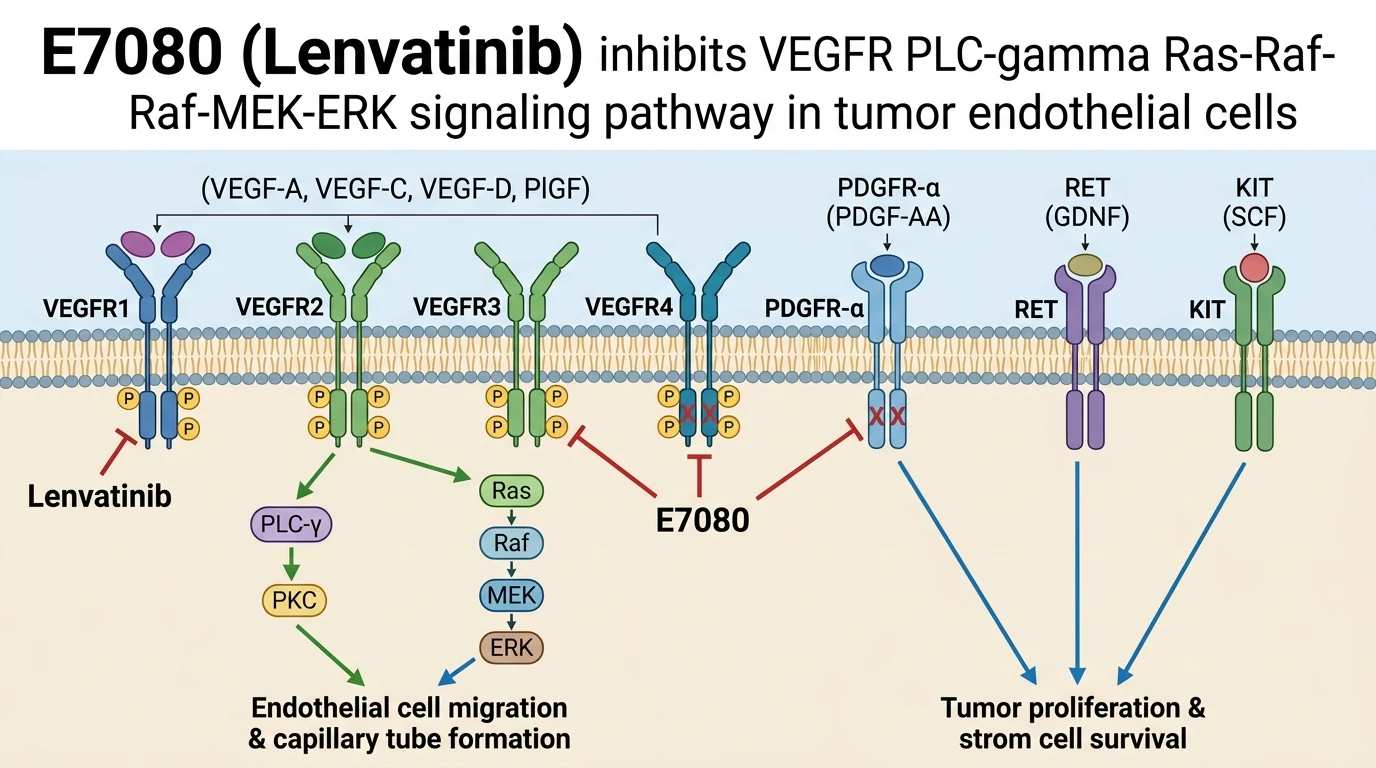
Structural and biochemical characterization reveals that E7080 (Lenvatinib) acts as a potent inhibitor of VEGFR family kinases. Receptor dimerization upon ligand binding triggers autophosphorylation of critical tyrosine residues within the cytoplasmic domain. The compound occupies the ATP-binding pocket of VEGFR1, VEGFR2, and VEGFR3, effectively competing with cellular ATP. This competitive occupancy prevents downstream trans-phosphorylation events necessary for enzyme activation. Downstream signaling nodes, including the phospholipase C-gamma (PLC-gamma) and protein kinase C (PKC) pathways, exhibit immediate suppression upon receptor engagement. Consequently, endothelial cell proliferation, migration, and capillary tube assembly are halted within the microenvironment. In addition, VEGFR4 inhibition modulates lymphatic endothelial sprouting, influencing interstitial fluid dynamics inside solid tumor masses.
In parallel to vascular targeted effects, E7080 (Lenvatinib) targets PDGFR-alpha, RET, and KIT receptor tyrosine kinases. PDGFR-alpha activation supports tumor stroma formation and pericyte recruitment around nascent blood vessels. RET and KIT activation directly stimulate intracellular RAS-RAF-MEK-ERK and PI3K-AKT signaling cascades inside malignant hepatocytes. Dual inhibition of stromal and parenchyma-derived receptor tyrosine kinases addresses both tumor microenvironment maintenance and cell-intrinsic proliferation. In patient-derived hepatocellular carcinoma models, simultaneous inhibition of these distinct receptor families yields greater suppression of downstream ERK phosphorylation than selective single-receptor blockade. Microvascular density within murine xenograft models decreases significantly following oral administration, confirming the compound's potent anti-angiogenic activity.
Clinical implementation of TKIs in advanced u-HCC frequently faces limitations due to acquired or intrinsic therapeutic resistance. Prior exposure to first-line agents such as sorafenib often induces secondary resistance pathways or alters receptor expression profiles. A multicenter real-world study evaluated therapeutic efficacy and safety parameters in 77 patients with u-HCC treated with lenvatinib. The trial design stratified the patient population into two distinct sub-groups: TKI-naive patients (n=33) and TKI-experienced patients (n=44). Clinical response metrics were assessed at 4 weeks and 12 weeks using standardized mRECIST criteria to capture both tumor shrinkage and intratumoral necrosis.
Overall response rate (ORR) and disease control rate (DCR) reached 38.5% and 80.8% at the 4-week mark across all evaluated patients. At 12 weeks, ORR stood at 32.4% while DCR remained robust at 70.3%. Comparative efficacy metrics demonstrated near-identical disease control irrespective of prior treatment history. Progression-free survival rates at 12 weeks were 80.4% in the TKI-naive group versus 80.1% in the TKI-experienced group. Overall survival rates at 12 weeks reached 96.7% in TKI-naive patients and 92.3% in TKI-experienced patients.
Adverse event monitoring identified hand-foot skin reaction, fatigue, and loss of appetite as the primary treatment-related toxicities. These adverse events were predominantly Grade 1 or 2 in severity and proved manageable through standard supportive interventions or dose adjustments. The incidence and severity of toxicity did not increase significantly in patients with prior TKI exposure. Within this observational cohort, E7080 (Lenvatinib) VEGFR inhibitor efficacy remained consistent regardless of line of therapy, establishing its real-world utility in advanced hepatocellular carcinoma management.
Real-World Efficacy and Pharmacological Tolerability Synthesis
Copy code to add this image to your page
E7080 (Lenvatinib) acts as a potent multi-target tyrosine kinase inhibitor targeting VEGFR1-4, PDGFR-alpha, RET, and KIT. By binding the ATP-binding pocket of these receptor tyrosine kinases, it blocks ligand-induced autophosphorylation and suppresses downstream RAS-RAF-MEK-ERK and PI3K-AKT signaling networks. This inhibition impedes endothelial cell migration, microvascular sprout formation, and direct tumor cell proliferation in unresectable hepatocellular carcinoma.
Equivalent Disease Control Across Prior Exposure Strata
Therapeutic options for unresectable hepatocellular carcinoma remain constrained by refractory disease biology. Prior treatment with systemic TKIs frequently alters kinase expression profiles. In this real-world multicenter cohort, treatment with E7080 (Lenvatinib) demonstrated high clinical activity across both treatment-naive and pre-treated patient subpopulations. The overall response rate was measured at 38.5% during the initial 4-week assessment window, driven by rapid vascular normalization and direct intratumoral necrosis. Cellular viability dropped sharply upon target engagement. The 4-week disease control rate reached 80.8% across the entire cohort. At 12 weeks, disease control remained high at 70.3%. The observed response rates suggest sustained target inhibition over prolonged dosing intervals. Importantly, prior exposure to sorafenib did not attenuate therapeutic responsiveness.
Superimposable Survival Parameters and Managed Adverse Profiles
Progression-free survival at 12 weeks showed no statistically significant divergence between groups. TKI-naive patients achieved an 80.4% survival rate; TKI-experienced patients reached 80.1%. Overall survival metrics remained similarly aligned at 96.7% and 92.3%, respectively. The target selectivity margin remained intact. Hand-foot skin reaction, fatigue, and appetite loss constituted the most common adverse events. These events were managed via protocol-defined dose interruptions or step-down modifications. Downstream signaling inhibition did not precipitate unexpected cumulative toxicities in pre-treated individuals. These empirical metrics confirm that E7080 (Lenvatinib) VEGFR inhibitor maintains its pharmacodynamic efficacy and safety profile regardless of prior receptor tyrosine kinase inhibitor exposure.