EIPA (L593754) EIPA Sodium Channel inhibitor Inefficacy in Deltacoronavirus Entry Pathways
Copy code to add this image to your page
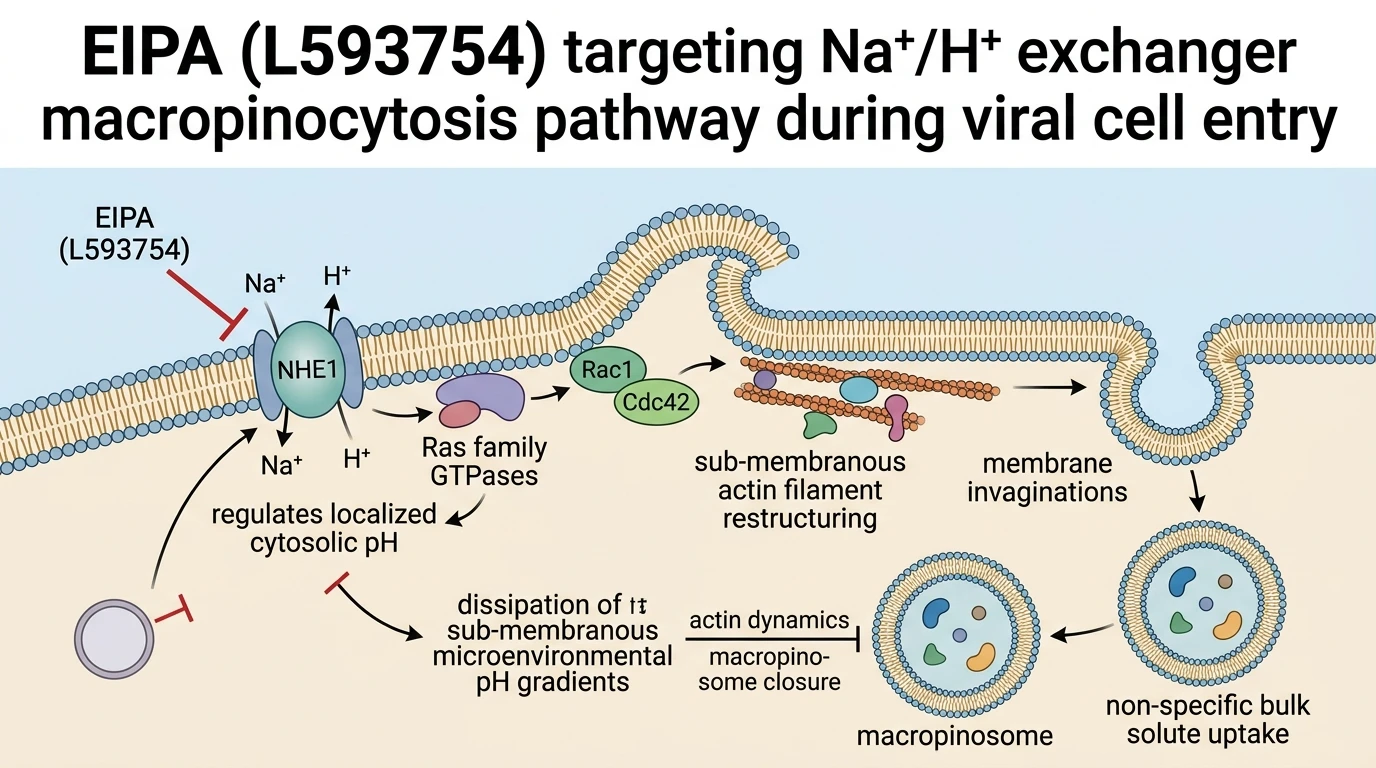
Macropinocytosis serves as an actin-dependent endocytic route exploited by numerous enveloped viruses to gain access to the host cytoplasm. Small molecule pharmacological inhibitors targeting this pathway provide crucial diagnostic tools to dissect viral entry mechanisms. The ethylisopropyl derivative of amiloride, designated EIPA (L593754), acts as a potent and selective blocker of Na+/H+ exchangers (NHEs). By arresting counter-transport of extracellular sodium and intracellular protons, EIPA dissipates sub-membranous pH microdomains essential for Rac1 GTPase activation and actin polymerization. Consequently, administration of an EIPA Sodium Channel inhibitor prevents membrane ruffling and macropinosome closure in susceptible cell lines.
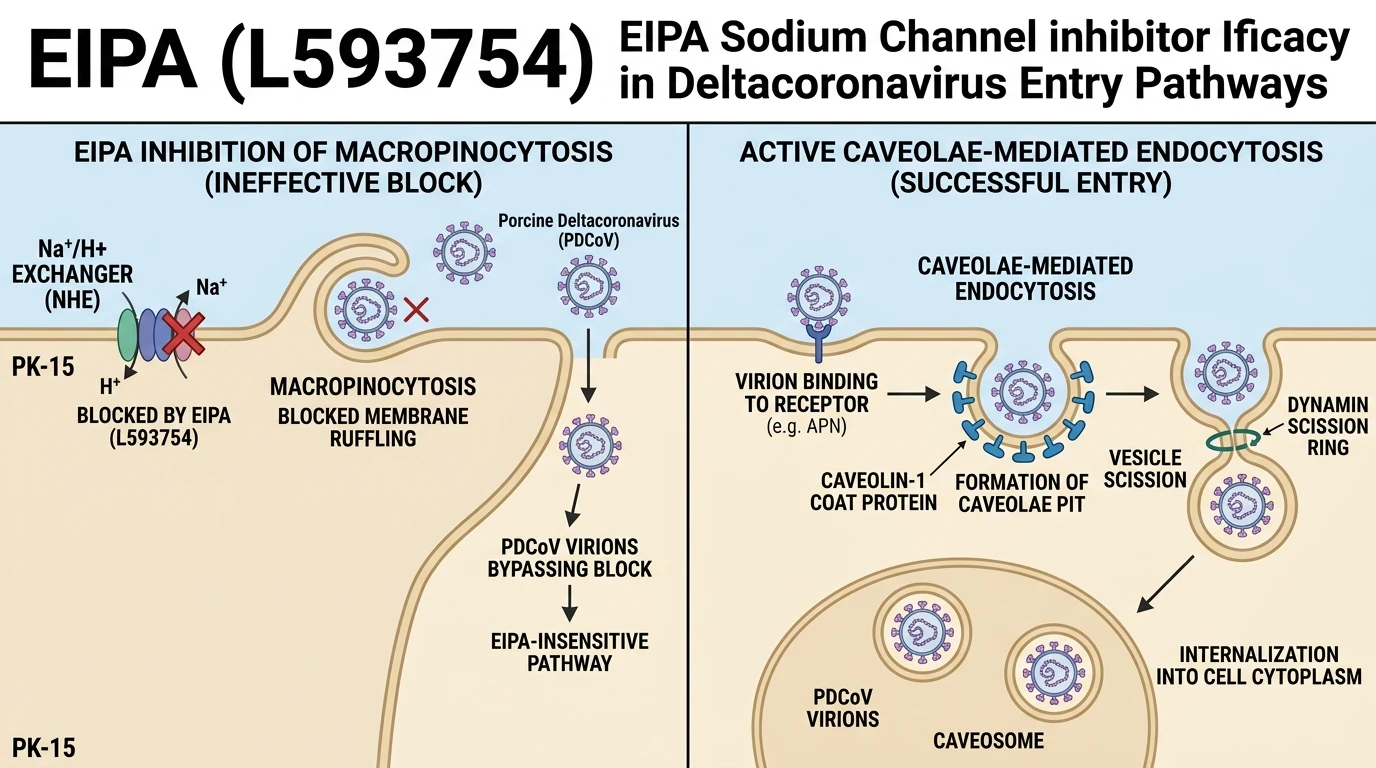
In studies investigating Porcine Deltacoronavirus (PDCoV) host entry, researchers utilized EIPA (L593754) to evaluate whether fluid-phase macropinocytosis mediates viral internalization into PK-15 porcine kidney epithelial cells. Host cells were pretreated with dose-escalating concentrations of EIPA prior to viral exposure under controlled in vitro assay conditions. Quantification of viral binding efficiency demonstrated that Na+/H+ exchanger blockade did not impair attachment of PDCoV virions to the host cell surface. Subsequent entry kinetic assays revealed that initial viral internalization proceeded unimpeded despite complete suppression of macropinocytic activity.
To determine if sub-pathway inhibition exerted delayed effects on replication, cellular samples were analyzed at 24 hours post-infection (hpi). Quantitative reverse transcription polymerase chain reaction (RT-qPCR) assays indicated that intracellular viral mRNA accumulation remained unchanged between EIPA-treated groups and vehicle controls. Consistent with transcript level observations, Western blot analysis and immunofluorescence assays confirmed equivalent expression levels of the viral nucleocapsid (N) protein across all experimental arms. The pharmacological profile of EIPA (L593754) confirms that Na+/H+ exchanger function is non-essential for productive PDCoV infection in this cellular model.
These empirical findings establish a clear mechanistic boundary for PDCoV entry requirements. While certain coronaviruses rely heavily on NHE-regulated macropinocytic internalization, PDCoV infectivity in PK-15 cells operates independently of fluid-phase endocytosis. Instead, comparative pharmacological profiling demonstrates that PDCoV entry relies strictly on caveolae-mediated endocytosis. Interruption of caveolar assembly, dynamin-dependent vesicle scission, or plasma membrane cholesterol depletion severely impairs PDCoV entry. Thus, the selective use of the EIPA Sodium Channel inhibitor ruled out macropinocytosis, isolating caveolar uptake as the primary entry route.
Pharmacological Dissection of PDCoV Internalization Kinetics
Copy code to add this image to your page
EIPA (L593754) selectively inhibits Na+/H+ exchangers (NHE), dissipating sub-membranous pH gradients required for Rac1-driven actin polymerization and macropinosome closure. In PK-15 cell infection models, treatment with EIPA does not alter Porcine Deltacoronavirus (PDCoV) surface binding, internalization, viral mRNA synthesis, or nucleocapsid protein expression. These findings establish that PDCoV entry is independent of Na+/H+ exchanger activity and macropinocytosis, relying instead on cholesterol-dependent, dynamin-mediated caveolae endocytosis.
EIPA Pretreatment Spares Initial PDCoV Surface Attachment
Targeting cellular entry pathways requires precise temporal resolution during initial viral engagement. Pharmacological intervention with the EIPA Sodium Channel inhibitor failed to alter PDCoV surface binding parameters. Preincubation of PK-15 monolayers with EIPA across micromolar ranges preserved virion attachment dynamics; primary binding assays showed non-significant variance relative to untreated controls. Early membrane invagination continued unabated. These empirical observations demonstrate that surface receptor engagement operates independent of host Na+/H+ exchange activity. Localized sub-membranous pH alterations induced by NHE blockade do not disrupt primary viral attachment factors.
Sustained Viral Replication Proceeds Independent of NHE Activity
Intracellular viral replication metrics further confirm macropinocytosis-independent viral processing. At 24 hours post-infection, viral mRNA synthesis exhibited no statistically significant reduction under NHE inhibition; transcript abundances aligned closely with vehicle control values. Application of the EIPA Sodium Channel inhibitor yielded unchanged intracellular levels of PDCoV structural nucleocapsid protein. Western blot bands remained consistent across all treatment cohorts. In contrast, inhibition of dynamin GTPase activity or enzymatic depletion of membrane cholesterol drastically restricted viral entry. PDCoV infectivity relies on caveolae-mediated endocytic mechanisms rather than NHE-dependent macropinocytic engulfment.