ISX-9 (Isoxazole 9) Isoxazole 9 Wnt/beta-catenin Driven Reprogramming to Dopaminergic Neurons
Copy code to add this image to your page
Direct somatic cell reprogramming into functional lineage-specific neurons offers an instructive model for neurodegenerative disease modeling and cell replacement research. Converting dermal fibroblasts directly into functional dopaminergic neurons bypasses the pluripotency stage, reducing risks of teratoma formation inherent to pluripotent stem cell intermediate states. Lineage specification traditionally relies on ectopic viral expression of lineage-defining transcription factors, notably the combination of Ascl1, Brn2, and Myt1l. However, viral delivery platforms carry risks of insertional mutagenesis, while conventional non-viral transfection methods often exhibit transient expression profiles and notable cellular toxicity. Small-molecule neural inducers, such as ISX-9 (Isoxazole 9), present an attractive strategy to reinforce transcriptional conversion by targeting endogenous signaling networks within adult neural stem and precursor cell populations.
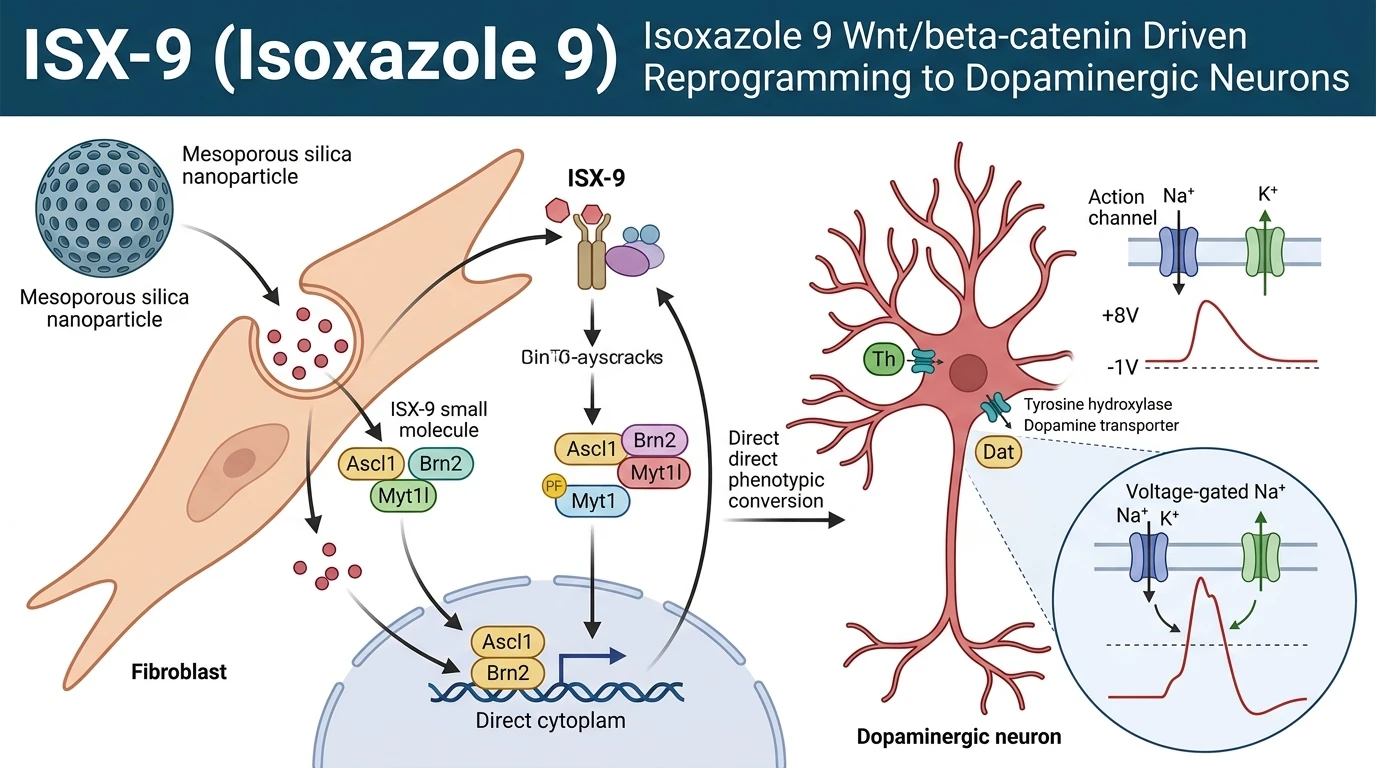
The application of mesoporous silica nanoparticles (MSNs) provides a tailored nanocarrier matrix capable of co-delivering genetic material and lipophilic small molecules. In this specific delivery platform, MSNs feature uniform pore geometries loaded with ISX-9 (Isoxazole 9) and capped with avidin protein complexes to prevent premature cargo leakage. Upon endocytosis into target fibroblast populations, intracellular biological triggers prompt cap disassembly, driving sustained, prolonged releases of the small-molecule cargo. Compared to standard cationic lipid formulations like Lipofectamine 2000, MSN formulations maintain minimal cytotoxic impact, preserving cell membrane integrity and high metabolic activity during the crucial initial phases of lineage transition.
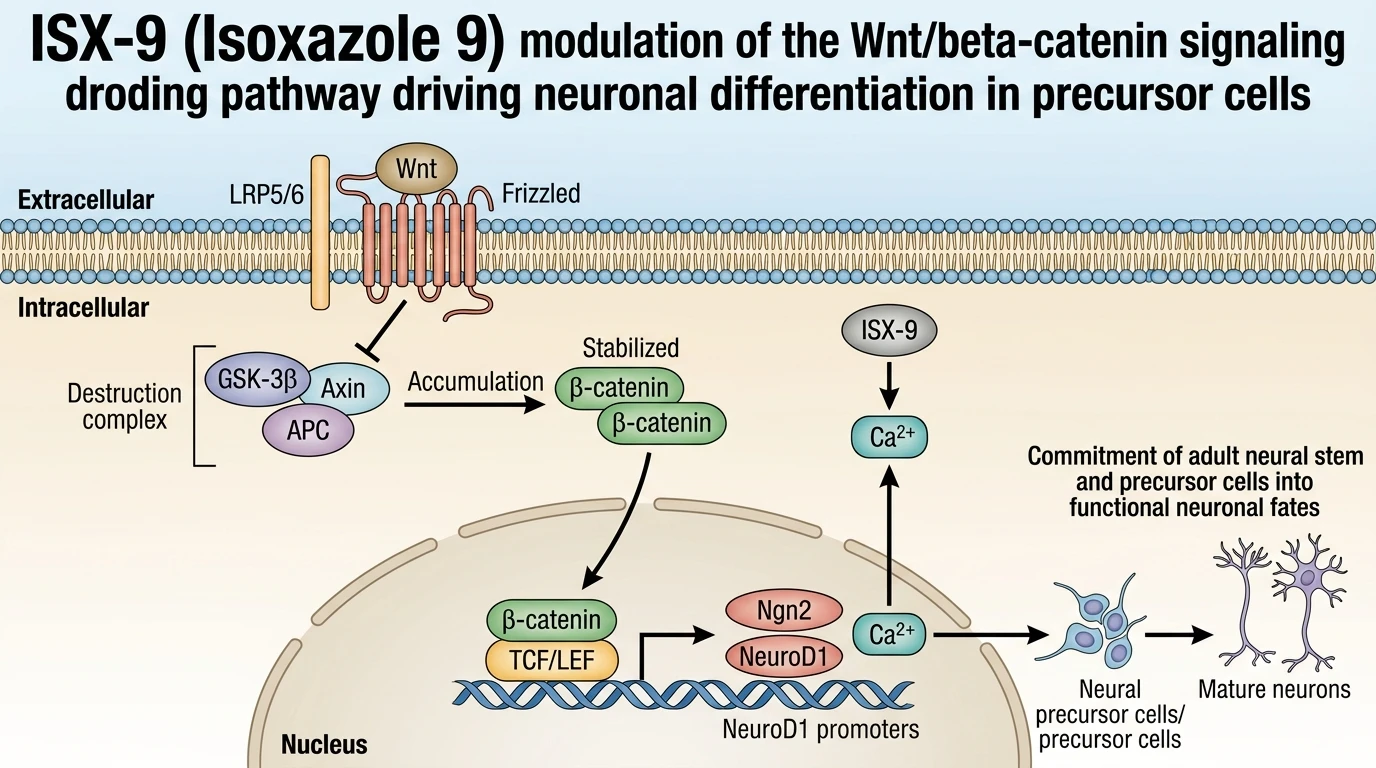
Mechanistically, ISX-9 operates as a powerful neurogenic signal transducer. The compound stimulates calcium influx across the plasma membrane, driving the activation of calcineurin and calmodulin-dependent protein kinase pathways. This signaling cascade induces phosphorylation and nuclear translocation of transcription factors that bind directly to neuron-specific gene promoters, including NeuroD1 and Ngn2. Concurrently, chemical engagement intersects with the Isoxazole 9 Wnt/beta-catenin signaling axis. Axin and GSK-3beta complexes are modulated, permitting beta-catenin accumulation and subsequent nuclear interaction with TCF/LEF transcription factor families. This dual pathway engagement opens closed chromatin domains surrounding neuronal locus control regions, enhancing the transcriptional accessibility of exogenous Ascl1, Brn2, and Myt1l constructs.
Experimental direct reprogramming of murine fibroblasts utilizing the MSN-mediated co-delivery of ABM factors and ISX-9 results in profound morphological and biochemical conversion. Within several days post-treatment under defined in vitro culture conditions, flat, non-neuronal fibroblastic morphologies undergo structural remodeling into bipolar and multipolar cell structures with extensive neurite outgrowth. Quantitative transcript analysis reveals rapid downregulation of fibroblast-specific genes, such as Col1a1, parallel to marked upregulation of pan-neuronal markers including Tuj1 (beta-III-tubulin) and Map2.
Lineage commitment extends specifically toward midbrain dopaminergic traits. Immunocytochemical assays confirm robust expression of critical enzymatic and transport proteins required for dopamine biosynthesis and handling. Converted functional dopaminergic neuron-like cells (fDA-neurons/iM-Neurons) display high immunoreactivity for tyrosine hydroxylase (Th), the rate-limiting enzyme in catecholamine synthesis, alongside the vesicular monoamine transporter 2 (Vmat2) and the plasmalemmal dopamine transporter (Dat). Enzyme-linked immunosorbent assays and high-performance liquid chromatography confirm basal release of dopamine into culture media, which escalates significantly upon depolarizing potassium chloride stimulation, indicating functional stimulus-secretion coupling.
Electrophysiological evaluation using whole-cell patch-clamp techniques confirms functional membrane maturation in the converted population. Voltage-clamp protocols record robust, fast-activating, and fast-inactivating inward sodium (Na+) currents alongside sustained outward potassium (K+) currents. Under current-clamp configurations, step-current injections evoke repetitive, mature action potentials with characteristic membrane resting potentials and threshold amplitudes. These biophysical metrics demonstrate that chemical and transcription factor co-delivery achieves functional ion channel density and membrane excitability matching endogenous neuronal phenotypes.
While these experimental results substantiate the utility of avidin-capped MSN nanocarriers for non-viral lineage reprogramming, boundary conditions must be recognized. The observed conversion efficiencies and electrophysiological characteristics were established within controlled murine fibroblast models in vitro. Extrapolating these findings to human adult donor cells requires further optimization of nanocarrier surface chemistry, dosage schedules, and targeted gene expression profiles. Additionally, long-term survival, functional integration, and genomic stability of converted cells must be rigorously verified in pre-clinical animal models of Parkinson's disease prior to evaluating therapeutic translation.
Nanocarrier Characterization and Electrophysiological Lineage Conversion
Copy code to add this image to your page
MSN nanocarriers co-deliver Ascl1, Brn2, and Myt1l transcription factors alongside ISX-9 (Isoxazole 9) to induce direct lineage reprogramming of mouse somatic fibroblasts into functional dopaminergic neurons. Avidin-capped mesoporous silica architecture ensures sustained intracellular drug release. ISX-9 activates neuron-specific gene promoters—including Tuj1, Dat, Vmat, Ngn2, Map2, and Th—working in concert with neurogenic signaling cascades. Converted cells express critical dopaminergic markers, display robust Na+/K+ channel activity, and secrete dopamine. This non-viral platform exhibits lower cytotoxicity than lipid-based transfectants in tested cell culture models.
Avidin-Capped MSNs Sustained Controlled ISX-9 Release Kinetics
Mesoporous silica nanoparticles were synthesized with uniform pore channels to encapsulate small-molecule ISX-9 (Isoxazole 9). Surface functionalization with avidin caps prevented premature burst leakage in neutral culture media. Cellular entry occurred via endocytosis. Endosomal acidification disrupted cap integrity, initiating steady payload diffusion into the cytoplasm. This continuous intracellular delivery profile avoided peak-concentration toxicity. In comparative viability assays, MSN transfections retained significantly higher cellular survival rates than Lipofectamine 2000 formulations. The nanocarrier platform maintained low cytotoxicity across varied dosing regimens. Concurrently, sustained exposure to ISX-9 elevated intracellular calcium transients. This chemical cue primed fibroblast chromatin structures for ectopic transcription factor binding.
Synergistic Reprogramming Yields Electrophysiologically Functional Dopaminergic Neurons
Co-delivery of Ascl1, Brn2, and Myt1l alongside ISX-9 activated neuron-specific gene promoters within four days post-transfection. Proneural locus activation led to early upregulation of Ngn2 and Tuj1 transcripts. The Isoxazole 9 Wnt/beta-catenin signaling crosstalk reinforced downstream expression of dopaminergic markers, including Th, Dat, and Vmat. Converted cells developed complex neurite extensions in primary culture. Whole-cell patch-clamp recordings revealed active membrane properties. Inward sodium currents reached peak amplitudes under step depolarization. Outward potassium currents demonstrated characteristic delayed-rectifier kinetics. Evoked action potentials fired reliably during current injections. HPLC analysis verified active dopamine synthesis and depolarization-induced exocytosis. These electrophysiological and secretory metrics demonstrate functional lineage specification under tested in vitro conditions.