Adavosertib Wee1 inhibitor (AZD1775, MK-1775) cardiac safety profile and concentration-QT modeling in solid tumors
Copy code to add this image to your page
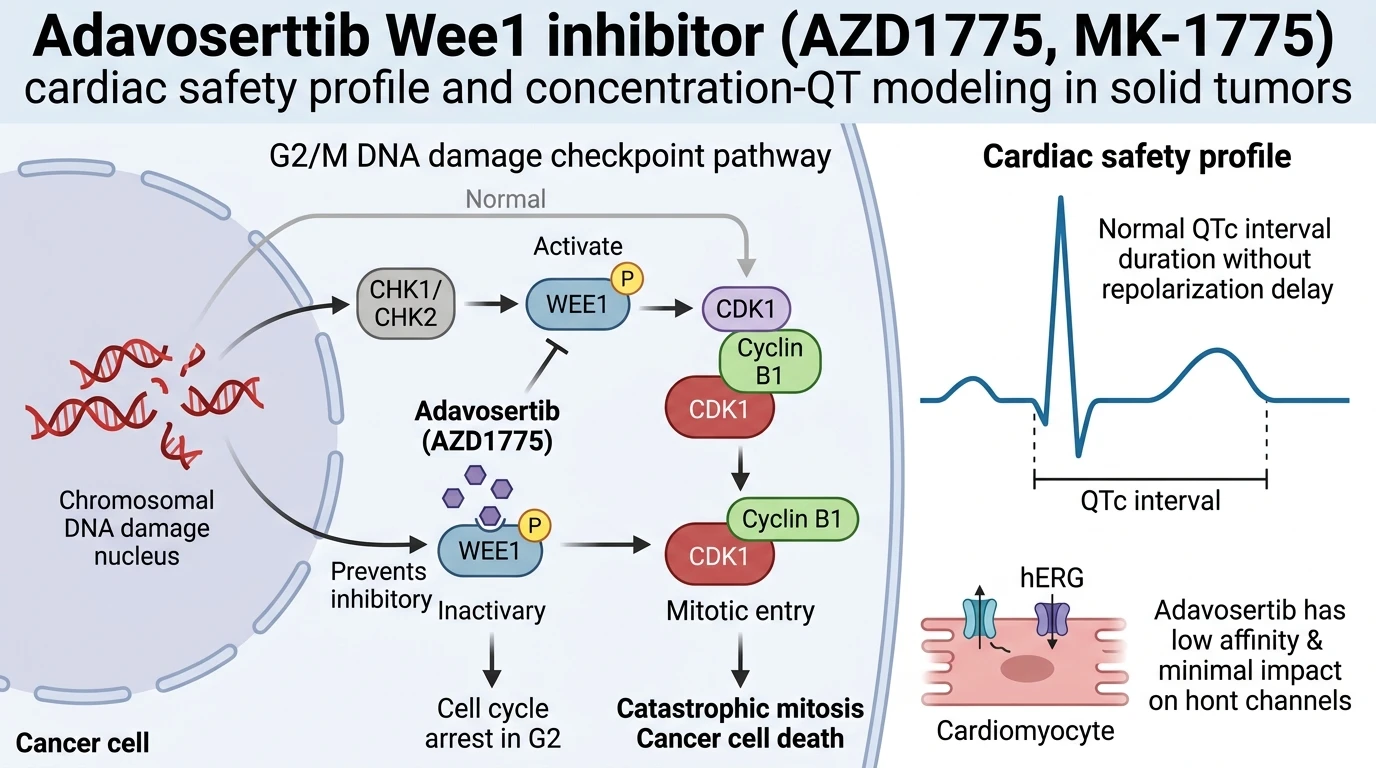
Adavosertib (AZD1775, MK-1775) is a potent, small-molecule, ATP-competitive inhibitor targeting Wee1 kinase, an essential regulator of the G2/M cell cycle checkpoint. In preclinical and clinical oncology, targeting the G2/M checkpoint represents a strategic vulnerability, particularly in TP53-mutant malignant tumors that lack functional G1 checkpoint control. By inhibiting Wee1 kinase activity, adavosertib prevents the inhibitory phosphorylation of CDK1 at Tyr15, forcing cancer cells with accumulated DNA damage to undergo premature entry into mitosis, ultimately leading to mitotic catastrophe and apoptosis.
While target engagement and antitumor efficacy remain primary objectives during early-phase clinical evaluations of kinase inhibitors, defining cardiovascular safety and cardiac repolarization liabilities is a critical regulatory milestone. Small-molecule kinase inhibitors often exhibit off-target interaction profiles or systemic pharmacological effects that can disrupt cardiac electrophysiology, specifically potassium channel conductances such as human ether-à-go-go-related gene (hERG) channels. Such interactions can manifest as prolongation of the ventricular repolarization phase, quantifiable on an electrocardiogram as an extended QT interval corrected for heart rate (QTc). Clinical prolongation of the QTc interval exceeding regulatory thresholds of concern (typically an upper bound of the 90% confidence interval for ΔQTc exceeding 10 ms) raises the risk of life-threatening ventricular tachyarrhythmias, notably Torsades de Pointes.
To thoroughly characterize the cardiac safety profile of the Adavosertib Wee1 inhibitor, a Phase I open-label clinical trial was conducted in patients presenting with advanced solid tumors. The trial design specifically targeted the assessment of QTc interval prolongation, exposure-response relationships, and systemic pharmacokinetic properties. Patients received oral adavosertib at a dose schedule of 225 mg twice daily on Days 1 and 2, followed by a single dose of 225 mg on Day 3 of the treatment cycle. Serial time-matched blood sampling for pharmacokinetic assay and triplicate 12-lead electrocardiograms (ECGs) were acquired across baseline and scheduled post-dose timepoints to perform robust concentration-QT modeling.
The empirical findings from this Phase I clinical evaluation demonstrated a benign cardiovascular safety profile regarding cardiac ventricular repolarization. Concentration–QT modeling established that the baseline-adjusted Fridericia-corrected QT interval (ΔQTcF) at the geometric mean maximum plasma concentration (Cmax) was −2.4 ms on Day 1 and −0.8 ms on Day 3. Crucially, the upper limits of the 90% two-sided confidence intervals surrounding these baseline-adjusted ΔQTcF values remained well below the 10 ms regulatory threshold established by the ICH E14 guidelines. Linear mixed-effects exposure-response analysis revealed no statistically significant positive slope between adavosertib plasma concentration and ΔQTcF (P = 0.27), indicating an absence of exposure-dependent prolongation of ventricular repolarization within the clinically relevant therapeutic concentration window.
Categorical electrocardiology assessments further corroborated the modeling results. No patient enrolled in the safety cohort developed absolute QTcF values exceeding 450 ms, nor did any individual experience a baseline-adjusted ΔQTcF prolongation greater than 60 ms at any point during the observation window. Furthermore, no treatment-emergent cardiac arrhythmias or clinically significant ECG abnormalities were observed in connection with peak plasma exposure. These robust findings demonstrate that therapeutic dosing with adavosertib does not induce clinically relevant QTc interval prolongation in patients with advanced solid tumors, providing essential safety confirmation for ongoing combinatorial and monotherapy oncological regimens.
Cardiovascular Safety and Concentration-QT Relationship Modeling
Copy code to add this image to your page
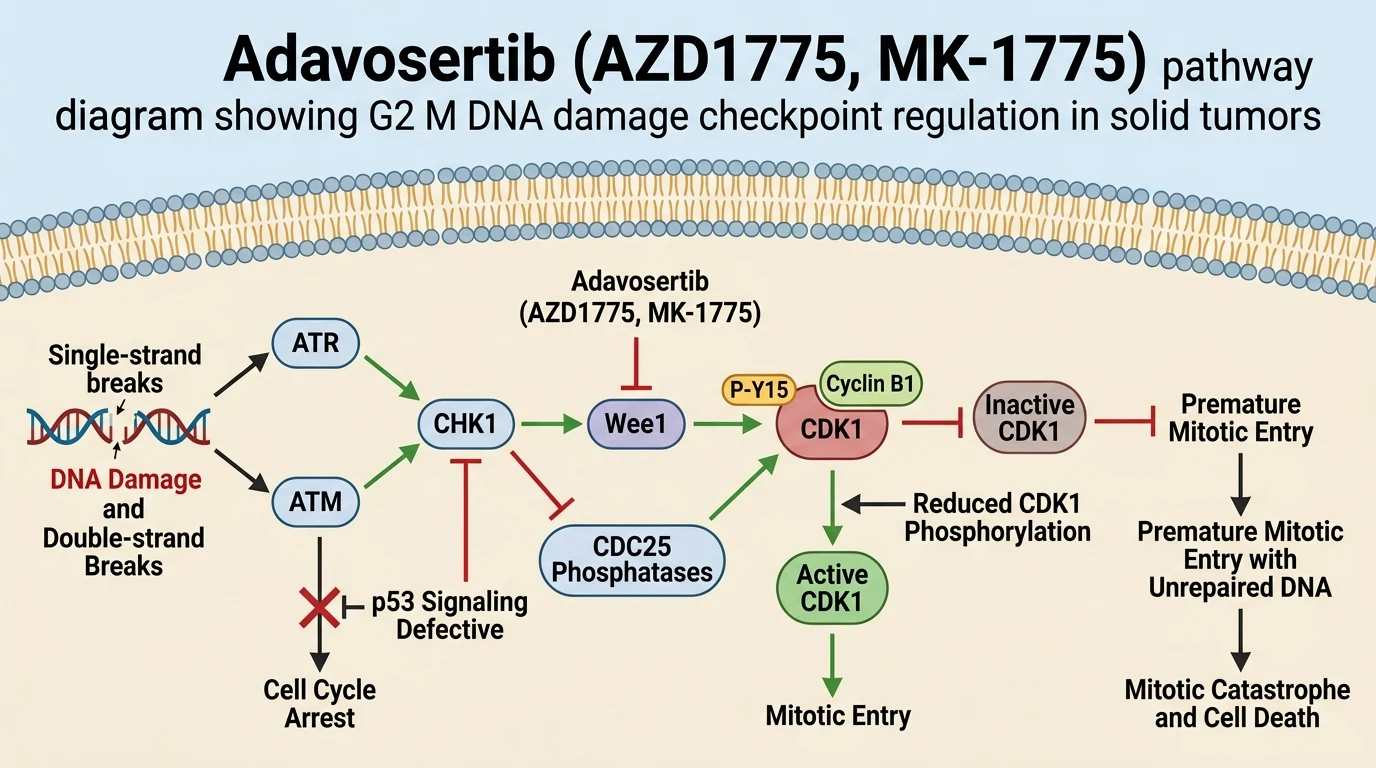
Adavosertib (AZD1775) acts as an ATP-competitive inhibitor of Wee1 kinase, a key regulator of the G2/M DNA damage checkpoint. By inhibiting Wee1, adavosertib blocks CDK1 Tyr15 phosphorylation, selectively abrogating the G2 checkpoint and forcing p53-deficient tumor cells with accumulated DNA damage into premature mitosis, leading to cell death. Clinical cardiovascular evaluation demonstrates no significant QTcF prolongation or concentration-dependent QTc prolongation.
Concentration-QTcF Modeling Confirms Absence of Repolarization Delay
Linear mixed-effects modeling showed no prolongation of ventricular repolarization across tested plasma concentrations. Baseline-adjusted ΔQTcF metrics remained negative relative to pre-dose values. At geometric mean peak concentrations, ΔQTcF reached −2.4 ms on Day 1 and −0.8 ms on Day 3; the upper bound of the 90% confidence interval stayed below 10 ms. These empirical findings demonstrate that the Adavosertib Wee1 inhibitor does not impair cardiac repolarization kinetics in human subjects. Systematic ECG monitoring confirmed these mathematical predictions.
Lack of Exposure-Response Trends at Clinical Cmax Values
Plasma concentration tracking revealed consistent linear pharmacokinetics across all patient cohorts. Exposure-response slope analysis yielded no statistically significant relationship between drug exposure and ΔQTcF parameter changes (P=0.27). Maximal plasma exposure occurred reliably following the scheduled 225 mg dosing regimen. Peak exposure did not trigger cardiac signal prolongation. Consequently, systemic Adavosertib Wee1 target engagement proceeds without compromising ionic channels governing cardiac action potential duration.
Absence of Absolute or Baseline-Adjusted QTcF Threshold Exceedances
Categorical safety boundaries were preserved across all evaluated clinical subjects. Zero patients demonstrated post-baseline absolute QTcF intervals above 450 ms. Furthermore, maximum individual ΔQTcF increases remained under the 60 ms threshold of clinical concern throughout the study period. No treatment-emergent arrhythmias occurred during serial monitoring. These observations confirm that Adavosertib Wee1 administration maintains a favorable cardiac safety margin in patients with advanced solid malignancies.