Axitinib (AG-013736) AG-013736 VEGFR inhibitor in Bcr-Abl1 T315I Mutant Resistance Dynamics
Copy code to add this image to your page
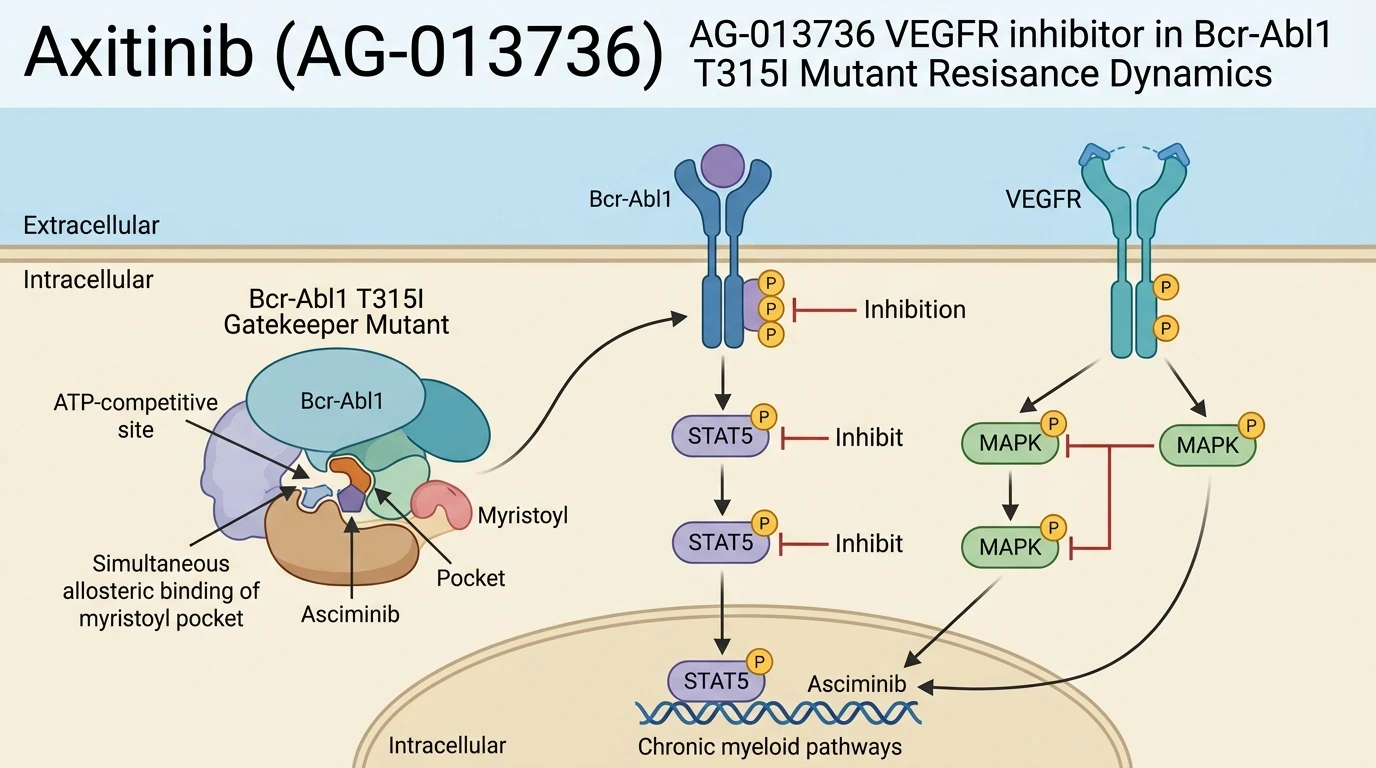
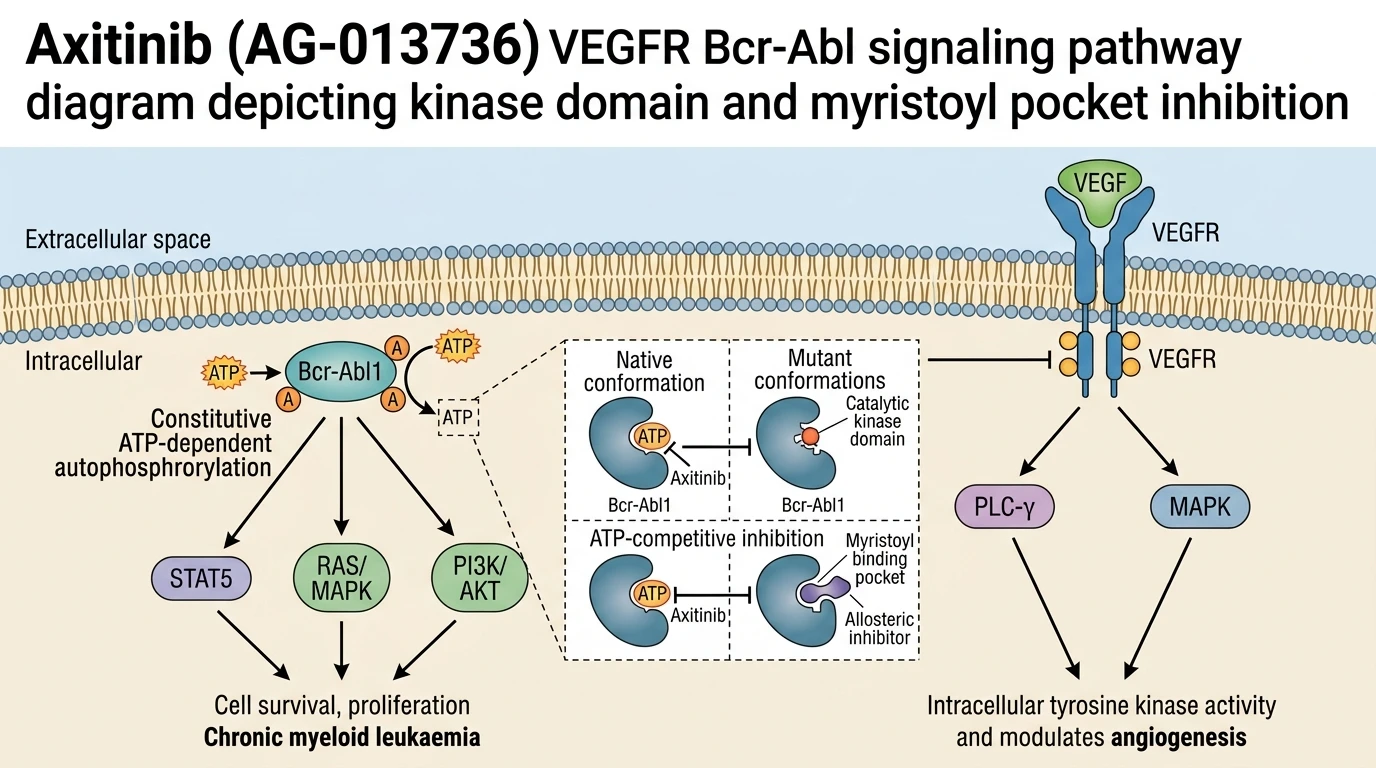
Axitinib (AG-013736) is recognized within clinical oncology primarily as a potent AG-013736 VEGFR inhibitor with nanomolar activity against vascular endothelial growth factor receptors VEGFR-1, VEGFR-2, and VEGFR-3. Biochemical profiling and structural binding studies reveal that this small-molecule tyrosine kinase inhibitor also exhibits affinity toward the Abl kinase domain, including the gatekeeper T315I mutant form of Bcr-Abl1. Chronic myeloid leukaemia (CML) is driven by the constitutive activity of the BCR-ABL1 oncogene, which triggers downstream survival cascades including STAT5, RAS/MAPK, and PI3K/AKT pathways. While targeted ATP-competitive tyrosine kinase inhibitors such as imatinib, dasatinib, and nilotinib remain clinical standards, acquired resistance through point mutations in the kinase domain continues to limit long-term remission. Among these mutations, the T315I substitution replaces a conserved threonine residue with a bulky isoleucine residue at position 315, creating steric conflict and removing a crucial hydrogen bond necessary for standard TKI binding.
To address mutational escape in leukemic populations, therapeutic strategies have shifted toward alternative binding sites and rational combination approaches. Asciminib represents a distinct mechanistic class that targets the myristoyl binding pocket of Bcr-Abl1. By binding this allosteric site, asciminib mimics the native autoregulatory mechanism of Abl1, locking the kinase domain in an inactive catalytic conformation regardless of ATP-binding cassette mutations. In contrast, axitinib functions through traditional ATP-competitive inhibition, yet its structural flexibility allows partial engagement with the T315I catalytic site. Evaluating how these two distinct pharmacological approaches—allosteric pocket engagement versus catalytic ATP-site inhibition—impact the evolutionary selection of resistant leukemic clones was performed using computational kinetic simulations paired with rigorous in vitro proliferation assays in KCL-22 human CML cells.
Pharmacological analysis of asciminib combinations in KCL-22 cell models demonstrated robust synergistic interactions when co-administered with conventional ATP-pocket TKIs, including imatinib, dasatinib, nilotinib, bosutinib, and ponatinib. This synergy was particularly pronounced at high levels of fractional target inhibition. By simultaneously occupying the myristoyl pocket and the ATP-binding domain, dual-agent exposure significantly lowered the required concentration of each individual compound to achieve target cell kill. In computational evolutionary models, this pronounced reduction in effective required dosage narrowed the mutational spectrum capable of surviving therapy. Consequently, combining an allosteric inhibitor with an ATP-competitive backbone effectively suppresses the emergence of single-point resistant mutants in vitro.
Conversely, experimental evaluation of axitinib supplementation yielded markedly different evolutionary dynamics. Although axitinib specifically engages the gatekeeper T315I mutant protein, its addition to TKI regimens provided only temporary suppression of T315I clone proliferation. In vitro cell culture models simulating daily patient dosing regimens demonstrated that axitinib exposure initially reduced T315I cell numbers. However, during the pharmacodynamic trough periods corresponding to diminished drug concentrations between simulated doses, T315I clones rapidly resumed active cell division. The temporary inhibition exerted by periodic axitinib exposure failed to abolish the competitive evolutionary advantage that T315I mutants hold over non-mutated Bcr-Abl1 cells.
These findings indicate critical boundary conditions for targeting gatekeeper resistance in CML. While axitinib demonstrates measurable biochemical activity against the T315I kinase domain, its pharmacodynamic profile under intermittent exposure is insufficient to clear resistant clones from leukemic populations. The persistent fitness advantage of T315I mutants under daily axitinib dosing prevents long-term clonal eradication. Consequently, supplementing TKI therapy with axitinib offers minimal clinical utility for preventing mutational resistance. In contrast, allosteric myristoyl pocket inhibition via asciminib combined with ATP-competitive TKIs represents a mechanistically viable strategy for preventing resistance emergence in leukemic cells.
Pharmacological Synergies and Mutational Selection Kinetics
Copy code to add this image to your page
Allosteric binding of asciminib to the myristoyl pocket of Bcr-Abl1 acts synergistically with conventional ATP-competitive tyrosine kinase inhibitors, significantly lowering required therapeutic doses and restricting the emergence of resistant mutant clones in KCL-22 cells. Conversely, axitinib targets the ATP-binding pocket of the T315I gatekeeper mutant but provides only transient proliferation suppression during active exposure window. Under simulated daily dosing dynamics, T315I clones rapidly recover during trough periods, retaining their evolutionary selection advantage and rendering axitinib supplementation ineffective for durable resistance prevention.
Asciminib Potentiates ATP-Competitive Kinase Inhibitors in KCL-22 Cells
High-level inhibition regimes demonstrate distinct evolutionary selection pressures in leukemic cell populations. In vitro proliferation assays utilizing KCL-22 cells indicate that asciminib, an allosteric inhibitor binding the myristoyl pocket of Bcr-Abl1, functions cooperatively when combined with conventional ATP-site inhibitors. Immature clonal expansion was checked effectively. The combination with imatinib, dasatinib, nilotinib, bosutinib, or ponatinib achieved pronounced antiproliferative synergy at elevated fractional inhibition thresholds. Consequently, required drug exposure levels were reduced substantially within this culture system. This dose reduction narrowed the spectrum of resistant mutations capable of escaping dual-agent pressure.
Axitinib Supplementation Fails to Eliminate T315I Evolutionary Advantage
Secondary pharmacological evaluation focused on direct gatekeeper mutant targeting. The AG-013736 VEGFR inhibitor axitinib exhibits measurable affinity for the Bcr-Abl1 T315I ATP-binding site. Under simulated daily dosing dynamics, axitinib transiently restricted T315I clone proliferation in vitro. Kinetic rebound occurred rapidly. The subpopulation retained its selective fitness advantage over wild-type clones between dosing intervals. Experimental observations indicate that periodic ATP-competitive target engagement by axitinib does not provide sustained clonal suppression. Thus, supplementing conventional regimens with this compound offers minimal utility for countering resistance.