Resiquimod (R-848) TLR agonist Reprograms Tumor Microenvironments via Pyroptosis and Macrophage Polarization
Copy code to add this image to your page
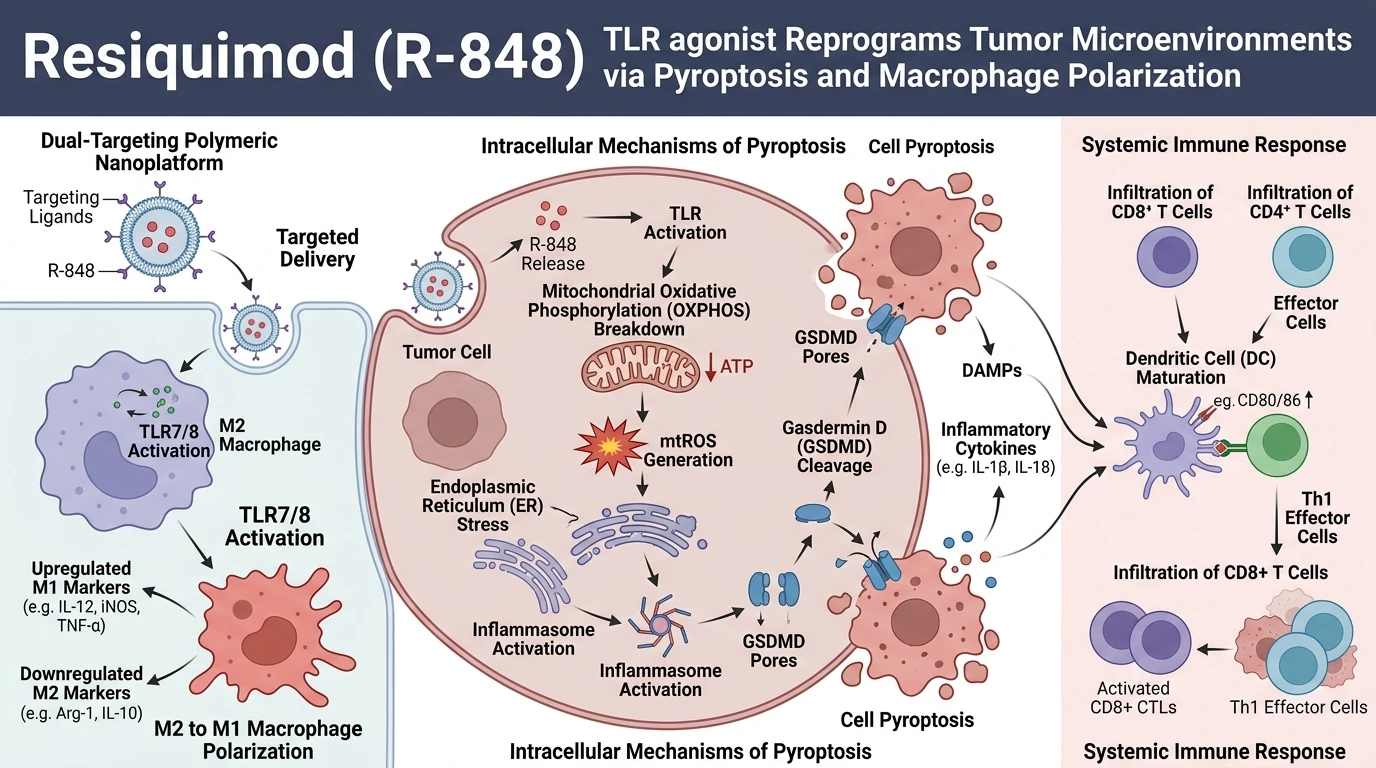
Toll-like receptors 7 and 8 (TLR7/8) represent essential endosomal pattern recognition receptors that sense single-stranded viral RNA. Engagement of these target structures stimulates robust innate immune pathways, bridging innate signaling with adaptive antitumor responses. Resiquimod (R-848) TLR agonist operates as a potent imidazoquinoline derivative targeting both TLR7 and TLR8. However, free drug administration frequently causes systemic off-target inflammatory responses and rapid renal clearance, limiting therapeutic windows in solid tumors. To circumvent these pharmacodynamic obstacles, a dual-targeting polymeric nanoplatform was engineered to encapsulate R848 while providing direct cytotoxic and immune-modulating capabilities.
In B16F10 murine melanoma cell models, the underlying polymeric carrier exerts intrinsic cytotoxic effects by altering mitochondrial oxidative phosphorylation. Cellular respiration slows markedly following nanocarrier uptake; mitochondrial membrane potentials drop within hours. This metabolic disruption leads to significant intracellular accumulation of mitochondrial reactive oxygen species (mtROS), inducing severe endoplasmic reticulum stress. ER stress signaling triggers canonical pyroptotic cascades, evidenced by increased cleavage and activation of Gasdermin D (GSDMD). The resulting N-terminal GSDMD fragments assemble into oligomeric pores within the plasma membrane. Osmotic swelling and plasma membrane rupture follow, liberating endogenous intracellular contents. This sequence establishes immunogenic cell death (ICD) independently of traditional chemotherapy regimens.
To ensure selective biodistribution, the nanoplatform incorporates surface modifications with cyclic RGD (cRGD) peptides and mannose ligands. The cRGD motif selectively targets integrin αvβ3 heterodimers expressed on melanoma cells and tumor neovasculature. Concurrently, mannose ligands target CD206 (mannose receptor) expressed on tumor-associated macrophages (TAMs). This dual-surface functionalization allows the delivery system to target both malignant tumor cells and immunosuppressive stromal elements within the tumor microenvironment.
Upon internalization by TAMs, released R848 activates endosomal TLR7/8 signaling pathways. Downstream activation of NF-κB transcription factors forces a phenotypic shift from M2-like pro-tumoral macrophages to M1-like anti-tumoral effector cells. Expression of inducible nitric oxide synthase (iNOS), interleukin-12, and tumor necrosis factor-alpha rises substantially; concurrently, CD206 and arginase-1 expression levels drop. In parallel, antigens released from pyroptotic tumor cells undergo uptake by local dendritic cells. DAMP release accelerates dendritic cell maturation, upregulating cell-surface CD80, CD86, and MHC class II molecules.
In syngeneic B16F10 tumor-bearing C57BL/6 mice, this coordinated activation functions as an in situ tumor vaccine. Intra-tumoral analysis demonstrates elevated infiltration of functional CD8+ cytotoxic T lymphocytes and CD4+ helper T cells. Meanwhile, the fraction of immunosuppressive FoxP3+ regulatory T cells (Tregs) decreases, lowering the local Treg-to-CD8+ ratio. Primary tumor volume growth is inhibited, culminating in extended survival times in treated animals.
To address adaptive immune resistance, this nanoformulation was combined with immune checkpoint inhibitors. Co-administration of anti-PD-1 antibodies rejuvenates exhausted T cells, while anti-CD47 antibodies block phagocytic resistance pathways on residual cancer cells. Within tested murine models, this multi-targeted approach achieved regression of established tumors and sustained immunological memory against rechallenge, highlighting the efficacy of combining innate immune activation with immune checkpoint blockade.
Pharmacological Mechanisms of Polymer-Assisted TLR7/8 Activation
Copy code to add this image to your page
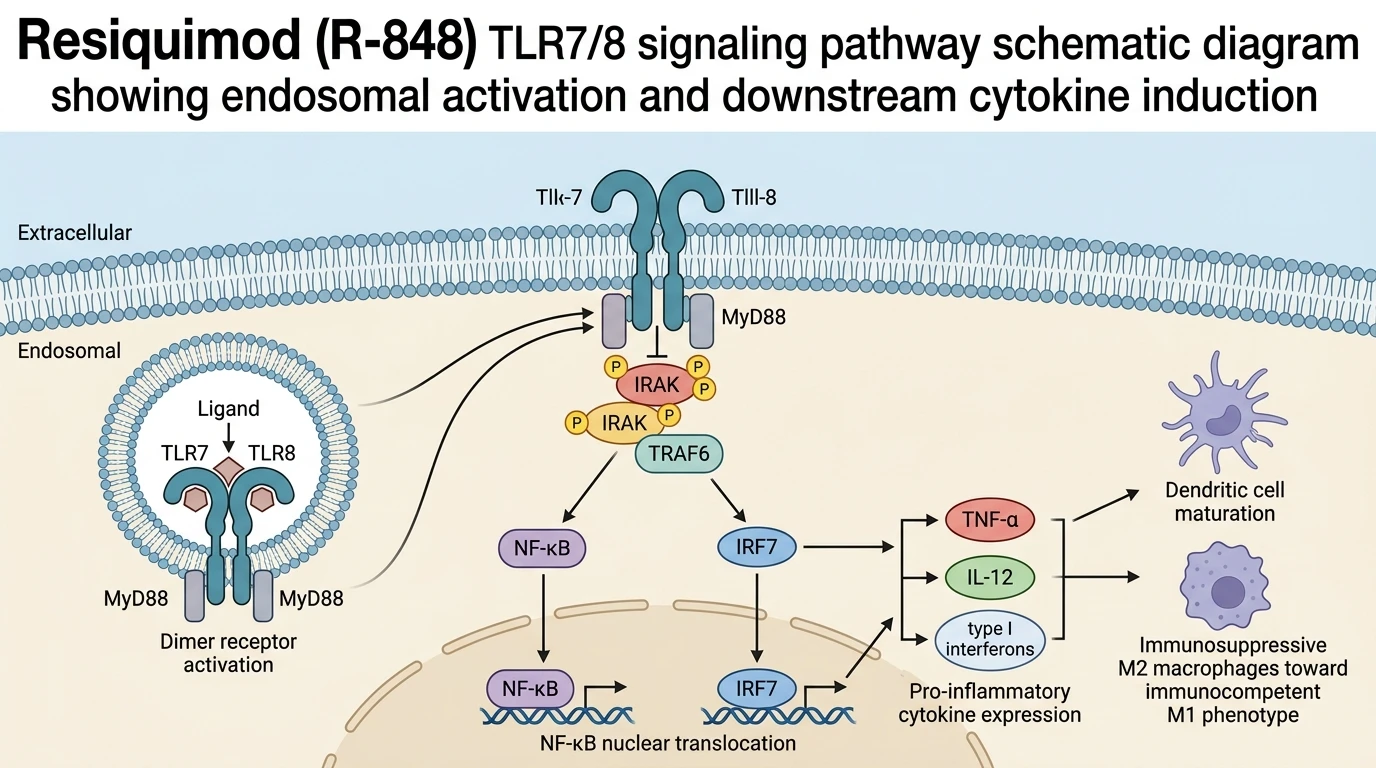
Resiquimod (R-848) activates endosomal TLR7/8 receptors, stimulating MyD88-dependent NF-κB and IRF7 signaling pathways. When delivered via a dual-targeted polymeric nanoplatform, the system induces mitochondrial oxidative phosphorylation disruption, mtROS production, ER stress, and GSDMD-mediated pyroptosis in melanoma cells. Concurrently, localized R848 delivery polarizes CD206+ TAMs from an M2 to M1 pro-inflammatory phenotype and drives dendritic cell maturation. In vivo, this coordinated mechanism recruits CD8+ and CD4+ T cells, depletes regulatory T cells, and acts synergistically with anti-PD-1 and anti-CD47 immune checkpoint blockade to restrict tumor growth.
Polymeric Delivery Drives Mitochondrial Dysfunction and GSDMD-Mediated Pyroptosis
Direct engagement of TLR7/8 in immunosuppressive environments requires sustained local drug exposure. In B16F10 melanoma models, the engineered nanoplatform alters mitochondrial electron transport. Oxygen consumption rates drop sharply within hours. Disrupted oxidative phosphorylation promotes mtROS generation—a crucial upstream driver of reticular stress; endoplasmic reticulum signaling subsequently upregulates GSDMD cleavage. Cleaved GSDMD N-terminal domains form membrane pores, causing cell swelling and membrane rupture. This process releases intracellular danger signals without requiring classical cytotoxic drugs. Resiquimod (R-848) TLR agonist delivery within this platform thus couples direct tumor cytotoxicity with danger signal generation.
Re-education of M2 Macrophages and In Situ Dendritic Cell Maturation
The tumor microenvironment often enforces macrophage polarization toward an immunosuppressive M2 state. Surface-conjugated mannose ligands target CD206 receptors on TAMs; cRGD peptides target integrin αvβ3 on melanoma cells. Upon intracellular release, the compound activates endosomal TLR7/8 signaling cascades. Inducible nitric oxide synthase expression rises rapidly; arginase-1 levels drop concurrently. This phenotypic shift transforms M2 TAMs into M1 pro-inflammatory effector cells. Simultaneously, antigens released from pyroptotic tumor cells undergo uptake by local dendritic cells. CD80 and CD86 surface expression increases significantly under tested ex vivo conditions. Effective antigen presentation converts the immunosuppressive lesion into an active site of immune priming.
In Vivo T Cell Recruitment and Synergistic Checkpoint Blockade Efficacy
Therapeutic efficacy was evaluated in syngeneic B16F10 melanoma murine models. Systemic administration of the dual-targeted nanoplatform led to robust T cell recruitment into primary lesions. CD8+ cytotoxic T lymphocytes and CD4+ helper cells infiltrated the core within three days; immunosuppressive regulatory T cells decreased proportionally. When combined with anti-PD-1 and anti-CD47 antibodies, the therapeutic regimen inhibited tumor growth significantly. Survival rates prolonged markedly compared to monotherapy controls. These observations highlight how TLR7/8 agonist activation can transform immunologically cold tumors into responsive targets for checkpoint blockade.