BI-10773 from Selleck (BI-10773 (Empagliflozin)) suppresses CaMKII activity and diastolic sarcoplasmic reticulum calcium leak
Copy code to add this image to your page
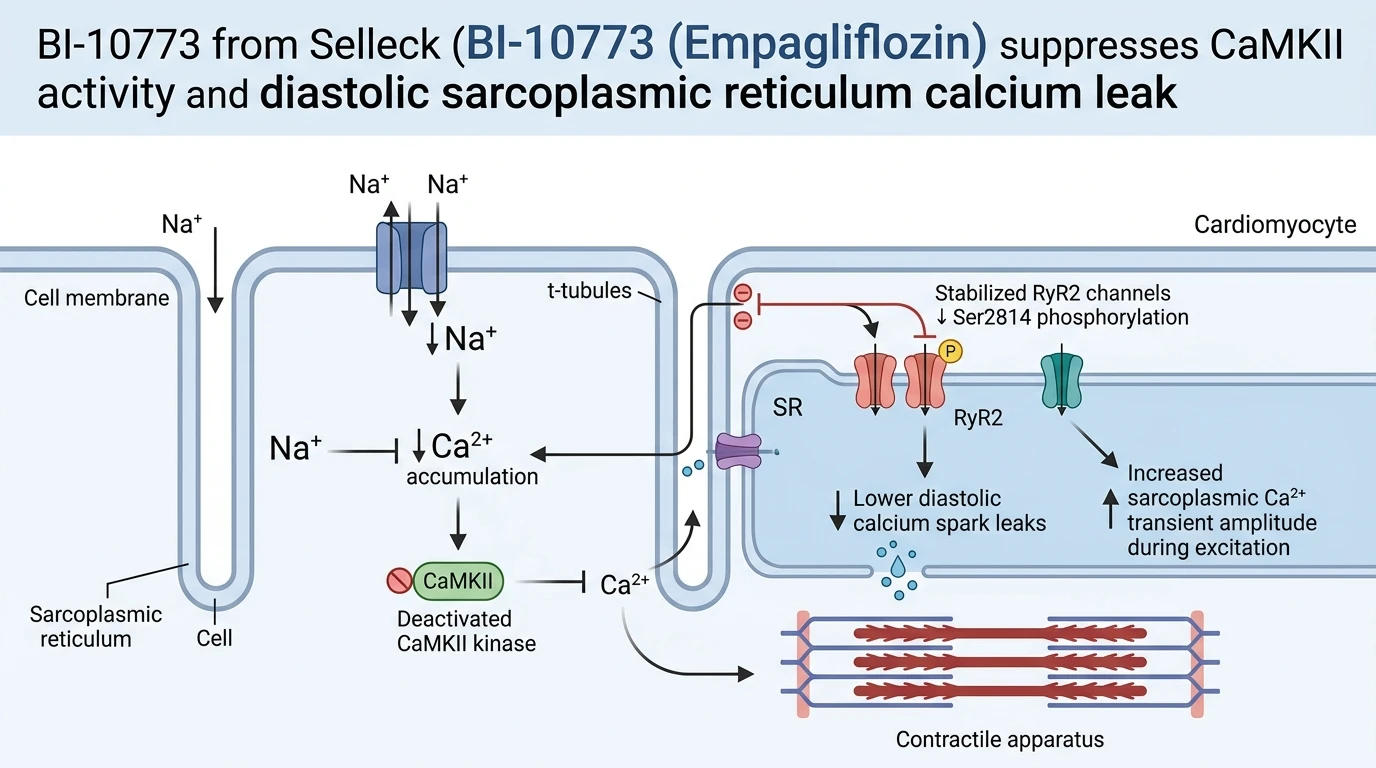
Sodium-glucose cotransporter 2 (SGLT2) inhibitors demonstrate consistent clinical efficacy in reducing cardiovascular mortality and heart failure hospitalizations. However, adult mammalian ventricular cardiomyocytes lack significant SGLT2 expression, indicating that direct myocardial benefit occurs through off-target or downstream ionic regulation. Experimental investigation of BI-10773 (Empagliflozin) illuminates an SGLT2-independent mechanism centering on cardiomyocyte sodium and calcium homeostasis. In pathological states such as heart failure, elevated cytosolic sodium ([Na+]i) concentrations alter the driving force of the sarcolemmal Na+/Ca2+ exchanger (NCX). This reversal reduces systolic calcium efflux and increases cytosolic calcium ([Ca2+]i) overload during diastole. Prolonged cytosolic calcium elevation triggers the autonomous activation of Ca2+/calmodulin-dependent kinase II (CaMKII), a central nodal kinase implicated in structural remodeling and arrhythmogenesis.
Evaluation of BI-10773 from Selleck across diverse experimental paradigms reveals distinct time-dependent pharmacodynamics. Exposure to 1 µmol/L empagliflozin for 24 hours significantly reduces autonomous CaMKII activity. This kinase suppression is consistently observed in healthy murine ventricular cardiomyocytes, transverse aortic constriction (TAC) mouse models of pressure-overload heart failure, and isolated human failing ventricular cardiomyocytes. Active CaMKII directly phosphorylates key sarcoplasmic reticulum (SR) ion channels and regulatory proteins. Specifically, CaMKII-dependent phosphorylation occurs at serine 2814 (Ser2814) on ryanodine receptor 2 (RyR2) and threonine 17 (Thr17) on phospholamban (PLN). Elevated RyR2 Ser2814 phosphorylation increases the open probability of SR calcium release channels during diastole, presenting as aberrant calcium sparks and cytosolic leakage. By suppressing CaMKII hyperactivation, treatment with 1 µmol/L empagliflozin restores normal phosphorylation stoichiometry at both RyR2 Ser2814 and PLN Thr17.
The attenuation of diastolic SR Ca2+ leak directly preserves intracellular calcium storage within the sarcoplasmic reticulum lumen. Reduced diastolic spark frequency prevents the progressive depletion of the SR Ca2+ reservoir during relaxation phases. Consequently, ventricular myocytes exhibit an increased total SR Ca2+ content upon subsequent depolarization. This enhanced luminal loading translates to greater fractional Ca2+ release during excitation, significantly raising systolic Ca2+ transient amplitude. These biochemical alterations restore mechanical twitch force without increasing overall energetic demands or forcing excessive sarcolemmal calcium influx.
Mechanistic dissection demonstrates that direct acute application of empagliflozin does not immediately inhibit recombinant or isolated CaMKII enzyme kinetics. Short-term exposure (30 minutes) to 1 µmol/L empagliflozin significantly reduces cytosolic [Na+]i without altering baseline CaMKII phosphorylation status. This temporal decoupling confirms that CaMKII suppression is secondary to sustained reductions in cytosolic sodium accumulation. Decreased cytosolic [Na+]i re-establishes normal forward-mode NCX flux, facilitating efficient diastolic [Ca2+]i extrusion and removing the ambient ionic trigger required for persistent CaMKII autophosphorylation. Thus, chronic SGLT2 inhibitor exposure normalizes cardiomyocyte calcium cycling through an upstream ionic cascade rather than direct catalytic site blockade of the kinase.
Ionic Homeostasis and Kinase Regulation in Ventricular Cardiomyocytes
Copy code to add this image to your page
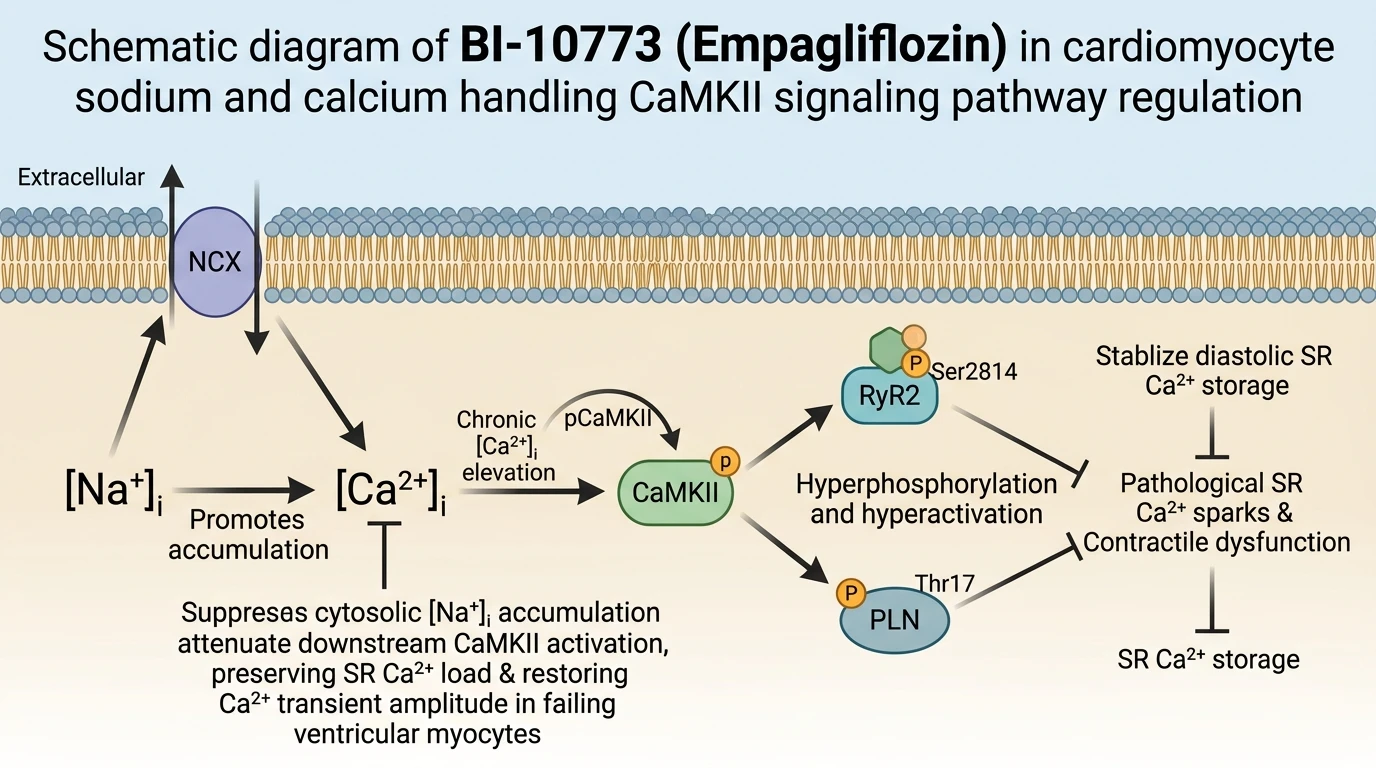
BI-10773 (Empagliflozin) modulates cardiomyocyte excitation-contraction coupling by lowering cytosolic [Na+]i independent of cardiac SGLT2 expression. Reduced cytosolic sodium levels prevent downstream [Ca2+]i overload, attenuating long-term autophosphorylation and hyperactivation of CaMKII. Suppressed CaMKII activity decreases phosphorylation of RyR2 at Ser2814 and PLN at Thr17. This restores sarcoplasmic reticulum membrane stability, suppresses pathological diastolic SR Ca2+ leak (spark frequency), elevates SR Ca2+ load, and enhances systolic Ca2+ transient amplitude in healthy and failing human ventricular cardiomyocytes.
Long-Term CaMKII Inhibition Attenuates Diastolic SR Calcium Leak
Sustained CaMKII hyperactivation promotes contractile dysfunction in failing myocardium. Treatment with BI-10773 from Selleck at 1 µmol/L for 24 hours lowers autonomous CaMKII activity across murine and human ventricular myocytes. Phosphorylation levels declined sharply. This kinetic suppression directly attenuates hyperphosphorylated RyR2 Ser2814 sites, decreasing aberrant diastolic Ca2+ spark frequency across treated cellular cohorts. Reduced spark frequency preserves luminal sarcoplasmic reticulum stores without inducing cytotoxicity under baseline conditions.
Temporal Segregation of Intracellular Sodium and Kinase Activity
Acute ionic shifts precede long-term enzymatic adaptations in treated cardiomyocytes. Exposure to BI-10773 from Selleck for 30 minutes significantly lowers cytosolic [Na+]i levels. Kinase activity remained unchanged initially. This temporal dissociation confirms that empagliflozin does not act as a direct competitive active-site inhibitor of CaMKII. Instead, sustained attenuation of cytosolic sodium accumulation indirectly limits downstream Ca2+-dependent CaMKII autophosphorylation over extended incubation periods.
Preservation of SR Calcium Content in Human Ventricular Models
Heart failure ventricular myocytes exhibit severe impairment of excitation-contraction coupling. In human failing myocardium, prolonged empagliflozin exposure reduces pathological PLN Thr17 hyperphosphorylation. Sarcoplasmic calcium retention improved substantially. Preserved SR calcium loading directly enhances systolic Ca2+ transient amplitudes during field stimulation in vitro. These cellular findings define an upstream ionic mechanism for improved myocardial function in clinical heart failure cohorts.