Regorafenib (BAY 73-4506) inhibits secondary KIT exon 17 mutations in refractory GIST
Copy code to add this image to your page
Gastrointestinal stromal tumors (GIST) represent the most common mesenchymal neoplasms of the gastrointestinal tract, driven predominantly by gain-of-function mutations in the KIT receptor tyrosine kinase or platelet-derived growth factor receptor alpha (PDGFRA). While primary line-of-care tyrosine kinase inhibitors such as imatinib effectively target initial mutations located in KIT exon 9 or exon 11, long-term disease control is frequently bottlenecked by secondary resistance mutations. These secondary mutations typically segregate into two localized structural clusters within the kinase domain: the ATP-binding pocket (exons 13 and 14) and the activation loop (exons 17 and 18). Activation loop mutations, particularly substitutions at residue D816 or N822 within exon 17, destabilize the inactive autoinhibitory conformation of the kinase domain. This structural shift locks the catalytic core in a constitutively active state, rendering first- and second-line inhibitors largely ineffective.
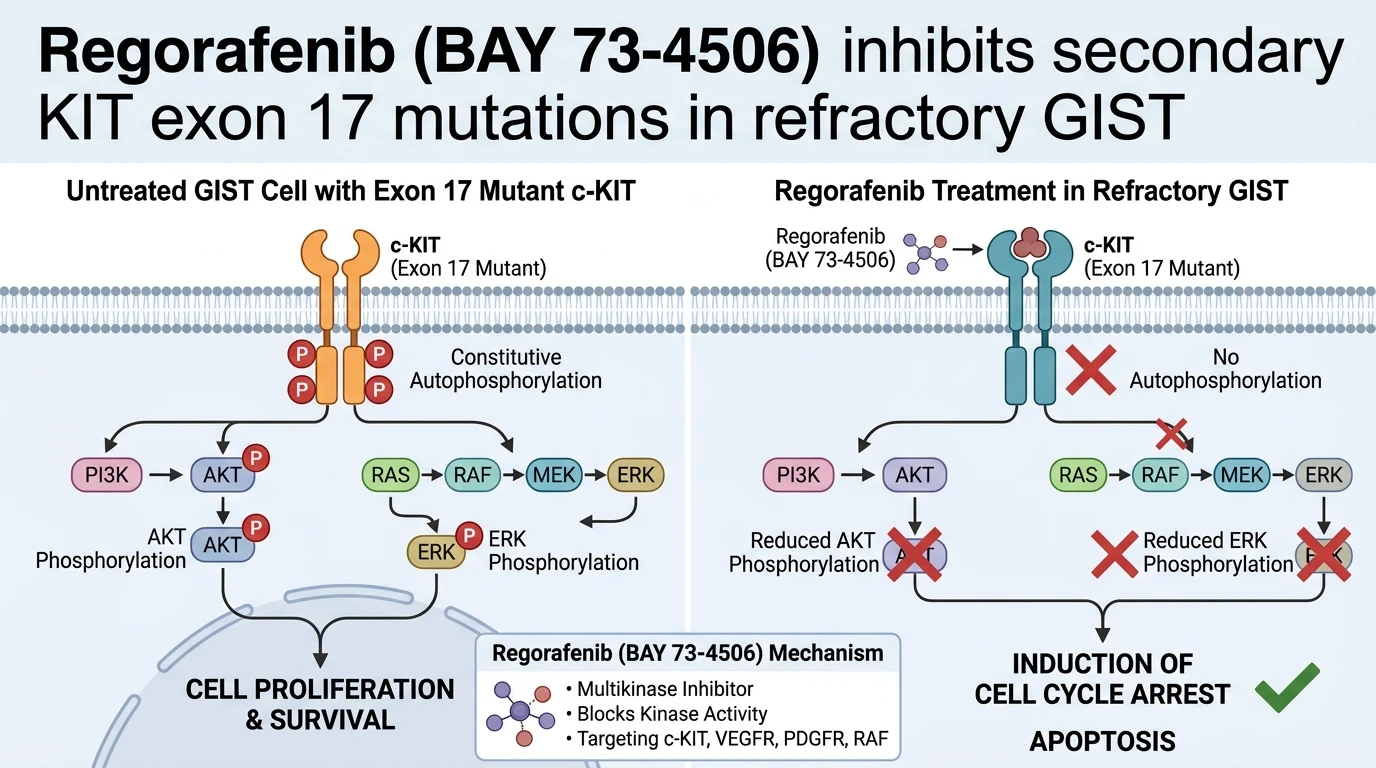
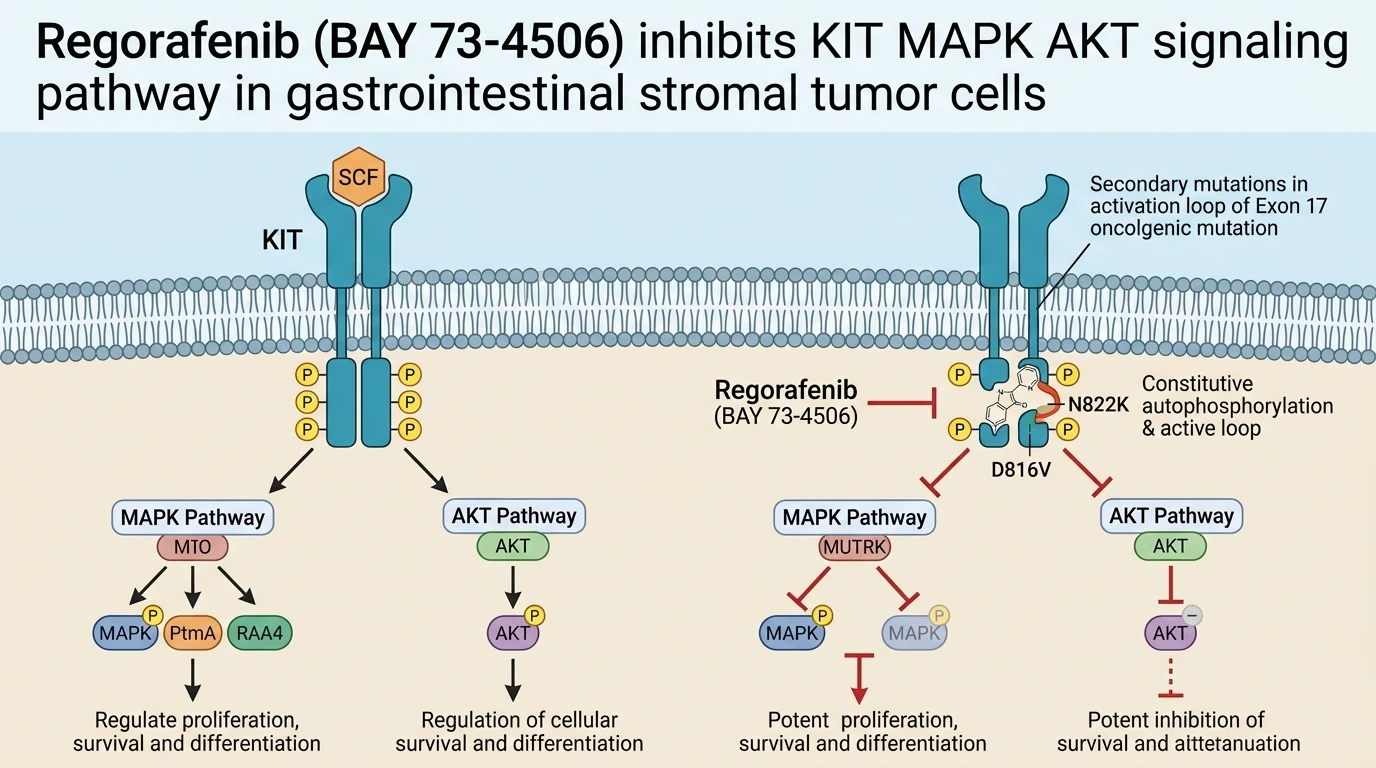
To address this therapeutic barrier, Regorafenib (BAY 73-4506) was evaluated as a multi-kinase inhibitor capable of binding both inactive and active kinase conformations. Pharmacologically, BAY 73-4506 targets c-KIT, PDGFRA, VEGFR1/2/3, RET, and FGFR1, suppressing primary and secondary mutant variants. Biochemical characterization demonstrates that the compound sterically occupies the adenosine triphosphate (ATP) binding cleft, directly inhibiting secondary activation loop mutants. By preventing ATP binding, regorafenib blocks self-phosphorylation at key tyrosine residues within the activation loop, halting downstream intracellular propagation along the mitogen-activated protein kinase (MAPK) and phosphatidylinositol 3-kinase (PI3K)/AKT signal transduction pathways.
In a prospective phase II clinical trial, investigators assessed the therapeutic efficacy and safety profile of regorafenib in patients with metastatic or unresectable GIST harboring secondary KIT exon 17 mutations following progression on prior therapies. Eighteen patients enrolled in the study received a standardized oral regimen of 160 mg regorafenib daily on a schedule of three weeks on treatment followed by one week off (3/1 schedule). Among the eighteen enrolled individuals, fifteen met all protocol criteria for evaluable response assessments.
The primary pharmacodynamic and clinical endpoints demonstrated substantial antineoplastic activity in this secondary exon 17 mutant subpopulation. At 16 weeks of continuous treatment, the clinical benefit rate (CBR)—defined as the aggregate proportion of confirmed complete responses, partial responses, and stable disease maintained for at least 16 weeks—reached 93.3%. Specifically, partial responses were confirmed in 6 patients (40.0%), while 8 patients (53.3%) maintained stable disease. Survival analysis revealed a median progression-free survival (mPFS) of 22.1 months within this cohort. When benchmarked against historical control cohorts receiving standard third-line options, where median PFS historically stagnates at approximately 5.5 months, this 22.1-month outcome reflects a significant clinical extension in disease control.
Mechanistically, the marked clinical activity of Regorafenib (BAY 73-4506) in exon 17 mutated GIST is attributed to its structural flexibility within the ATP-binding pocket. Unlike early-generation inhibitors that require an unactivated, collapsed activation loop to achieve tight binding, regorafenib accommodates the structural alterations caused by exon 17 substitutions such as D816V or N822K. Consequently, intracellular assays confirm complete suppression of c-KIT autophosphorylation following exposure to physiologically active concentrations of the compound. Downstream effector nodes demonstrate corresponding inactivation; phosphorylation levels of AKT at Ser473 and ERK1/2 at Thr202/Tyr204 drop substantially, terminating anti-apoptotic signals and arresting cell cycle progression at the G1/S phase boundary.
The toxicity profile recorded during this trial aligns with the known multi-kinase inhibitory spectrum of regorafenib. Grade 3 treatment-emergent adverse events were documented, with hand-foot skin reaction (HFSR) representing the most frequent high-grade adverse effect, occurring in 55.6% of participants (n=10). Grade 3 hypertension was reported in 27.8% of patients (n=5). These adverse events were managed primarily through supportive measures and protocol-defined dose interruptions or reductions, allowing most patients to continue therapy without permanent discontinuation.
While these Phase II findings demonstrate potent activity against activation loop secondary mutations, several boundary conditions must be noted. The study evaluated a restricted sample size of 18 patients within a single-arm, non-randomized framework. Biological variability in co-occurring tertiary mutations or heterogeneous subclonal evolution across metastatic lesions may influence long-term duration of response in broader clinical populations. Nevertheless, within this evaluated exon 17 mutant cohort, regorafenib successfully suppressed oncogenic KIT driver signaling, achieving clinically meaningful disease control and prolonged progression-free survival.
Clinical Efficacy and Pharmacodynamic Evaluation of Regorafenib
Copy code to add this image to your page
Regorafenib (BAY 73-4506) functions as a multikinase inhibitor with potent activity against secondary KIT activation loop mutations in exon 17. By sterically preventing ATP binding, it blocks KIT autophosphorylation and shuts down downstream MAPK and AKT signaling cascades. In clinical evaluations of advanced GIST harboring exon 17 resistance mutations, regorafenib demonstrated robust antitumor efficacy, providing a clinical benefit rate of 93.3% and extending progression-free survival to 22.1 months.
Progression-Free Survival and Response Rates in Exon 17 Mutants
Primary imatinib resistance frequently emerges through secondary kinase mutations. In this phase II cohort of patients harboring secondary KIT exon 17 mutations, oral BAY 73-4506 administration at 160 mg daily demonstrated substantial efficacy. The 16-week clinical benefit rate reached 93.3%. Out of fifteen evaluable subjects, six achieved confirmed partial responses while eight maintained disease stabilization under tested clinical trial conditions. Disease control remained durable over time. Median progression-free survival reached 22.1 months, representing a marked improvement over the historical benchmark of 5.5 months observed with conventional second-line interventions. Progression rates decreased notably across the cohort.
Safety Profile and Toxicity Management in Advanced GIST
Adverse events were consistent with multikinase inhibition. Treatment with BAY 73-4506 induced Grade 3 toxicity in a subset of participants, predominantly presenting as hand-foot skin reactions in 55.6% of patients. Grade 3 hypertension occurred in 27.8%. These management-requiring toxicities necessitated dose interruptions or modifications, which effectively controlled symptoms without permanently compromising overall therapeutic intensity. Targeted clinical monitoring proved essential during therapy. Downstream inhibition of KIT autophosphorylation and concurrent VEGFR suppression likely account for both the observed efficacy and peripheral vascular toxicity. Safety parameters remained predictable throughout treatment.