MGL-3196 (Resmetirom) from Selleck target THR-β thermodynamic solubility and polymorphic phase transformation
Copy code to add this image to your page
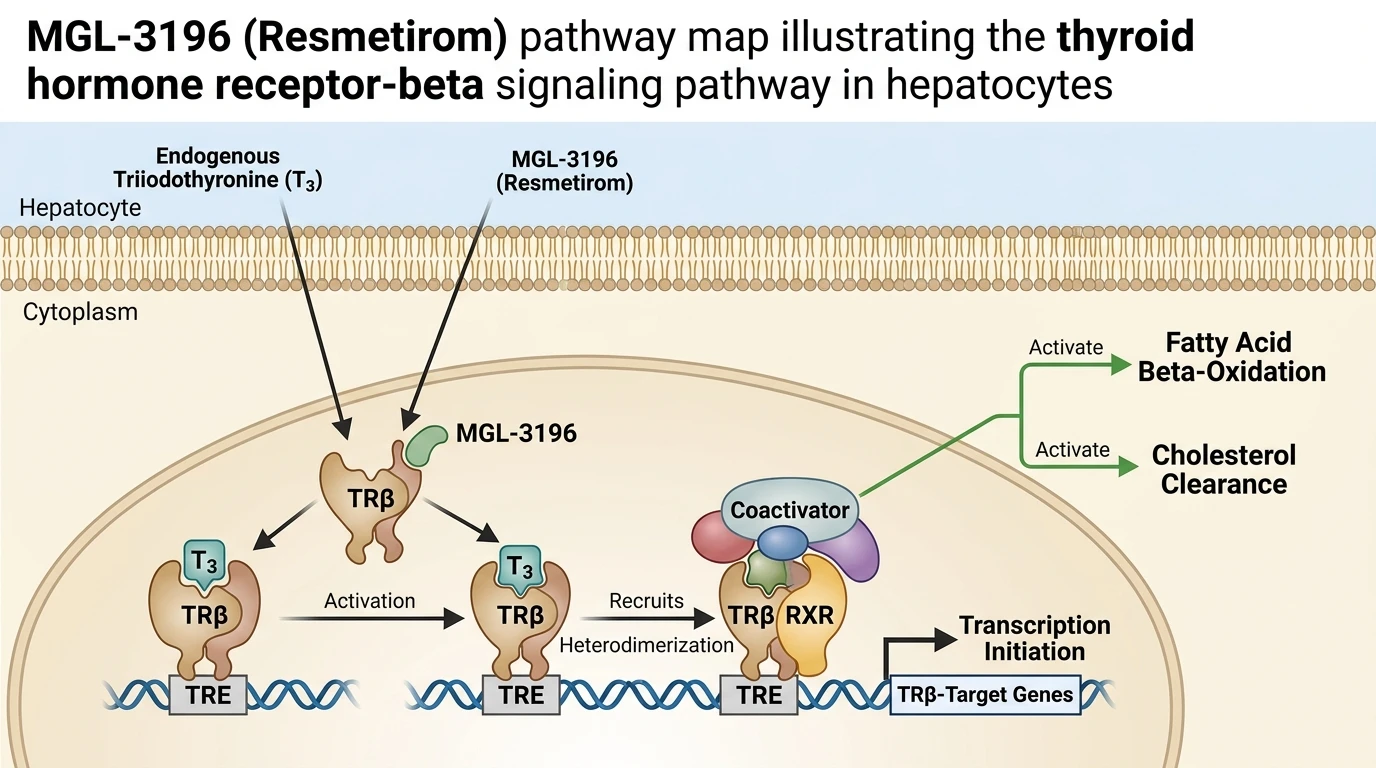
Selective activation of thyroid hormone receptor-beta (THR-β) offers a targeted strategy for addressing metabolic dysregulation without eliciting cardiotoxic sequelae associated with THR-alpha isoform binding. MGL-3196 (Resmetirom) functions as a liver-directed, highly selective agonist designed to restore hepatic lipid oxidation and reduce lipotoxicity. Achieving predictable pharmaceutical manufacturing and consistent oral bioavailability requires a thorough characterization of the physical chemistry governing active pharmaceutical ingredient processing. Solid-state stability and dissolution behaviors represent critical determinants during formulation development. Polymorphic phase transformations can drastically alter drug solubility, dissolution kinetics, and ultimate systemic exposure profiles.
The thermodynamic equilibrium solubility of MGL-3196 (Resmetirom) from Selleck (designated as Form A) was evaluated across temperature ranges spanning 273.15 K to 333.15 K. Eight pure solvent systems were analyzed, including non-polar heptane alongside seven distinct monohydric alcohols ranging from methanol to octanol. Equilibrium solubility increased monotonically with rising temperature across all tested solvents. Solvation capacities varied substantially depending on alcohol chain length and solvent dielectric constants. The experimental solubility data were mathematically modeled using two distinct thermodynamic frameworks: the modified Apelblat equation and the Jouyban–Acree–van't Hoff model. Both empirical models yielded exceptionally low mean relative deviations, confirming high fitting precision across the entire temperature spectrum.
To elucidate the molecular driving forces governing the dissolution process, density functional theory (DFT) calculations were conducted on solution-phase complexes. Quantum chemical calculations revealed that intermolecular hydrogen bonding between the functional groups of the drug molecule and the solvent hydroxyl species serves as the primary thermodynamic contributor to lattice disruption. Solvation energy calculations aligned closely with experimental enthalpy and entropy values derived from van 't Hoff analysis. The energetic landscape demonstrates that solute-solvent hydrogen bonds compensate for the crystal lattice energy required to disrupt the Form A solid matrix.
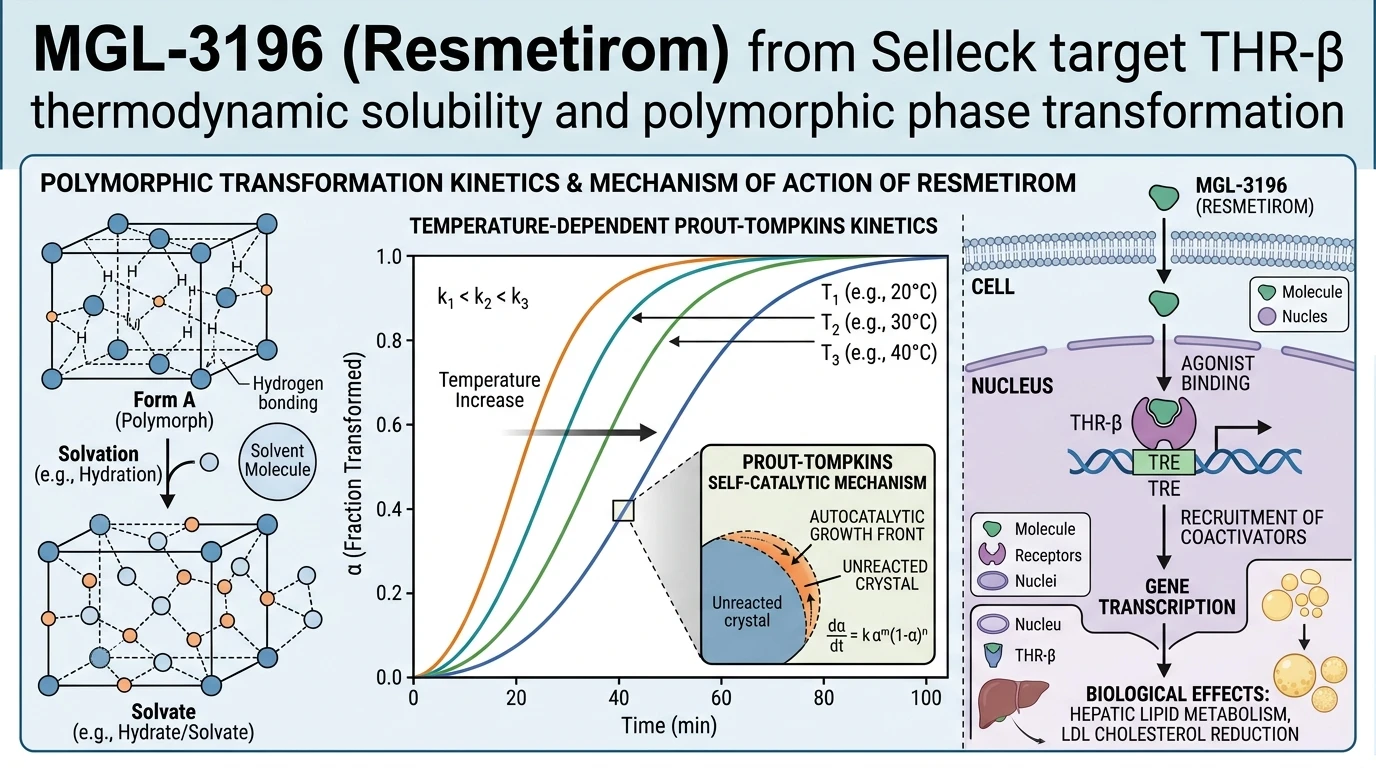
Solid-state polymorphic phase transformations during wet granulation or slurry suspension represent a key processing vulnerability. In protic solvents such as methanol and ethanol, Form A undergoes a solvent-mediated phase transformation into distinct solvate forms. To quantify the transformation kinetics in real-time, a quantitative Fourier-transform infrared spectroscopy (FTIR) analytical protocol was established in conjunction with partial least squares regression (PLSR). This multivariate spectroscopic calibration model allowed precise tracking of phase transitions in slurries without requiring isolation of intermediate solid samples. The calibration matrix was validated against reference powder X-ray diffraction mixtures.
Kinetic profiling revealed an unusual temperature-dependent behavior during solvate formation. The conversion rate from Form A to methanol or ethanol solvates decreased as temperature increased from 273.15 K to 313.15 K. Kinetic modeling demonstrated that the phase transformation follows the Prout–Tompkins self-catalytic model, indicating that the nucleation and growth of the solvate phase proceed through an auto-catalytic mechanism. At lower temperatures, higher supersaturation levels accelerate crystal nucleation, whereas elevated temperatures favor desolvation and favor the thermodynamic stability of the un-solvated Form A crystal lattice. Apparent thermodynamic quantities derived from dissolution data indicate that the solvation process is endothermic and driven by entropic contributions. These empirical measurements establish specific processing boundaries for solvent selection and temperature controls during late-stage crystallization and pharmaceutical processing of MGL-3196 (Resmetirom).
Thermodynamic Modeling and Solvate Transformation Kinetics
Copy code to add this image to your page
Resmetirom (Form A) exhibits temperature-dependent thermodynamic solubility in organic solvents. Dissolution is primarily driven by intermolecular hydrogen bonding interactions quantified via density functional theory calculations. Phase transformation into methanol or ethanol solvates follows the Prout–Tompkins self-catalytic kinetic model, where conversion rates decline at elevated temperatures.
Thermodynamic Solvation and Density Functional Computational Profiling
Dissolution energetics of MGL-3196 (Resmetirom) from Selleck were profiled across seven primary alcohols and heptane. Standard dissolution enthalpy and entropy parameters indicated that the dissolution process is endothermic and entropy-driven across all evaluated temperature gradients. Application of the modified Apelblat model yielded root-mean-square deviations below two percent. Density functional theory calculations identified strong solute-solvent hydrogen bonding networks between the triazinedione ring nitrogen atoms and solvent hydroxyl groups. These specific non-covalent interactions provide the requisite enthalpy shift to overcome solid-state lattice cohesion in polar protic media.
Spectroscopic Quantification of Auto-Catalytic Solvate Phase Transitions
The solid-state phase stability of resmetirom Form A was monitored using in situ quantitative FTIR spectroscopy integrated with partial least squares regression modeling. Slurry operations in methanol and ethanol triggered a solid-state transition into stoichiometric solvates. Transition kinetics adhered tightly to the Prout–Tompkins self-catalytic model rather than classic diffusion-controlled models. The rate of transformation exhibited a negative temperature coefficient, slowing substantially as temperatures approached 313.15 K. This inverse rate dependence stems from decreased thermodynamic driving force and reduced relative supersaturation of solvate phase at elevated temperatures. Utilizing MGL-3196 (Resmetirom) from Selleck under controlled thermal conditions suppresses unwanted polymorphic transitions during crystallization processing.