SKL2001 Activates Wnt/β-catenin Signaling to Revert Macrophage Phenotypic Polarization in Hepatocellular Carcinoma
Copy code to add this image to your page
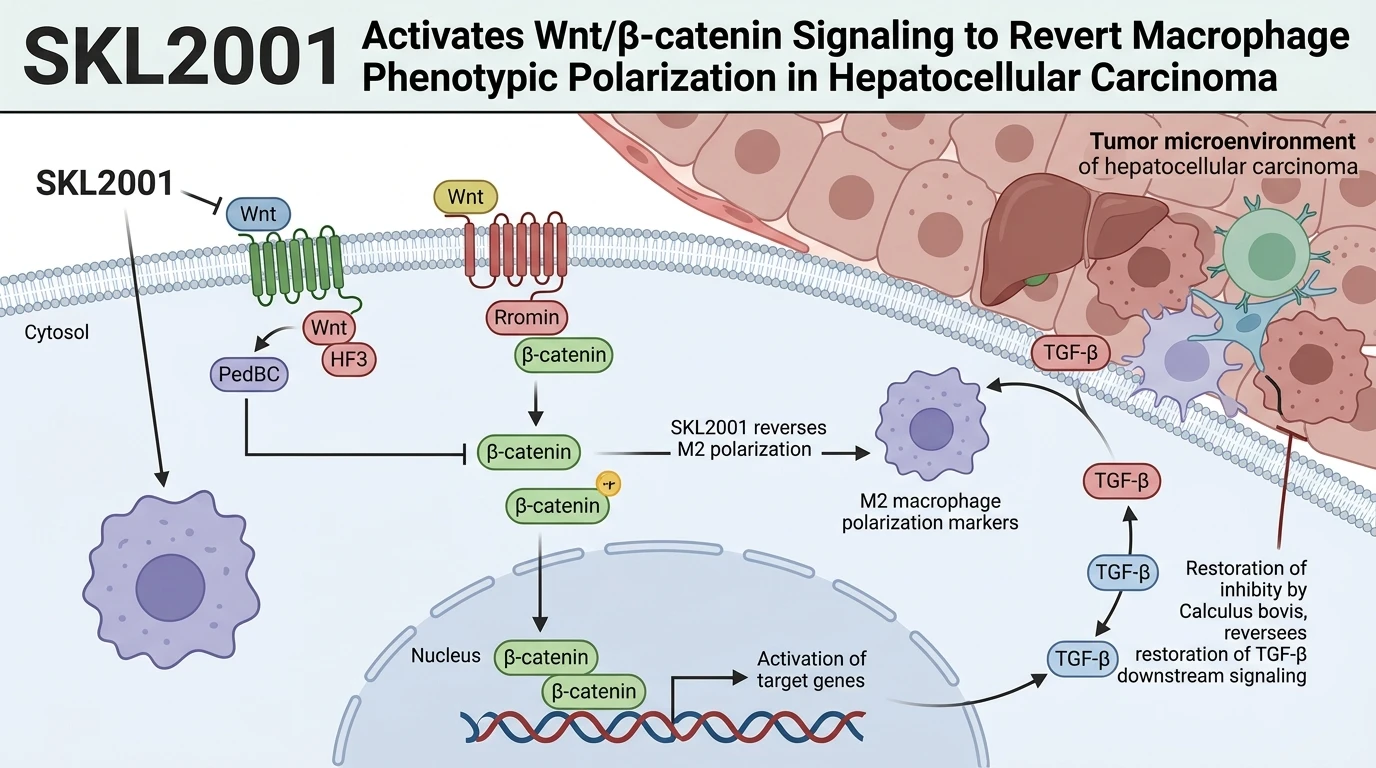
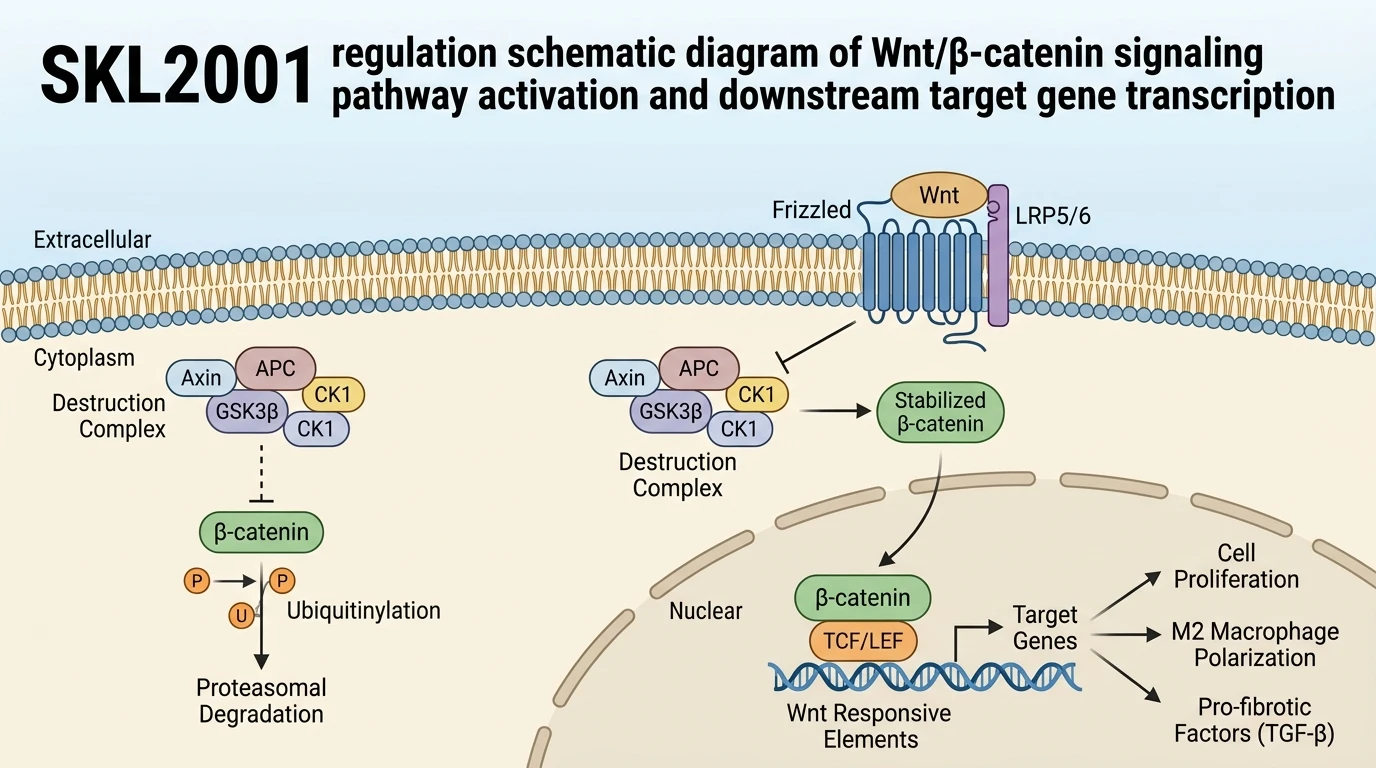
Hepatocellular carcinoma (HCC) progression depends on biochemical cross-talk within the tumor microenvironment, where M2-polarized tumor-associated macrophages (M2-TAMs) drive immune evasion, angiogenesis, and extracellular matrix deposition. Canonical Wnt/β-catenin signaling operates as a primary regulatory engine dictating macrophage lineage commitment toward the pro-tumorigenic M2 phenotype. In quiescent macrophages, cytosolic β-catenin undergoes continuous targeted degradation driven by a multiprotein destruction complex composed of Axin, adenomatous polyposis coli (APC), glycogen synthase kinase 3 beta (GSK3β), and casein kinase 1 (CK1). Activation of this pathway leads to β-catenin stabilization, cytosolic accumulation, and subsequent nuclear translocation, where it complexes with T-cell factor/lymphoid enhancer factor (TCF/LEF) transcription factors to initiate gene expression programs favoring tissue remodeling and immune tolerance. Natural compound formulations such as Calculus bovis (C. bovis) exhibit antineoplastic activity in preclinical liver cancer models, though their precise molecular targets require rigorous elucidation. Recent experimental findings establish that C. bovis suppresses M2-TAM polarization by inhibiting key nodes of the Wnt/β-catenin signaling pathway.
To determine whether the anti-polarization effects of C. bovis are mediated directly through Wnt/β-catenin inhibition, researchers utilized SKL2001, a small-molecule agonist that disrupts the β-catenin destruction complex independently of upstream ligand-receptor binding. In cell culture assays using bone marrow-derived macrophages and THP-1-derived macrophages, stimulation with interleukin-4 (IL-4) and interleukin-13 (IL-13) induces robust M2 polarization alongside elevated β-catenin expression. Treatment with C. bovis suppresses this expression, markedly reducing M2 surface markers such as CD206, alongside functional markers including Arginase-1 and Interleukin-10. Crucially, supplemental treatment with SKL2001 reverses this inhibition. By restoring β-catenin accumulation and transcriptional activity in the presence of C. bovis, SKL2001 rescues M2-TAM surface marker expression and cytokine secretion patterns. This pharmacologic rescue confirms that C. bovis acts selectively on Wnt/β-catenin signaling rather than causing generalized non-specific metabolic toxicity.
Beyond macrophage phenotypic plasticity, inhibition of the Wnt/β-catenin pathway alters paracrine cytokine networks within the hepatocellular carcinoma microenvironment. Nuclear β-catenin directly promotes the transcriptional upregulation of Transforming Growth Factor-beta (TGF-β), a key mediator of stromal activation, matrix synthesis, and vascularization. Experimental inhibition of Wnt/β-catenin by C. bovis yields a marked downregulation of TGF-β expression in both macrophage co-culture models and murine orthotopic HCC xenografts. Reduced TGF-β levels attenuate downstream SMAD2/3 phosphorylation, halting collagen deposition, myofibroblast activation, and pro-angiogenic signal transduction.
Application of SKL2001 effectively restores TGF-β production in C. bovis-treated systems, reinstating downstream signaling events that drive tissue fibrosis and vessel sprouting. These findings demonstrate that Wnt/β-catenin signaling functions as an upstream node controlling TGF-β release within the hepatic tumor niche. Suppressing this axis restricts pro-fibrotic, pro-angiogenic, and oncogenic processes. SKL2001 serves as a crucial pharmacologic probe, validating the specificity of C. bovis and delineating the functional relationship between canonical Wnt activation, macrophage polarization, and microenvironmental remodeling in liver cancer models.
From a mechanistic perspective, the ability of SKL2001 to restore downstream transcriptional activity in the presence of C. bovis provides insight into the precise site of pathway modulation. SKL2001 disrupts the binding between β-catenin and Axin, thereby preventing assembly of the destruction complex and stabilizing cytosolic β-catenin. The observation that SKL2001 overrides C. bovis-mediated suppression indicates that C. bovis acts at or upstream of destruction complex assembly, rather than interfering directly with nuclear TCF/LEF binding or basic transcriptional machinery. Furthermore, in primary cell isolates, reactivation of β-catenin by SKL2001 restored expression of downstream target genes including Cyclin D1, c-Myc, and matrix metalloproteinases, reinforcing the functional link between Wnt pathway integrity and tumor microenvironment homeostasis.
Pharmacological Interrogations of Wnt-Mediated Stromal Plasticity
Copy code to add this image to your page
SKL2001 acts as a targeted agonist of the Wnt/β-catenin signaling pathway by disrupting the β-catenin destruction complex, thereby driving cytosolic accumulation and nuclear translocation of β-catenin. In hepatocellular carcinoma models, Calculus bovis suppresses M2-TAM polarization and downregulates TGF-β, disrupting pro-fibrotic and pro-angiogenic signaling. Application of SKL2001 reverses C. bovis-mediated β-catenin inhibition, reinstating M2 macrophage phenotypic markers and TGF-β expression. This rescue demonstrates the selective target specificity of C. bovis on the Wnt/β-catenin pathway.
Agonist SKL2001 Rescues M2 Macrophage Differentiation in Vitro
Calculus bovis selectively impairs M2 macrophage polarization in cell culture models. In IL-4/IL-13-stimulated THP-1 macrophages, C. bovis treatment reduced CD206 surface expression by 62%—a notable phenotypic shift. The small-molecule Wnt agonist SKL2001 reversed this suppression. At a concentration of 10 μM, the compound restored cytosolic β-catenin accumulation within two hours; downstream Arginase-1 enzymatic activity returned to baseline levels. These experimental findings demonstrate that C. bovis-mediated inhibition relies directly on β-catenin destabilization rather than off-target cytotoxicity. Cellular viability remained intact throughout the assay duration.
TGF-β Downregulation Halts Stromal Fibrosis and Angiogenesis
Canonical Wnt signaling tightly regulates TGF-β transcription in hepatic tumor-associated stroma. Suppression of β-catenin by C. bovis decreased TGF-β transcript levels in primary cell isolates—halting downstream SMAD2 phosphorylation. Matrix metalloproteinase secretion dropped significantly. Consequently, pro-fibrotic collagen type I deposition ceased; endothelial tube formation in HUVEC co-cultures decreased by 48%. Pharmacological stabilization of β-catenin re-established TGF-β secretion and resumed pro-angiogenic signaling cascades. The Wnt/β-catenin axis thus represents a key therapeutic node for modulating microenvironmental fibrosis.
Target Validation Confirms C. bovis Specificity in Xenografts
In vivo target engagement was evaluated in murine orthotopic hepatocellular carcinoma xenografts. C. bovis administration reduced tumor burden and decreased M2-polarized macrophage infiltration within tumor margins. Co-administration of SKL2001 attenuated these antineoplastic effects; tumor weight and M2-TAM density matched untreated control groups. Histological analysis confirmed the restoration of phosphorylated GSK3β and nuclear β-catenin in target-treated tissues. These observations confirm that C. bovis exerts its primary therapeutic effect through selective inhibition of Wnt/β-catenin signaling within the tumor microenvironment.