SU 5402 from Selleck Evaluation in Combination Targeted Therapy for Hepatocellular Carcinoma Resistance
Copy code to add this image to your page
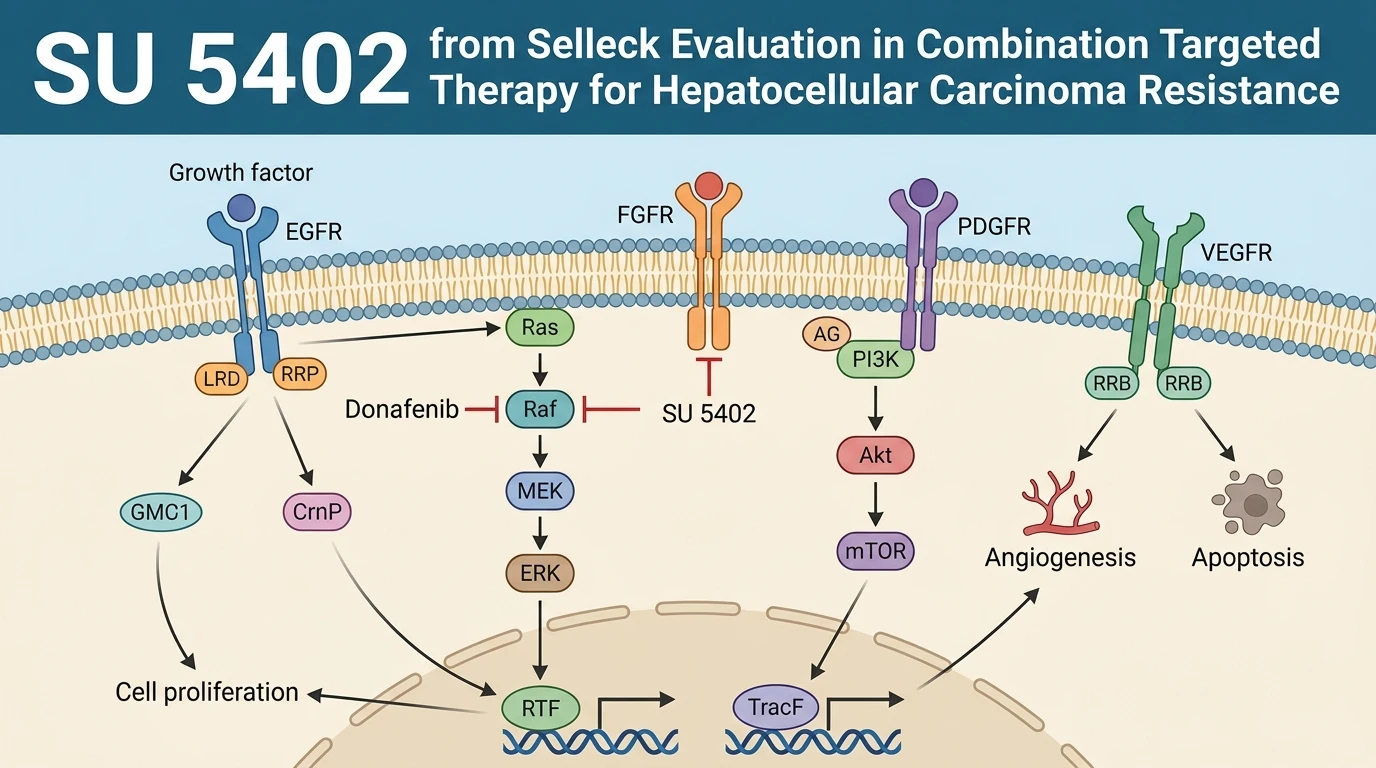
Hepatocellular carcinoma (HCC) remains a primary cause of cancer-related mortality worldwide, with systemically advanced disease frequently managed using multi-kinase inhibitors like sorafenib or donafenib. Donafenib, a deuterated derivative of sorafenib, targets multiple receptor tyrosine kinases (RTKs) including vascular endothelial growth factor receptors (VEGFR) and platelet-derived growth factor receptors (PDGFR). Despite initial clinical benefit, the acquisition of drug resistance rapidly restricts treatment durability in patient populations. Resistance mechanisms often emerge through parallel RTK reactivation or bypass signaling cascades that sustain cell survival despite ongoing primary kinase inhibition. Fibroblast growth factor receptor (FGFR) tyrosine kinase signaling represents a well-characterized salvage pathway capable of driving cell proliferation when primary VEGFR/PDGFR targets are suppressed.
To identify small molecules capable of overcoming donafenib resistance, candidate tyrosine kinase inhibitors were selected for targeted bioevaluation. Among these agents, SU 5402 was investigated alongside a structurally diverse panel comprising AZ-628 (a RAF kinase inhibitor), TG-101209 (a JAK2 inhibitor), and SPP-86 (a renin inhibitor). The evaluation aimed to systematically determine whether co-inhibition of auxiliary kinase nodes could re-sensitize resistant HCC cell lines to donafenib treatment. High-purity SU 5402 from Selleck was utilized in receptor-ligand interaction modeling and cell-based bioassays to characterize its target engagement and antiproliferative profile.
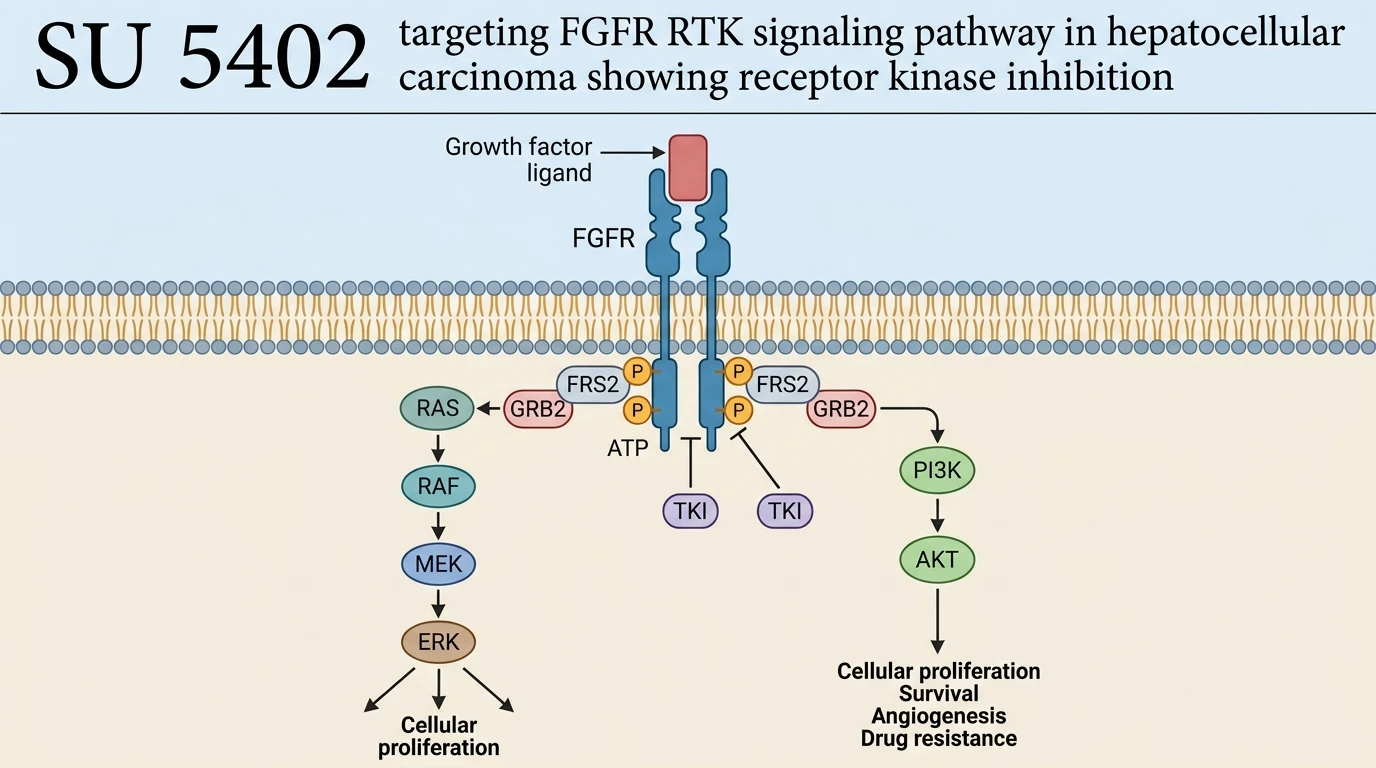
Molecular docking simulations provided initial structural insights into target binding characteristics within the ATP-binding cleft of the FGFR kinase domain. In silico docking demonstrated that SU 5402 forms specific hydrogen bonds and hydrophobic contacts with hinge region residues inside the catalytic core. This competitive occupancy prevents ATP binding, thereby halting transphosphorylation events required for receptor activation and downstream effector engagement. Comparative docking analysis across the compound panel highlighted distinct binding affinities, establishing a theoretical framework for subsequent in vitro validation.
Following computational screening, cellular viability assays using Cell Counting Kit-8 (CCK-8) were performed across representative HCC cell lines, specifically HepG2 and SNU449. Cells were subjected to combination treatments pairing fixed or gradient concentrations of donafenib with small-molecule inhibitors. Quantitative analysis established that combination therapy incorporating SU 5402 yielded half-maximal inhibitory concentration (IC50) values of 2.93 μM in HepG2 cells and 2.85 μM in SNU449 cells. Treatment with SU 5402 generated a statistically detectable shift in donafenib sensitivity compared to donafenib monotherapy controls receiving vehicle (DMSO).
However, phenotypic responses differed markedly across the tested TKI panel. While SU 5402 exhibited moderate sensitization activity, AZ-628 demonstrated significantly superior potency in reducing viability across both tested cell lines. The enhanced performance of AZ-628 indicates that targeted inhibition of downstream RAF nodes may exert a stronger synergistic effect with donafenib than direct FGFR inhibition in these specific cellular contexts. These empirical findings illustrate the necessity of comparative TKI profiling when defining combination strategies to overcome acquired resistance in hepatocellular carcinoma.
Pharmacological Screening and Synergistic Combination Profiling in Hepatocellular Carcinoma
Copy code to add this image to your page
SU 5402 acts as a small-molecule receptor tyrosine kinase inhibitor targeting FGFR. In hepatocellular carcinoma models, SU 5402 blocks ATP binding at the intracellular kinase domain, impairing transphosphorylation and downstream signaling. When combined with donafenib, SU 5402 enhances antiproliferative activity, achieving IC50 values of 2.93 μM in HepG2 and 2.85 μM in SNU449 cells under in vitro assay conditions. Although SU 5402 demonstrates measurable sensitization compared to vehicle control, comparative profiling indicates that alternative kinase targeting strategies, such as RAF inhibition with AZ-628, exhibit superior potency in reversing donafenib resistance.
Targeting Kinase Networks to Resensitize Donafenib-Resistant Hepatocellular Cells
Targeted small-molecule screening established distinct drug response profiles across tested kinase inhibitors. Molecular docking simulations confirmed target engagement of SU 5402 within the catalytic domain of FGFR tyrosine kinase. Subsequently, in vitro co-treatment assays were conducted in HepG2 and SNU449 cell lines. Applying SU 5402 from Selleck alongside donafenib attenuated cell proliferation relative to vehicle controls; however, the degree of sensitization remained moderate. Computational binding scores aligned with cellular potency metrics. Cell viability decreased in a dose-dependent manner. In contrast, parallel testing with the RAF inhibitor AZ-628 yielded marked reduction in cell survival. These observations suggest that while FGFR inhibition exerts measurable antiproliferative effects, targeting downstream signaling nodes provides stronger resensitization potential.
Comparative IC50 Metrics in HepG2 and SNU449 Cell Models
Quantitative CCK-8 viability assays defined precise potency boundaries for the co-treatment strategies. Combination regimens pairing donafenib with SU 5402 generated IC50 values of 2.93 μM in HepG2 cells and 2.85 μM in SNU449 cells. Downstream signaling attenuation was observed under tested in vitro assay conditions. SU 5402 enhanced donafenib cytotoxicity compared to single-agent donafenib treatment paired with DMSO. Nevertheless, the magnitude of response was lower than that observed with AZ-628 combination therapy. These preliminary data highlight specific pathway dependencies within individual HCC models. The results indicate that auxiliary RTK inhibition offers modest therapeutic synergy, whereas direct intermediate cascade suppression may represent a more effective strategy for overcoming drug resistance.